Preview
 Send
Send Share
Share
 Details
 Guide
Guide

 Download
 Similars
 X-Ray
X-Ray Diaporama
 Stats
StatsFind


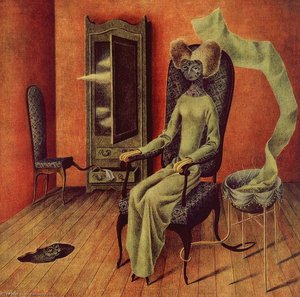
Remedios Varo's surreal 'Find' depicts a wooden boat adrift in an enchanted forest, showcasing the artist’s unique blend of science and mysticism from the early 20th century. Discover this captivating artwork and bring its dreamlike vision into your space.
 Read More
Discover Remedios Varo (1908-1963), the Spanish-Mexican para-surrealist painter! Explore her mystical art blending science, philosophy & dreamlike imagery. Find hand-painted reproductions!
Giclée / Art Print
Museum-quality giclée or canvas print with fast production and flexible finish options. ( Buy Hand Made Painting Switch to Digital Image)




P118B $10

P118H $10

P118W $10

P438Z $10

P508JH $12

P508YH $12

P805H $10

P805Z $10

P919BZ $10

P919G $10

P919XJ $10

P959ZH $10

P968JZ $12

W106C $8

W218G $10

W218JH $8

W218Y $10

W307PJ $10

W316G $10

W316PJ $8

W316Y $10

W398PJ $8

W4111J $10

W500HY $15

W500JH $15

W692G $12

W849H $8

W940BG $15

W953PJ $8




Standard
custom
CM
INCH
Pick from our preset sizes that match the artwork's original proportions.
Loading sizes...

width
height
Type the width and the height you need, to fit your frame or your wall. A print can only be cut, never made bigger than the picture, so a size with a different shape loses a part of the image. We send you a digital mockup to approve before we print anything. The picture shown on this page does not show the real cut — only the mockup does.
Worldwide Delivery () in 2 weeks instead of standard 4/5 weeks. (22 October)

Free Worldwide Express Shipping

High-Quality Linen Canvas

Full Shipping Insurance

Customs Tax Refund Guarantee

True Color Matching Guarantee

100-Day Return Policy (Defects Only)

100% Money-Back Guarantee

Bulk Discount Offer
 Glass option is only available in size under 110 CM

Find
Giclée / Art Print
Reproduction Size
-


Total Price
$ 70
A Journey Into the Unconscious: Remedios Varo's "Find"
Remedios Varo’s “Find” is not merely a depiction of a boat adrift in a forest; it’s an immersion into a meticulously constructed dreamscape, a testament to the artist’s profound engagement with science, mysticism, and the very nature of perception. Painted by Varo during her most productive period, this surrealistic work embodies her unique artistic vision – one that seamlessly blends technical precision with fantastical imagery, inviting viewers on a deeply personal and intellectually stimulating journey.
- Subject Matter: The scene centers around a small wooden boat, seemingly lost within an expansive, almost primeval forest. Two figures are present, their postures suggesting both vulnerability and determination as they navigate this enigmatic environment. An umbrella adds a touch of unexpected practicality to the otherwise ethereal setting.
- Style & Technique: Varo’s meticulous technique is immediately apparent in the rendering of textures – the weathered wood of the boat, the intricate details of the trees, and the delicate folds of the fabric. Her use of color is restrained yet evocative, relying on earthy tones punctuated by flashes of vibrant blues and greens to create a sense of depth and atmosphere. The painting’s surface possesses a remarkable tactile quality, achieved through layering and glazing – a hallmark of Varo's approach.
Decoding the Symbolism: Alchemy and the Search for Knowledge
“Find” is rich in symbolic resonance, reflecting Varo’s fascination with alchemy, mythology, and the pursuit of hidden knowledge. The boat itself can be interpreted as a vessel – not just for physical travel, but also for the journey of the soul. The forest represents the unknown, a space where traditional rules no longer apply, demanding introspection and adaptation. The umbrella, a seemingly mundane object, could symbolize protection from the elements, both literal and metaphorical, suggesting a need to shield oneself from doubt or uncertainty during this exploration.
- Alchemical Imagery: Varo frequently incorporated alchemical symbols into her work, representing stages of transformation and spiritual enlightenment. While not overtly explicit, subtle references can be found within the composition – perhaps in the boat’s design or the arrangement of elements within the forest.
- Personal Mythology: Many of Varo's paintings draw upon personal myths and legends, reflecting her own intellectual and spiritual quests. “Find” aligns with this trend, presenting a narrative that feels both timeless and deeply rooted in her individual worldview.
Historical Context & Varo’s Unique Position
Remedios Varo (1908-1963) was a remarkably independent artist working within the context of 20th-century Surrealism, yet she resisted easy categorization. Born in Anglès, Spain, her upbringing – shaped by her engineer father and devout Catholic mother – instilled in her a unique perspective that combined scientific observation with spiritual inquiry. Her work stands apart due to its intellectual rigor and deeply personal symbolism, often exploring themes of transformation, the relationship between science and spirituality, and the search for meaning in a rapidly changing world. Varo’s influence extends beyond the Surrealist movement, solidifying her place as one of the most original and compelling artists of her time.
Emotional Impact & Artistic Value
"Find" evokes a profound sense of mystery and wonder, prompting viewers to contemplate their own journeys of discovery. The painting's quiet intensity and meticulous detail invite prolonged observation, rewarding those who are willing to surrender to its enigmatic allure. A hand-painted reproduction of this artwork offers an unparalleled opportunity to experience Varo’s artistic vision firsthand – a chance to possess a piece of art that is both intellectually stimulating and emotionally resonant. Its enduring appeal lies in its ability to tap into our deepest desires for adventure, knowledge, and ultimately, self-discovery.
Questions & Answers
How can I view "Find" by Remedios Varo as a slideshow?
A slideshow is available: the Diaporama page of "Find" by Remedios Varo.
How does the style of "Find" relate to its creator's era?
In "Find" by Remedios Varo, the Surrealist Movement movement meets the 19th-Century era.
Toward which tone does "Find" lean?
"Find" leans toward an amber to saffron tone.
Artist Biography
A Life Bridging Science, Mysticism, and Surrealism
Remedios Varo (1908-1963) stands as a singular figure in 20th-century art, an artist whose work defies easy categorization. Though often associated with the Surrealist movement, her vision extended far beyond its boundaries, weaving together scientific precision, alchemical symbolism, and a deeply personal mythology. Born María de los Remedios Alicia Rodriga Varo y Uranga in Anglès, Spain, her early life was shaped by a fascinating duality: a pragmatic father, a hydraulic engineer who instilled in her a love for technical drawing and meticulous observation, and a devoutly Catholic mother whose influence sparked a lifelong questioning of established norms. This tension between reason and faith, science and spirituality, would become a defining characteristic of her art. Her childhood was marked by frequent relocations following her father’s work, exposing her to diverse landscapes and cultures, while her formal education at the Real Academia de Bellas Artes de San Fernando in Madrid provided a solid foundation in traditional artistic techniques. It was there she encountered fellow artists like Salvador Dalí, though her path would diverge into more introspective and uniquely symbolic territory.
From Madrid to Mexico: A Journey of Artistic Discovery
Varo’s early work reflected the prevailing styles of the time—sensitive portraits and realistic depictions of her surroundings. However, a growing fascination with the esoteric began to permeate her artistic explorations. In Madrid, she became involved with a group known as the Logicophobists, who sought to reconcile art and metaphysics, delving into realms beyond rational understanding. This period marked a crucial shift in her thinking, laying the groundwork for the intensely personal iconography that would define her mature style. The outbreak of the Spanish Civil War forced Varo to flee Europe, eventually finding refuge in Mexico City in 1938. This relocation proved transformative. Freed from the constraints and political turmoil of wartime Europe, she discovered a vibrant artistic community and an environment conducive to fully realizing her unique vision. Mexico offered not just safety but also a fertile ground for exploring her interests in alchemy, astrology, and indigenous philosophies—influences that would become inextricably linked to her art.
The Language of Symbols: Alchemy, Technology, and the Feminine Mystique
Varo’s artistic style is instantly recognizable – a meticulous blend of technical draftsmanship and dreamlike imagery. Her paintings are populated by fantastical machines, hybrid creatures, and enigmatic female figures engaged in mysterious activities. These aren't merely whimsical creations; they are carefully constructed allegories, laden with symbolic meaning. Alchemy serves as a central theme, not simply as a historical practice but as a metaphor for transformation—the process of refining the self through knowledge and experience. Her depictions of intricate apparatuses suggest a desire to understand and manipulate the forces of nature, while also hinting at the limitations of human control. Perhaps most compelling is her portrayal of women: not as passive muses or objects of desire, but as active agents of change—inventors, scientists, alchemists, and seekers of knowledge. She challenges traditional gender roles, presenting a vision of feminine power rooted in intellect, intuition, and spiritual exploration. Creation of the World or Microcosm, for example, showcases her early fascination with creation myths and scientific principles, while works like Star Catcher exemplify her ability to merge mysticism with technical skill.
A Legacy of Para-Surrealism and Enduring Influence
Remedios Varo’s contribution to art history lies in her development of what has been termed “para-surrealism”—an expansion upon traditional Surrealism that incorporates elements of alchemy, mysticism, and esoteric knowledge. She wasn't interested in simply accessing the subconscious, as many Surrealists were; she sought to create a visual language for exploring deeper truths about the universe and humanity’s place within it. Her work resonates with contemporary audiences because it speaks to our enduring fascination with the mysteries of existence, the power of transformation, and the search for meaning in an increasingly complex world. Though her career was relatively short—she died prematurely at the age of 54—her impact on subsequent generations of artists is undeniable. She paved the way for a more inclusive and multifaceted understanding of Surrealism, inspiring those who seek to bridge the gap between science, spirituality, and artistic expression. Her paintings continue to captivate viewers with their intricate detail, enigmatic symbolism, and profound sense of wonder.
Exploring Varo’s World Today
- Her works can be found in numerous private collections worldwide.
- Significant examples of her art are held at the Real Academia de San Fernando (Madrid).
- The Munnings Art Museum offers a glimpse into British artistry that influenced her early work.
- Museums like MoMA have featured her works, solidifying her place in art history.
Today, Remedios Varo’s legacy continues to grow. Her paintings invite us to embark on our own journeys of discovery—to question assumptions, embrace the unknown, and explore the hidden dimensions of reality. Through her unique artistic vision, she reminds us that true knowledge lies not in finding definitive answers but in embracing the endless possibilities of imagination and inquiry.

Remedios Varo
1865 - 1911 , Spain
Quick Facts
- Full Name: Remedios Varo
- Nationality: Spanish-Mexican
- Date Of Birth: 1865
- Date Of Death: 1911
- Place Of Birth: Angles, Spain
- Notable Artworks:
- Star Catcher
- Icon
- Face
- Dead Leaves
- Scorpions
- Artistic Movement Or Style: Para-Surrealism
- Artists Who Influenced This Artist:
- Hieronymus Bosch
- Francisco Goya
- El Greco
- Artists Or Movements Influenced By This Artist: ['Future generations of artists']
Related Articles

Surrealist Dreamscapes: A Curated Journey Through the Subconscious Majesty of Surrealism
Embark on a sophisticated journey through Surrealist dreamscapes. Explore the profound symbolism of masters like Dalí and discover how to curate breathtaking, museum-quality surrealist art for your private collection with expert guidance.
Explore artworks organized by themes, styles, and characteristics.