

Shown: · With its frame:
 Preview
 Send
Send Share
Share
 Details
 Guide
Guide

 Download
 Similars
 X-Ray
X-Ray Diaporama
 Q&A
Q&A Stats
Stats
$ 269
Hand Made Oil Reproduction
Hand-painted oil on canvas in your size and frame, made to order by our artists. ( Switch to Print Switch to Digital Image)
Size
·Standard
custom
CM
INCH
Pick from our preset sizes that match the artwork's original proportions.
Loading sizes...

width
height
Type the width and the height you need, to fit your frame or your wall. This is hand-painted, so for a size with a different shape the artist can paint a bit more around the picture, or cut a bit — you choose. We send you a digital mockup to approve before the painting starts. The picture shown on this page does not show the real result — only the mockup does.
 Read more
Finish
·
White $1

Blurside $1

Extended $1

P118B $10

P118H $10

P118W $10

P438Z $10

P508JH $12

P508YH $12

P805H $10

P805Z $10

P919BZ $10

P919G $10

P919XJ $10

P959ZH $10

P968JZ $12

W106C $8

W218G $10

W218JH $8

W218Y $10

W307PJ $10

W316G $10

W316PJ $8

W316Y $10

W398PJ $8

W4111J $10

W500HY $15

W500JH $15

W692G $12

W849H $8

W940BG $15

W953PJ $8

H24-GOLD $30

H24-SILVER $30

H36-GOLD $45

H36-SILVER $45
Shipped in a protective tube, ready for your own framer.
Above 105 cm the frame is shipped as a kit for a professional framer — read the details.
Extras
optionalWhat do the extras include?
Examples of what can be changed: Replace face with customer photo; Add pet (e.g., replace cat with dog); Include hidden message in background; Change background landscape or elements.
After order, TopImpressionists.com team will email client for instructions and provide a mockup preview
After order, TopImpressionists.com team will email client for instructions and provide a mockup preview
Worldwide Delivery () in 3/4 weeks instead of standard 5 weeks. (31 October). No compromise on quality.
Protective Varnish
Nameplate
Engraved Bronze Plaque Details
This elegant plaque features the artist's name and the title of the artwork, finely engraved for a timeless presentation.
It is made from bronze with a refined, elegant finish. The text is precisely laser-engraved for a sharp and permanent result. Measuring 9x2 cm, the plaque is compact yet easy to read. It's built to be durable and scratch-resistant, offering a professional, museum-quality look. Mounting is simple thanks to the included adhesive backing.
Transparent Acrylic Plaque Details
The plaque includes essential engraved details such as the artist's name, the title of the artwork, the date it was created, the type of media used-like oil on canvas or watercolor-a brief description of the piece, and a QR code that links to the complete artwork information.
It is crafted from clear acrylic, offering a sleek, modern appearance. The text is UV-engraved in black to ensure strong visual contrast. With a size of 10x15 cm, it ensures optimal readability. It comes equipped with two metal hooks for secure wall mounting. The plaque is designed to be weather-resistant, making it suitable for various environments, and it includes interactive features that work seamlessly with smartphone scanning.
Black Acrylic Plaque Details
This elegant plaque includes engraved information such as the artist's name, the title of the artwork, the date it was created, the type of media used (like oil on canvas or watercolor), a short description of the artwork, and a QR code for quick access to more information.
The plaque itself is made from refined black acrylic with a premium finish. The text is laser-engraved in white for high contrast and readability. Its size is 10x15 cm, designed to be easy to read. It comes with two metal hooks for professional mounting. The design is sleek and fits any interior style. It is also weather-resistant and durable, with built-in digital integration for mobile compatibility.
Glass option is only available in size under 110 CM
 Glass option is only available in size under 110 CM
- Free Worldwide Express Shipping
- High-Quality Linen Canvas
- Full Shipping Insurance
- Customs Tax Refund Guarantee
- True Color Matching Guarantee
- 100-Day Return Policy (Defects Only)
- 100% Money-Back Guarantee
- Bulk Discount Offer


Collectible Description
Explore Victor Gilbert’s ‘Sweeping the Feathers,’ a realistic oil painting depicting rural life & domestic labor. Captivating detail, muted palette, & poignant symbolism – a unique piece.
Artist Biography
Victor Gabriel Gilbert (1847-1933) was a French painter renowned for vibrant Parisian street scenes & market life. Explore his Impressionistic style and captivating depictions of 19th-century France.
About the painting
Quick facts and art quiz
About Victor Gabriel Gilbert

Victor Gabriel Gilbert
1847 - 1933, France
Artist Biography
The Soul of the Parisian Market: The Life and Art of Victor Gabriel Gilbert
Born in the heart of Paris in 1847, Victor Gabriel Gilbert was a painter whose destiny seemed initially tethered to the humble craft of carpentry, following in the footsteps of his father. However, a natural aptitude for drawing and a resilient spirit steered him toward a much more luminous path. Lacking the means to attend the prestigious École des Beaux-Arts, Gilbert sought his education through grit and apprenticeship, studying under the artisan painter and decorator Eugène Adam and later with Charles Busson. This early immersion in the tactile world of textures and decorative arts would later manifest in his profound ability to render the organic beauty of fruit, vegetables, and the bustling atmosphere of the French capital.
Gilbert’s artistic evolution is a captivating study of a painter finding his voice amidst a sea of shifting movements. His early works, appearing at the Salon des artistes français in the 1870s, were characterized by a somber, realist palette, heavily influenced by the moody, dark tones of masters like Bonvin and Ribot. Yet, as the vibrant energy of Impressionism began to sweep through Paris, Gilbert did not merely observe the change; he embraced it. He transitioned from the heavy shadows of realism toward a brighter, more luminous approach, adopting the loose brushstrokes and spontaneous light effects that defined the era. This stylistic metamorphosis allowed him to capture not just the physical presence of his subjects, but the very ephemeral essence of light dancing across a flower market or a crowded café.
A Master of the Everyday: Themes and Technique
The true legacy of Victor Gabriel Gilbert lies in his role as a chronicler of Parisian life. He became the preeminent painter of Les Halles, the legendary central marketplace of Paris, transforming mundane scenes of commerce into poetic celebrations of urban existence. His oeuvre, which spans over 60 and includes hundreds of works, focuses on the rhythmic vitality of the streets. Whether depicting a florist tending to colorful blooms at the Pont Neuf or the organized chaos of a morning fish market, Gilbert possessed a rare gift for finding grandeur in the ordinary.
His technique was a masterful blend of precision and impressionistic freedom. While his compositions often utilized the soft, atmospheric light characteristic of Impressionism, he maintained a meticulous attention to detail that anchored his work in reality. One can observe his skill in the delicate textures of a ripening peach, the translucent petals of a poppy, or the heavy drape of a merchant's apron. This duality—the ability to evoke a fleeting moment while celebrating the tangible weight of objects—is what makes his paintings so enduringly tactile and emotionally resonant.
Recognition and Lasting Impression
Throughout his prolific career, Gilbert earned significant acclaim within the French art establishment. His contributions were recognized with prestigious honors, including:
- A Silver Medal from the Société des Artistes Français in 1889.
- The Bonnat Prize in 1926, a testament to his sustained excellence late into his career.
- International Exhibition Presence at major venues such as the World's Columbian Exposition in Chicago and exhibitions in Munich, Vienna, and London.
Beyond the accolades, Gilbert’s historical significance resides in his ability to bridge the gap between the structured traditions of 19th-century realism and the sensory revolution of Impressionism. He provided a window into a vanished era of Paris—a time of bustling street markets and a burgeoning urban culture that felt both intimate and grand. Today, his works reside in esteemed collections such as the Musée Carnavalet in Paris and the Philadelphia Museum of Art, serving as vibrant, breathing reminders of the beauty found in the daily rhythms of Parisian life.
Quick facts about Victor Gabriel Gilbert
- Full Name: Victor Gabriel Gilbert
- Nationality: French
- Date Of Birth: 1847
- Date Of Death: 1933
- Place Of Birth: Paris, France
- Notable Artworks:
- Sweeping the Feathers
- A parisian flower market
- Boys playing
- Artistic Movement Or Style: Impressionism
- Artists Who Influenced This Artist:
- Gustave Courbet
- Jean-François Millet
- Artists Or Movements Influenced By This Artist: ['Romanticism']
Explore artworks organized by themes, styles, and characteristics.


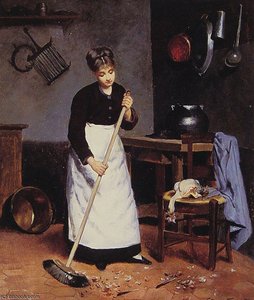
Victor Gabriel Gilbert
Sweeping the Feathers
() ·
With its frame: · Hand-painted in oil on linen
Total