Atelier — Complimentary worldwide shipping — Delivery 2–6 weeks
      Donatello, 1386 – 1466

      Donatello: The 100 Best-Known Paintings

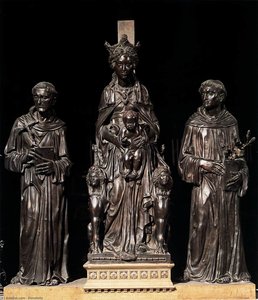
      Of all Donatello's paintings, Madonna and Child between St Francis and St Anthony (1448) is the most famous; it hangs in the Basilica di Sant'Antonio, Padua. Close behind come Cantoria (1439) and Entombment (1447). Among the 148 works by Donatello in our catalogue, these 100 are the most celebrated, each shown with its date, its museum and its story.

      Ranked by our popularity score, which combines the searches, visits and orders for each work. Updated October 2026. Each painting on this page can be ordered as an oil reproduction painted by hand on linen canvas, or as a fine art print, made to the size you choose.

      Portrait of Donatello
      Donatello · 1386 – 1466
      Born · died
      1386 – 1466, Florence
      Movement
      Early renaissance
      Works in our catalogue
      148
      Most famous
      Madonna and Child between St Francis and St Anthony (1448)
      Most works at
      Museo dell'Opera del Duomo

      Donatello's 10 most celebrated paintings

      Madonna and Child between St Francis and St Anthony (1448) by Donatello
      1

      Madonna and Child between St Francis and St Anthony

      1448 · Bronze · Basilica di Sant'Antonio, Padua

      In the heart of the Italian Renaissance, where the shadows of antiquity met the burgeoning light of humanism, Donatello breathed life into metal with his masterpiece, Madonna and Child between St Francis and St Anthony. Created around 1448, this profound bronze sculpture serves as a window into a period of unparalleled spiritual and artistic transformation. The composition is a masterclass in symmetrical grace; at its center, the Virgin Mary cradles…

      Cantoria (1439) by Donatello
      2

      Cantoria

      1439 · Marble · Museo dell'Opera del Duomo, Florence

      To stand before Donatello’s Cantoria is to witness the very moment the Renaissance found its pulse. Completed around 1439 for the Cathedral of Santa Maria del Fiore in Florence, this monumental marble relief is far more than a functional singers' gallery; it is a breathtaking explosion of movement and spiritual ecstasy. While much of the era’s sculpture remained tethered to the static, formal traditions of the Byzantine style, Donatello broke…

      Entombment (1447) by Donatello
      3

      Entombment

      1447 · Oil On Canvas · Basilica di Sant'Antonio, Padua

      To stand before Donatello's depiction of the Entombment is to be enveloped in an atmosphere so thick with grief, it feels almost palpable. This scene transcends mere narrative illustration; it is a profound meditation on loss, sacrifice, and the solemn weight of human devotion. The composition draws the viewer into the immediate aftermath of unimaginable tragedy. Jesus Christ lies within the tomb, not merely as a subject, but as the…

      Miracle of the Repentant Son (1447) by Donatello
      4

      Miracle of the Repentant Son

      1447 · Acrylic · Basilica di Sant'Antonio, Padua

      Donatello’s bronze sculpture, "Miracle of the Repentant Son," transcends mere representation; it's a profound meditation on faith, remorse, and divine grace. Created in 1447 during the apex of his artistic maturity, this work embodies the burgeoning humanism and emotional depth that defined the Early Renaissance in Florence. More than just a depiction of a biblical miracle – the restoration of a severed limb by St. Anthony – it’s a study…

      Crucifix (1412) by Donatello
      5

      Crucifix

      1412 · Acrylic On Canvas · Santa Croce, Florence

      Donatello's 1412 Crucifix, housed within the Basilica of Santa Croce in Florence, isn’t merely a depiction of Christ on the cross; it’s a visceral experience. This early Renaissance masterpiece transcends simple representation, plunging the viewer into the heart of Christian theology and embodying the profound tension between suffering and redemption. Crafted from richly-toned pearwood, the sculpture immediately commands attention with its remarkably realistic portrayal of the human form – a…

      Annunciation (1435) by Donatello
      6

      Annunciation

      1435 · Acrylic On Canvas · Santa Croce, Florence

      Donatello’s 1435 Annunciation, housed within the Basilica di Santa Croce in Florence, isn’t merely a depiction of a biblical moment; it’s a profound meditation on grace, humility, and the transformative power of faith. Commissioned during a pivotal period of artistic innovation – bridging the Gothic and Renaissance eras – this sculpture embodies Donatello's revolutionary approach to humanism and his masterful command of classical forms. The scene unfolds with an arresting…

      St George (detail) (1416) by Donatello
      7

      St George (detail)

      1416 · Marble · Museo Nazionale del Bargello, Florence

      The marble figure of St. George, sculpted by Donatello around 1416, stands as more than just a depiction of a saint; it's a pivotal moment in the evolution of Renaissance sculpture – a testament to the artist’s innovative spirit and his profound understanding of human form and narrative. Originally gracing the north wall of Orsanmichele, Florence’s imposing guildhall, this statue immediately captivated viewers with its dynamic energy and strikingly realistic…

      Herod's Banquet (1427) by Donatello
      8

      Herod's Banquet

      1427 · Bronze · Baptistry, Siena

      Donatello's Herod’s Banquet, crafted around 1427 for the baptismal font of Siena’s San Giovanni Baptistery, isn’t merely a depiction of a biblical episode; it’s a profound meditation on power, betrayal, and the chilling consequences of unchecked ambition. Commissioned amidst the competitive fervor of Renaissance Florence and Siena, this bronze relief stands as a testament to Donatello's burgeoning mastery – a pivotal work that showcases his innovative approach to sculpture and…

      Bearded Prophet (1418) by Donatello
      9

      Bearded Prophet

      1418 · Bronze · Museo dell'Opera del Duomo, Florence

      In the heart of the Florentine Renaissance, where the shadows of antiquity began to dance with the light of new humanism, Donatello breathed life into bronze with his Bearded Prophet. Created around 1418, this monumental figure is far more than a mere sculpture; it is a profound meditation on the weight of divine knowledge and the solemnity of faith. As one gazes upon the weathered surface of the bronze, there…

      St. John the Evangelist (1415) by Donatello
      10

      St. John the Evangelist

      1415 · Marble

      St. John the Evangelist is a marble sculpture created by the artist Donatello. Dated 1410, this work depicts one of the twelve apostles of Jesus. The subject is rendered as an elderly man, presented with a face etched with lines and a gaze that suggests a state of contemplation and wisdom. This choice of representation presents the figure as a philosopher-like individual.

      Donatello paintings ranked 11 to 100

      St Mark (1411) by Donatello
      #11

      St Mark

      1411 · Orsanmichele

      Within the echoing halls of Orsanmichele in Florence, stands Donatello's sculpture of St. Mark – more than just a depiction of a biblical figure; it is a profound…

      Prophet with Scroll (detail) (1418) by Donatello
      #12

      Prophet with Scroll (detail)

      1418 · Museo dell'Opera del Duomo

      To stand before this detail of a prophet is to encounter a moment suspended in time—a profound echo from the heart of the Italian Renaissance. The marble itself,…

      St John on Patmos (1428) by Donatello
      #13

      St John on Patmos

      1428

      The St John on Patmos painting, created by the renowned artist Donatello in 1428, is a stunning example of Renaissance art. This masterpiece is a testament to Donatello's…

      David (detail) (1409) by Donatello
      #14

      David (detail)

      1409 · Museo Nazionale del Bargello

      To stand before this detail of Donatello's David is to encounter not merely a sculpture, but a profound meditation on nascent heroism. The marble seems to breathe with…

      Pietà (1447) by Donatello
      #15

      Pietà

      1447 · Basilica di Sant'Antonio

      In the quiet sanctity of the Basilica di Sant’Antonio in Padua, there exists a moment frozen in bronze, a profound intersection of divine tragedy and human vulnerability. Donatello’s…

      Pulpit (on the right) (1465) by Donatello
      #16

      Pulpit (on the right)

      1465 · San Lorenzo

      In the hallowed, sun-drenched silence of the Basilica of San Lorenzo in Florence, there exists a sculptural marvel that captures the very essence of a soul nearing its…

      Prophet Jeremiah (1423) by Donatello
      #17

      Prophet Jeremiah

      1423 · Museo dell'Opera del Duomo

      To stand before Donatello’s Prophet Jeremiah is to encounter not merely carved stone, but the very weight of human contemplation. This marble masterpiece transports us into a moment…

      Prophet Habakkuk (1427) by Donatello
      #18

      Prophet Habakkuk

      1427 · Museo dell'Opera del Duomo

      In the heart of Florence, within the hallowed halls of the Museo dell'Opera del Duomo, stands a figure that seems to breathe with the weight of centuries. Donatello’s…

      Pulpit (1438) by Donatello
      #19

      Pulpit

      1438 · Museum of the Cathedral

      The Pulpit by Donatello emerged from the stone and the shared vision of a workshop. In 1438, the artist completed this marble structure, working alongside collaborators Michelozzo and…

      Miracle of the New-born Child (detail) (1447) by Donatello
      #20

      Miracle of the New-born Child (detail)

      1447 · Basilica di Sant'Antonio

      This bronze detail captures an aged figure rendered with profound realism. The sculpture focuses on the upper torso and head, where deep wrinkles and facial contours convey experience…

      Miracle of the Ass (1447) by Donatello
      #21

      Miracle of the Ass

      1447 · Basilica di Sant'Antonio

      In the heart of the Italian Renaissance, amidst the burgeoning humanism of Florence, Donatello breathed life into metal with his 1447 masterpiece, The Miracle of the Ass. This…

      Cantoria (detail) (1439) by Donatello
      #22

      Cantoria (detail)

      1439 · Museo dell'Opera del Duomo

      The “Cantoria,” or Singing Gallery, crafted by the towering figure of Donatello between 1439 and 1440, isn't merely a decorative element within Florence’s Duomo; it’s an immersive experience,…

      Evangelist Luke (1428) by Donatello
      #23

      Evangelist Luke

      1428

      The "Evangelist Luke" is a remarkable painting created by the renowned artist Donatello in 1428. This stunning work of art, crafted from stucco and measuring 215 x 215…

      Order this canvas →
      Pulpit (detail) (1438) by Donatello
      #24

      Pulpit (detail)

      1438 · Museo dell'Opera del Duomo

      To look closely at this detail from the pulpit is to witness a quiet revolution in stone. The marble figures emerge from their setting with a sense of…

      Christ before Pilate and Caiaphas (1460) by Donatello
      #25

      Christ before Pilate and Caiaphas

      1460 · San Lorenzo

      Donatello's 1460 bronze sculpture, “Christ Before Pilate and Caiaphas,” stands as a monumental achievement within the burgeoning artistic landscape of the Italian Renaissance. Housed in the San Lorenzo…

      David (1409) by Donatello
      #26

      David

      1409 · Museo Nazionale del Bargello

      To stand before Donatello’s David is not merely to observe a sculpture; it is to witness a suspended moment of profound human potential. Carved from luminous marble, this…

      St George and the Dragon (1416) by Donatello
      #27

      St George and the Dragon

      1416 · Museo Nazionale del Bargello

      Gazing upon this marble bust is to confront a moment frozen in time—a powerful confluence of classical revivalism and raw human emotion. The subject, rendered with breathtaking verisimilitude,…

      Saint George (1417) by Donatello
      #28

      Saint George

      1417 · Museo Nazionale del Bargello

      In the heart of Florence, where the echoes of the Quattrocento still resonate through the cobblestone streets, stands a figure of unparalleled poise and quiet strength. Donatello’s Saint…

      St John the Evangelist (detail) (1410) by Donatello
      #29

      St John the Evangelist (detail)

      1410 · Museo dell'Opera del Duomo

      Donatello's “St John the Evangelist (detail),” a remarkably preserved marble sculpture created around 1410-1411, stands as a pivotal work in the transition from the late Gothic to the…

      St John the Evangelist (1410) by Donatello
      #30

      St John the Evangelist

      1410 · Museo dell'Opera del Duomo

      St John the Evangelist is a marble sculpture created by the artist Donatello. The work is dated 1410. It depicts one of the twelve apostles of Jesus, specifically…

      Deposition (detail) (1465) by Donatello
      #31

      Deposition (detail)

      1465 · San Lorenzo

      Donatello's Deposition, a pivotal work from 1465, isn’t merely a depiction of Christ being lowered from the cross; it’s a profound meditation on grief, loss, and the nascent…

      Have it painted by hand →
      North pulpit (1460) by Donatello
      #33

      North pulpit

      1460 · San Lorenzo

      To stand before the North Pulpit is to witness a profound moment in the evolution of Western art, where the rigid structures of the Middle Ages began to…

      David (1430) by Donatello
      #35

      David

      1430 · Museo Nazionale del Bargello

      Michelangelo’s “David,” a colossal marble sculpture residing within the Galleria dell’Accademia in Florence, isn't merely a depiction of a biblical hero; it’s an embodiment of human potential, a…

      Bring this light home →
      Miracle of the Avaricious Man's Heart (1447) by Donatello
      #37

      Miracle of the Avaricious Man's Heart

      1447 · Basilica di Sant'Antonio

      Within the hallowed, sun-drenched walls of the Basilica di Sant’Antonio in Padua, there exists a moment frozen in time, a bronze whisper of the divine captured by the…

      Allegoric Figure of a Boy (Atys), rear view (1430) by Donatello
      #38

      Allegoric Figure of a Boy (Atys), rear view

      1430 · Museo Nazionale del Bargello

      To stand before an image evoking this bronze figure is to feel the very breath of the Renaissance wind against one's skin. This depiction, titled Allegoric Figure of…

      St George (detail) (1416) by Donatello
      #39

      St George (detail)

      1416 · Museo Nazionale del Bargello

      In the heart of Florence, within the hallowed halls of the Museo Nazionale del Bargello, resides a fragment of eternal courage. Donatello’s St. George, specifically captured in this…

      Cantoria (detail) (1439) by Donatello
      #40

      Cantoria (detail)

      1439 · Museo dell'Opera del Duomo

      In the heart of Florence, within the hallowed halls of the Museo dell’Opera del Duomo, lies a fragment of divine ecstasy known as the Cantoria. Created by the…

      Equestrian Statue of Gattamelata (1447) by Donatello
      #42

      Equestrian Statue of Gattamelata

      1447 · Piazza del Santo

      Donatello's Equestrian Statue of Gattamelata, a monumental bronze sculpture residing in Padua, Italy, isn’t merely a depiction of a historical figure; it’s an embodiment of Renaissance ideals –…

      Bring this light home →
      Marzocco (1419) by Donatello
      #43

      Marzocco

      1419 · Museo Nazionale del Bargello

      In the heart of the Renaissance, amidst the political tremors and cultural rebirth of 15th-century Florence, Donatello breathed life into stone to create one of the city's most…

      Prophet Jeremiah (detail) (1423) by Donatello
      #44

      Prophet Jeremiah (detail)

      1423 · Museo dell'Opera del Duomo

      Donatello's “Prophet Jeremiah (detail),” a poignant study carved from pristine white marble around 1423-1427, transcends mere portraiture to become a profound meditation on faith, suffering, and the weight…

      Order this canvas →
      Cantoria (detail) (1439) by Donatello
      #45

      Cantoria (detail)

      1439 · Museo dell'Opera del Duomo

      Donatello's "Cantoria," a breathtaking detail from the larger marble relief adorning the south sacristy doors of the Duomo in Florence, isn’t merely a sculpture; it’s a vibrant snapshot…

      Order this canvas →
      Herod's Banquet (detail) (1427) by Donatello
      #46

      Herod's Banquet (detail)

      1427 · Baptistry

      In the hallowed, quiet corridors of the Siena Baptistery, there exists a moment frozen in time, captured not in paint, but in the enduring strength of bronze. Donatello’s…

      Miracle of the Avaricious Man's Heart (detail) (1447) by Donatello
      #47

      Miracle of the Avaricious Man's Heart (detail)

      1447 · Basilica di Sant'Antonio

      The Miracle of the Avaricious Man's Heart is a remarkable bronze relief created by the renowned Italian artist Donatello in 1447. This stunning work of art is located…

      Bearded Prophet (detail) (1418) by Donatello
      #48

      Bearded Prophet (detail)

      1418 · Museo dell'Opera del Duomo

      Donatello's "Bearded Prophet" – often referred to as “Pensieroso,” meaning “the Thinker” – stands not merely as a sculpture, but as a profound meditation on humanity’s relationship with…

      Cantoria (detail) (1439) by Donatello
      #49

      Cantoria (detail)

      1439 · Museo dell'Opera del Duomo

      Donatello's Cantoria, a breathtaking marble relief sculpture from the Duomo di Firenze (Florence Cathedral), isn’t merely a decorative element; it’s a vibrant snapshot of Renaissance ambition and artistic…

      Have it painted by hand →
      Prophet Jeremiah (1423) by Donatello
      #50

      Prophet Jeremiah

      1423 · Museo dell'Opera del Duomo

      Prophet Jeremiah is a marble sculpture created by the artist Donatello. Dated 1423, the work represents a significant religious subject through the depiction of the biblical prophet. The…

      South pulpit (1460) by Donatello
      #51

      South pulpit

      1460 · San Lorenzo

      Donatello’s Passion Pulpit, a monumental bronze ensemble housed within the Basilica of San Lorenzo in Florence, isn’t merely a religious depiction; it’s a visceral embodiment of the artist’s…

      Order this canvas →
      Deposition (1465) by Donatello
      #52

      Deposition

      1465 · San Lorenzo

      Donatello's Deposition, completed in 1465, isn’t merely a sculpture; it’s a profound meditation on loss, faith, and the raw vulnerability of humanity. Carved from rich, burnished bronze –…

      St George (1416) by Donatello
      #53

      St George

      1416 · Museo Nazionale del Bargello

      Donatello’s “St. George,” sculpted in 1416 for the Museo Nazionale del Bargello in Florence, isn’t merely a depiction of a biblical hero; it’s a potent distillation of Renaissance…

      Cantoria (1439) by Donatello
      #54

      Cantoria

      1439 · Museo dell'Opera del Duomo

      Within the hallowed halls of the Museo dell'Opera del Duomo in Florence resides a sculpture that transcends mere stone and marble – it is an embodiment of Renaissance…

      Faith (1427) by Donatello
      #55

      Faith

      1427 · Baptistry

      Donatello's "Faith," crafted in bronze around 1427-1429 for the baptismal font within Siena Cathedral, stands as a pivotal work bridging the late Gothic and burgeoning Early Renaissance styles.…

      Old Sacristy (1428) by Donatello
      #56

      Old Sacristy

      1428 · San Lorenzo

      To step into the Old Sacristy within the Basilica of San Lorenzo is to leave the chaotic bustle of Florence behind and enter a realm of profound mathematical…

      Annunciation (detail) (1435) by Donatello
      #57

      Annunciation (detail)

      1435 · Santa Croce

      Donatello's "Annunciation," specifically this exquisite detail from the relief adorning the Cavalcanti Chapel in Santa Croce, Florence, stands as a pivotal moment in the burgeoning Renaissance. Crafted around…

      Order this canvas →
      Pulpit (on the left) (1465) by Donatello
      #58

      Pulpit (on the left)

      1465 · San Lorenzo

      Within the serene confines of San Lorenzo church in Florence resides a sculpture that transcends mere marble; it is a profound meditation on faith, humanity, and the very…

      Order this canvas →
      Prophet with Scroll (1418) by Donatello
      #59

      Prophet with Scroll

      1418 · Museo dell'Opera del Duomo

      Donatello’s “Prophet with Scroll,” crafted between 1415 and 1418, stands as a pivotal work in the burgeoning Early Renaissance of Florence. More than simply a depiction of biblical…

      St John the Evangelist (1410) by Donatello
      #60

      St John the Evangelist

      1410 · Museo dell'Opera del Duomo

      Donatello’s “St John the Evangelist,” completed between 1410 and 1411, isn't merely a sculpture; it’s an invitation into a realm of contemplative grace. Carved from pristine white marble,…

      Bring this light home →
      Prophet Habakkuk (1427) by Donatello
      #61

      Prophet Habakkuk

      1427 · Museo dell'Opera del Duomo

      In the hallowed, sun-drenched halls of the Museo dell'Opera del Duomo in Florence, there exists a figure that seems to breathe with the heavy weight of centuries. Donatello’s…

      Entombment (1465) by Donatello
      #62

      Entombment

      1465 · San Lorenzo

      Donatello's “Entombment,” completed around 1465 in Florence, stands as a monumental achievement within the Early Renaissance—a sculpture that transcends mere representation to embody profound human emotion and theological…

      Cantoria (9) (1439) by Donatello
      #63

      Cantoria (9)

      1439 · Museo dell'Opera del Duomo

      Donatello's "Cantoria," completed in 1439 for the Duomo of Florence, isn’t merely a decorative element; it’s a vibrant embodiment of Renaissance ideals – a testament to human ingenuity,…

      Bring this light home →
      Lamentation over the Dead Christ by Donatello
      #64

      Lamentation over the Dead Christ

      Victoria and Albert Museum

      Donatello, one of the most influential artists of the Italian Renaissance, created the Lamentation Over The Dead Christ around 1455-1460. This remarkable bronze relief is currently housed in…

      St George (1416) by Donatello
      #65

      St George

      1416 · Museo Nazionale del Bargello

      Donatello's *Saint George*, sculpted in 1416 during the nascent Renaissance, is more than just a marble statue; it’s a potent distillation of classical ideals interwoven with burgeoning humanist…

      St John the Baptist (1438) by Donatello
      #66

      St John the Baptist

      1438 · Santa Maria Gloriosa dei Frari

      Donatello’s “St. John the Baptist,” sculpted around 1438 in Carrara marble and now residing within the serene Chapel of St. John the Baptist at Santa Maria Gloriosa dei…

      Order this canvas →
      Madonna with the Child (1448) by Donatello
      #67

      Madonna with the Child

      1448 · Basilica di Sant'Antonio

      Donatello's Madonna with the Child, sculpted in 1448 for the High Altar of the Basilica di Sant’Antonio in Padua, isn’t merely a depiction of Mary and Jesus; it’s…

      Have it painted by hand →
      Chellini Madonna, verso by Donatello
      #68

      Chellini Madonna, verso

      Victoria and Albert Museum

      Donatello's "Chellini Madonna," a bronze relief cast in the mid-15th century, stands as a remarkably intimate and profoundly moving work within the artist’s oeuvre. More than simply a…

      Bust of Niccolo da Uzzano (1430) by Donatello
      #71

      Bust of Niccolo da Uzzano

      1430 · Museo Nazionale del Bargello

      Donatello's 1430s marble bust of Niccolò da Uzzano is more than just a sculpted likeness; it’s a profound meditation on leadership, duty, and the quiet strength required to…

      Crucifixion (1465) by Donatello
      #72

      Crucifixion

      1465 · Museo Nazionale del Bargello

      A Moment Frozen in Time: Donatello’s Crucifixion The bronze sculpture “Crucifixion” by Donatello stands as an enduring testament to the artistic fervor of the Florentine Renaissance, capturing not…

      Pulpit (1438) by Donatello
      #79

      Pulpit

      1438 · Cathedral

      A Masterpiece of Renaissance Sculpture: Donatello's Marble Pulpit Donatello’s marble pulpit, created in 1438 for the Church of San Lorenzo in Florence, stands as a pivotal work within…

      Have it painted by hand →
      Agony in the Garden (1465) by Donatello
      #80

      Agony in the Garden

      1465 · San Lorenzo

      Giovanni Bellini's "Agony in the Garden," housed within the venerable halls of the National Gallery, London, isn’t merely a depiction of a biblical scene; it’s a profound meditation…

      Have it painted by hand →
      Funeral Monument to John XXIII (detail) (1435) by Donatello
      #81

      Funeral Monument to John XXIII (detail)

      1435 · Baptistry

      The Funeral Monument to John XXIII (detail) is a work by the sculptor Donatello. This specific fragment captures a moment of stillness within a larger funerary structure. It…

      Chellini Madonna, recto by Donatello
      #82

      Chellini Madonna, recto

      Victoria and Albert Museum

      To gaze upon the Chellini Madonna is to step into the very heart of the Florentine Renaissance, where the divine and the human intersect through the masterful hands…

      Hope (1427) by Donatello
      #83

      Hope

      1427 · Baptistry

      Within the quiet, hallowed space of the Baptistery of San Giovanni in the Siena Cathedral, a figure emerges from the shadows of a shallow marble niche. This is…

      St Mark (1411) by Donatello
      #84

      St Mark

      1411 · Orsanmichele

      In the Orsanmichele of Florence, a marble figure of St Mark emerges from its Gothic niche, marking a departure from the rigid traditions of the Middle Ages. Created…

      St Rossore (1425) by Donatello
      #86

      St Rossore

      1425 · Museo Nazionale di San Matteo

      In the quiet presence of Donatello’s St Rossore, one does not merely observe a sculpture; one encounters a profound dialogue between the earthly and the divine. Created around…

      Musician Angels (1447) by Donatello
      #90

      Musician Angels

      1447 · Basilica di Sant'Antonio

      In the hallowed stillness of the Basilica of Saint Anthony in Padua, there exists a moment where time seems to suspend itself, captured forever in the shimmering bronze…

      Donatello's canvases, period by period

      What Donatello painted most

      The four subjects that return most often on these canvases, each with its best-loved example.

      Where Donatello's canvases hang

      The 8 museums that hold the most of the paintings on this page.

      Museum City Works by Donatello Paintings from this list
      Museo dell'Opera del Duomo, FlorenceMuseo dell'Opera del Duomo Florence 22 Cantoria, Bearded Prophet, Prophet with Scroll (detail)
      Museo Nazionale del Bargello, FlorenceMuseo Nazionale del Bargello Florence 13 St George (detail), David (detail), David
      Basilica di Sant'Antonio, PaduaBasilica di Sant'Antonio Padua 12 Madonna and Child between St Francis and St Anthony, Entombment, Miracle of the Repentant Son
      San Lorenzo, FlorenceSan Lorenzo Florence 12 Pulpit (on the right), Christ before Pilate and Caiaphas, Deposition (detail)
      Piazza del Santo, PaduaPiazza del Santo Padua 6 Equestrian Statue of Gattamelata (8), Equestrian Statue of Gattamelata (11), Equestrian Statue of Gattamelata
      Baptistry, SienaBaptistry Siena 4 Herod's Banquet, Herod's Banquet (detail), Faith
      Baptistry, FlorenceBaptistry Florence 4 Funeral Monument to John XXIII (detail), Funeral Monument to John XXIII (detail), Funeral Monument to John XXIII (detail)
      Santa Croce, FlorenceSanta Croce Florence 3 Crucifix, Annunciation, Annunciation (detail)

      Decade by decade: Donatello's most celebrated canvas

      1. 1400s
        David (detail) (1409) by Donatello
        14 of 100

        David (detail)

        Age 14 – 23 · Museo Nazionale del Bargello

        To stand before this detail of Donatello's David is to encounter not merely a sculpture, but a profound meditation on nascent heroism. The marble seems to breathe with…

      2. 1410s
        Crucifix (1412) by Donatello
        Canvas 5 of 100

        Crucifix

        Age 24 – 33 · Santa Croce

        Donatello's 1412 Crucifix, housed within the Basilica of Santa Croce in Florence, isn’t merely a depiction of Christ on the cross; it’s a visceral experience. This early Renaissance…

      3. 1420s
        Herod's Banquet (1427) by Donatello
        8 of 100

        Herod's Banquet

        Age 34 – 43 · Baptistry

        Donatello's Herod’s Banquet, crafted around 1427 for the baptismal font of Siena’s San Giovanni Baptistery, isn’t merely a depiction of a biblical episode; it’s a profound meditation on…

      4. 1430s
        Cantoria (1439) by Donatello
        Ranked 2 of 100

        Cantoria

        Age 44 – 53 · Museo dell'Opera del Duomo

        To stand before Donatello’s Cantoria is to witness the very moment the Renaissance found its pulse. Completed around 1439 for the Cathedral of Santa Maria del Fiore in…

      5. 1440s
        Madonna and Child between St Francis and St Anthony (1448) by Donatello
        1 of 100

        Madonna and Child between St Francis and St Anthony

        Age 54 – 63 · Basilica di Sant'Antonio

        In the heart of the Italian Renaissance, where the shadows of antiquity met the burgeoning light of humanism, Donatello breathed life into metal with his masterpiece, Madonna and…

      6. 1450s
      7. 1460s
        Pulpit (on the right) (1465) by Donatello
        Canvas 16 of 100

        Pulpit (on the right)

        Age 74 – 80 · San Lorenzo

        In the hallowed, sun-drenched silence of the Basilica of San Lorenzo in Florence, there exists a sculptural marvel that captures the very essence of a soul nearing its…

      Your questions on Donatello's paintings, answered

      Which is the most celebrated painting by Donatello?Read the answer

      Madonna and Child between St Francis and St Anthony (1448), Basilica di Sant'Antonio, Padua. Cantoria (1439) and Entombment (1447) follow.

      How old was Donatello at the time of Madonna and Child between St Francis and St Anthony?Read the answer

      Donatello, born in 1386, was 62 years old: Madonna and Child between St Francis and St Anthony dates from 1448.

      Which ten paintings is Donatello most famous for?Read the answer

      Madonna and Child between St Francis and St Anthony, Cantoria, Entombment, Miracle of the Repentant Son, Crucifix, Annunciation, St George (detail), Herod's Banquet, Bearded Prophet and St. John the Evangelist. Each canvas in the ranking above comes with its year and its museum.

      How many paintings by Donatello are known?Read the answer

      148 works by Donatello are in our catalogue, dated 1406 to 1465.

      Which museums hold Donatello's best-known canvases?Read the answer

      Mostly in Museo dell'Opera del Duomo (Florence), Museo Nazionale del Bargello (Florence) and Basilica di Sant'Antonio (Padua); the list above names each museum and its canvases.

      In which years did Donatello paint the most celebrated canvases?Read the answer

      In 1430s, which gave 22 of the 100 works on this page, Cantoria among them.

      What are the first and the last of Donatello's famous canvases?Read the answer

      The earliest canvas here is Prophet (left of the Porta della Mandorla) (1406); the latest is Pulpit (on the right) (1465).

      Which subjects return most often in Donatello's paintings?Read the answer

      Sculpture (34), Marble (17) and Florence (12), across the 100 works on this page.

      What did Donatello usually paint with?Read the answer

      Marble, used in 27 of the 100 works on this page.

      To which art movement does Donatello belong?Read the answer

      Early renaissance, as the canvases on this page show.

      What can I see by Donatello at the Museo dell'Opera del Duomo?Read the answer

      The Museo dell'Opera del Duomo, Florence holds 21 of the works on this page, among them Cantoria, Bearded Prophet and Prophet with Scroll (detail).

      Can I order a hand-painted copy of a painting by Donatello?Read the answer

      Yes. Every painting on this page can be ordered from its own page as an oil reproduction painted by hand, or as a fine art print, in the size you choose.

      Donatello: the painter's story

      The Life and Identity of Donatello

      Born as Donato di Niccolò di Betto Bardi, the man known to history as Donatello spent his life within the walls of Florence, Italy. He arrived in the world around 1386, a time when the city was beginning to reshape its own image through stone and bronze. His presence in the Florentine landscape was constant, marked by a steady hand and a focus on the physical reality of his subjects. He was an Italian Renaissance sculptor who understood the weight of the materials he handled, from the hardness of marble to the fluidity of wax.

      His work was not a solitary pursuit of perfection but a series of responses to the needs of his time. He moved through the streets of Florence, working in various mediums and leaving behind a trail of figures that captured a specific, human presence. While he was known to be amiable and well-liked by those around him, he struggled with the practicalities of running a business. He often took on more work than his hands could finish in a timely manner, sometimes leaving the final touches to others or delivering pieces later than expected. This tendency toward over-commitment suggests a man more concerned with the act of creation than the management of a workshop.

      Donatello died in Florence on December 13, 1466. He left behind a body of work that changed how sculptors approached the human form, moving away from the rigid traditions of the past toward something more grounded and expressive. His life was tied to the city, and his identity remains inseparable from the Florentine soil where he lived and worked.

      Early Life and Artistic Training

      Born in Florence, Italy, Donatello grew up in a city that acted as the primary epicenter for the burgeoning Renaissance. This environment provided the essential cultural energy for his development. He spent his early years immersed in the local atmosphere, where the shift away from rigid medieval traditions was already taking hold. His connection to the Florentine landscape was deep, as the city's evolving values shaped his early approach to form and figure.

      His training involved a close study of classical sculpture. This focus on antiquity helped him move toward a new style that prioritized realism and humanism. Before finding his own voice, he learned the International Gothic style from Lorenzo Ghiberti. This period of learning allowed him to master the technical skills of his craft before he began to deviate from those established traditions. He worked with various materials, including stone, bronze, wood, clay, stucco, and wax, often using glass in inventive ways to achieve specific effects.

      Patrons, Workshop and Commissions

      Donatello’s hands were often full. He had a habit of accepting more work than his schedule could hold, a tendency that sometimes meant projects were finished late or handed off to others to complete. This heavy workload required a steady presence in his workshop, where he worked alongside several assistants. A group of four was a typical number for his studio, helping him manage the physical demands of stone, bronze, and clay.

      The Medici family provided steady support, offering the kind of patronage that allowed him to work through different phases of his life. His reach extended far beyond the streets of Florence; he traveled to work on commissions in Rome, Padua, and Siena. This movement between cities meant his practice was never confined to a single place, as he carried his methods and his assistants to various centers of activity.

      Innovative Techniques and Artistic Style

      Donatello’s approach to sculpture moved away from the rigid traditions of the International Gothic style. He developed an Early Renaissance style that favored a new kind of realism. This was often achieved through a deep understanding of the human form and the way light hits a surface. He was not limited to a single medium, working instead with stone, bronze, wood, clay, stucco, and wax. He even found ways to use glass in inventive ways to add detail to his figures.

      One of his most specific technical contributions was the development of rilievo stiacciato. This is a very shallow type of bas-relief where the carving is so slight that it creates an illusion of depth through subtle shifts in thickness. By using this method, he could suggest perspective and distance on a nearly flat surface. His work often shows a tension between the physical weight of the material and the expressive movement of the subject. He could make marble appear as soft as skin or bronze carry a sense of heavy, muscular energy.

      Key Sculptural Masterpieces

      In 1416, he finished Saint George, a marble figure that captures a sense of resolute courage. The sculpture depicts the knight in armor, balancing on the balls of his feet rather than standing in a traditional contrapposto. There is a palpable sense of the muscular body working beneath the surface of the stone. This work was one of many commissioned by the guilds of Florence to decorate the external niches of the Orsanmichele Church.

      His bronze David remains a significant point in the history of sculpture. It is the first freestanding nude male sculpture produced since antiquity. The figure is depicted with an enigmatic smile, standing with a foot placed upon the severed head of Goliath. While the marble version of this subject was an early commission, the bronze version is noted for its delicate, androgynous physique and the way it uses the youth's nakedness to contrast with the heavy sword in hand.

      Later in his career, he moved toward different materials and scales. The Equestrian Monument of Gattamelata, created in 1453, is a massive bronze work located in Padua. Around 1440, he produced the Penitent Magdalene, a wooden sculpture carved from white poplar. This figure is gaunt and emaciated, departing from the typical depictions of a beautiful young woman. The carving is stark and highly detailed, showing a different side of his technical skill.

      • Saint George, 1416
      • David (bronze), c. 1440
      • Penitent Magdalene, c. 1440
      • Equestrian Monument of Gattamelata, 1453

      Legacy and Artistic Influence

      Donatello's approach to form did not find immediate acceptance within his community. His work moved through distinct phases, starting with a focus on classical monumentality and a growing sense of expressiveness. As his career progressed, this style gained traction, eventually becoming the most popular way of working in the region. His influence reached far beyond the borders of Florence, spreading to other Italian courts and affecting artists across Europe.

      The way he handled materials allowed for a range of emotional depths. He moved from the heavy, solid presence of his early marble figures to more stark, even brutal works in his later years. This shift showed a willingness to explore the human condition through varied textures, from the smooth surfaces of stone to the textured, emaciated wood of his later religious carvings. His ability to capture a sense of movement and psychological weight changed how sculptors approached the human figure.

      All 148 works by Donatello →