

Se muestra: · Con su marco:
 Ver en contexto
 Enviar
 Compartir
 Detalles
 Guía
Guía

 Descargar
 Similares
 Radiografía
 Presentación de diapositivas
 Preguntas y respuestas
 Estadísticas

€ 240
Reproducción al óleo hecha a mano
Óleo sobre lienzo pintado a mano en el tamaño y marco de su elección, realizado por encargo por nuestros artistas. ( Cambiar a impresiones Cambiar a imagen digital)
Tamaño
·Tamaño estándar
a medida
CM
INCH
Elija entre nuestros tamaños predefinidos que respetan las proporciones originales de la obra.
Cargando tamaños...

ancho
altura
Indique el ancho y el alto que necesite para adaptarse a su marco o pared. Al tratarse de una obra pintada a mano, si requiere un tamaño con una proporción distinta, el artista puede pintar un poco más alrededor de la imagen o recortarla ligeramente; usted elige. Le enviaremos una maqueta digital para su aprobación antes de comenzar la pintura. La imagen que se muestra en esta página no refleja el resultado real; solo la maqueta lo hace.
 Leer más información
Finalizar
·
Blanco €1

Bordes difuminados €1

Continuación de imagen €1

P118B €10

P118H €10

P118W €10

P438Z €10

P508JH €12

P508YH €12

P805H €10

P805Z €10

P919BZ €10

P919G €10

P919XJ €10

P959ZH €10

P968JZ €12

W106C €8

W218G €10

W218JH €8

W218Y €10

W307PJ €10

W316G €10

W316PJ €8

W316Y €10

W398PJ €8

W4111J €10

W500HY €15

W500JH €15

W692G €12

W849H €8

W940BG €15

W953PJ €8

H24-GOLD €30

H24-SILVER €30

H36-GOLD €45

H36-SILVER €45
Se envía en un tubo protector, listo para que lo enmarque su profesional de confianza.
Servicios adicionales
opcional¿Qué incluyen los extras?
Ejemplos de lo que se puede cambiar: Reemplazar el rostro con la foto del cliente; Añadir una mascota (por ejemplo, cambiar un gato por un perro); Incluir un mensaje oculto en el fondo; Cambiar el paisaje o los elementos del fondo.
Tras realizar el pedido, el equipo de TopImpressionists.com enviará un correo electrónico al cliente para solicitar instrucciones y proporcionar una vista previa del boceto
Tras realizar el pedido, el equipo de TopImpressionists.com enviará un correo electrónico al cliente para solicitar instrucciones y proporcionar una vista previa del boceto
Envío a todo el mundo () en 3-4 semanas en lugar de las 5 semanas estándar. (7 noviembre). Sin comprometer la calidad.
Barniz protector
Cartela
Detalles de la placa de bronce grabada
This elegant plaque features the artist's name and the title of the artwork, finely engraved for a timeless presentation.
It is made from bronze with a refined, elegant finish. The text is precisely laser-engraved for a sharp and permanent result. Measuring 9x2 cm, the plaque is compact yet easy to read. It's built to be durable and scratch-resistant, offering a professional, museum-quality look. Mounting is simple thanks to the included adhesive backing.
Detalles de la placa de acrílico transparente
The plaque includes essential engraved details such as the artist's name, the title of the artwork, the date it was created, the type of media used-like oil on canvas or watercolor-a brief description of the piece, and a QR code that links to the complete artwork information.
It is crafted from clear acrylic, offering a sleek, modern appearance. The text is UV-engraved in black to ensure strong visual contrast. With a size of 10x15 cm, it ensures optimal readability. It comes equipped with two metal hooks for secure wall mounting. The plaque is designed to be weather-resistant, making it suitable for various environments, and it includes interactive features that work seamlessly with smartphone scanning.
Detalles de la placa de acrílico negro
This elegant plaque includes engraved information such as the artist's name, the title of the artwork, the date it was created, the type of media used (like oil on canvas or watercolor), a short description of the artwork, and a QR code for quick access to more information.
The plaque itself is made from refined black acrylic with a premium finish. The text is laser-engraved in white for high contrast and readability. Its size is 10x15 cm, designed to be easy to read. It comes with two metal hooks for professional mounting. The design is sleek and fits any interior style. It is also weather-resistant and durable, with built-in digital integration for mobile compatibility.
La opción de vidrio solo está disponible en tamaños inferiores a 110 cm.
 La opción de vidrio solo está disponible en tamaños inferiores a 110 cm.
- Envío exprés gratuito a todo el mundo
- Lienzo de lino de alta calidad
- Seguro de envío total
- Garantía de reembolso de aranceles aduaneros
- Garantía de fidelidad cromática exacta
- Política de devolución de 100 días (solo por defectos)
- Garantía de devolución del 100% del dinero
- Descuento por cantidad


Descripción del objeto
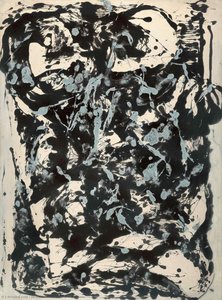
Una obra maestra de Jackson Pollock que captura la esencia del expresionismo abstracto con colores vibrantes y una composición dinámica. Descubre el legado de este icono artístico.
Biografía del artista
¿Quién fue Jackson Pollock? Descubre el artista pionero del expresionismo abstracto y la técnica del goteo que revolucionó el arte moderno. Análisis de su obra más famosa y legado artístico.
Sobre la obra
Introduction to Abstract Expressionism
Abstract Expressionism is a genre of art that emerged in the mid-20th century, characterized by intense subjectivity and rough handling of materials. This movement produced some of the most influential artists of the time, including Jackson Pollock. Known for his unique style of drip painting, Pollock was a major figure in the Abstract Expressionist movement.'Orange Head': A Study in Abstraction
Orange Head is an iconic example of Pollock’s drip painting technique, which involves pouring or splattering paint onto a canvas laid on the floor. This method allowed Pollock to create dynamic compositions that captured the essence of movement and energy. In Orange Head, Pollock used vibrant colors, including various shades of orange, yellow, black, and white, to create an abstract yet captivating image.The Legacy of Jackson Pollock's 'Orange Head'
Orange Head is a testament to Pollock’s innovative approach to art-making and his significant contribution to the Abstract Expressionist movement. The painting showcases Pollock’s mastery of color, composition, and texture, making it an essential piece in understanding the evolution of abstract art. To learn more about Jackson Pollock and other influential Abstract Expressionists, visit the extensive collection of fine art available at https://TopImpressionists.com.- Abstract Expressionism: Learn more about the Abstract Expressionist movement and its key artists.
- Art Styles: Discover various art styles, movements, groups, and schools represented in our collection, including works by Clyfford Still and Yoo Youngkuk.
- Explore the Museum of Modern Art and its collection of modern and contemporary art.
The unique style of Jackson Pollock has made him one of the most famous artists of the 20th century. His innovative approach to art-making has inspired generations of artists and continues to influence contemporary art. To explore more works by Jackson Pollock and other influential Abstract Expressionists, visit https://TopImpressionists.com.
In conclusion, Orange Head is a remarkable example of Jackson Pollock's unique style and contribution to the Abstract Expressionist movement. Its vibrant colors and dynamic composition make it an essential piece in understanding the evolution of abstract art. Photo Description: The image is a painting of a face with a mouth open, painted in reds and oranges. The face appears to be distorted and has a strange expression on it. There are two eyes visible, one near the top left corner and another towards the center-left of the painting. The mouth is located at the bottom center of the image. The painting is an abstract expressionist piece by Jackson Pollock, which can be identified by its bold colors and unusual composition. It appears to be a close-up view of the face, capturing the viewer's attention with its vibrant hues and intriguing facial features. Size: Unknown Date: Unknown
Preguntas y respuestas
¿Qué lugar ocupa "Orange Head" entre los temas recurrentes de Jackson Pollock?
"Orange Head" representa drip painting, color field, geometric abstraction, emotional intensity, american art, psychedelic, totemic imagery, mientras que los temas recurrentes de Jackson Pollock son inspired by picasso & primitive art, exploring inner psyche & emotion, symbolic gestures & totemic forms, central piece in pollock’s oeuvre, reflecting trauma & resilience, bold color palette & dynamic composition, iconic representation of abstract expressionism. Al comparar ambos, se observa cómo la obra se relaciona con los temas habituales del artista.
¿Qué representa "Orange Head" de Jackson Pollock?
Los temas presentes en "Orange Head" de Jackson Pollock incluyen drip painting, color field, geometric abstraction, emotional intensity, american art, psychedelic, totemic imagery, los cuales resumen la temática de la obra.
¿Dónde puedo encontrar estadísticas sobre "Orange Head" de Jackson Pollock?
Existe una página de Estadísticas para "Orange Head". En ella se detallan las visitas mensuales de la obra y de otras piezas del artista, con desgloses por país e idioma.
Datos rápidos y cuestionario de arte
Sobre Jackson Pollock

Jackson Pollock
1912 - 1956, Estados Unidos
Biografía del artista
Early Life and the Seeds of Innovation
Paul Jackson Pollock, born in Cody, Wyoming, in 1912, was a restless spirit from the outset. His early life was marked by frequent relocation as his father pursued work as a land surveyor across the vast landscapes of the American West. This itinerant existence instilled in young Pollock a deep connection to the natural world and an exposure to diverse cultures, particularly through encounters with Native American art during those surveying trips – impressions that would subtly permeate his artistic vision later in life.
Pollock’s formal artistic training began at the Manual Arts High School in Los Angeles, followed by studies at the Art Students League of New York under the tutelage of Thomas Hart Benton. Benton, a prominent figure in the Regionalist movement, emphasized rhythmic composition and narrative themes rooted in American life. While Pollock initially absorbed these lessons, his inherent inclination leaned toward more abstract explorations. He was also profoundly impacted by Mexican muralists like José Clemente Orozco, whose powerful depictions of social struggle resonated deeply with him. These early influences laid a foundation, but it was the burgeoning world of Surrealism that truly unlocked Pollock’s artistic potential.
The Birth of Action Painting and a Revolutionary Technique
The 1930s saw Pollock experimenting with various techniques, seeking alternatives to traditional brushwork. He began pouring paint, exploring its fluidity and unpredictable nature. However, it was around 1947 that his artistic trajectory underwent a radical transformation. Abandoning the easel altogether, Pollock laid canvases directly on the floor, initiating what would become known as his “drip painting.” He then proceeded to drip, splash, and fling paint onto the canvas from above, orchestrating a dynamic dance between artist, medium, and surface.
This wasn’t merely about applying paint; it was about embodying the act of creation itself. Pollock's canvases became arenas for physical expression, capturing the immediacy of his gestures and emotions. The resulting paintings are characterized by their “all-over” composition – a lack of central focus that invites the viewer to explore the entire surface as a unified field of energy. Intricate networks of lines and colors intertwine, creating a visual complexity that is both captivating and challenging. He employed unconventional tools—sticks, knives, even syringes—to manipulate the paint in unpredictable ways, further emphasizing the spontaneous nature of his process.
This innovative approach positioned Pollock as a central figure in the burgeoning Abstract Expressionist movement, which emerged in post-World War II New York City. Abstract Expressionism prioritized spontaneous gesture, large scale, and non-representational imagery, reflecting a broader cultural shift away from traditional artistic conventions. His marriage to fellow artist Lee Krasner was also pivotal; she provided unwavering emotional support and actively encouraged his artistic development, recognizing the groundbreaking nature of his work.
Iconic Works and Lasting Legacy
Pollock’s most celebrated works—such as Number 1, 1950 (Lavender Mist), One: Number 31, 1950, Blue Poles: Number 11, 1952, and Convergence—are testaments to his revolutionary technique. These paintings are not simply images; they are records of a performance, imbued with the artist’s physical presence and emotional intensity. The dynamic energy that emanates from these canvases is palpable, drawing viewers into a world of pure abstraction.
His style transcends mere aesthetics; it's an exploration of process over product. Pollock sought to capture the immediacy of his actions and emotions on canvas, rejecting traditional notions of composition and representation. He delved into Jungian psychology, exploring archetypes and the subconscious in his art, seeking to tap into universal symbols and primal energies.
Pollock’s impact on the history of art is immeasurable. He fundamentally altered the way artists approached painting, breaking free from easel-based methods and embracing a more performative approach. His work helped solidify New York City's position as a global center for modern art, shifting the focus away from European dominance. His influence can be seen in the work of countless artists who followed, including those associated with Color Field painting and later forms of abstract expressionism.
Though initially met with mixed reviews—some critics dismissed his work as chaotic or lacking skill—Pollock’s reputation grew steadily after his untimely death in 1956 at the age of 44. Today, he is universally recognized as one of the most important and influential artists of the 20th century, a visionary who dared to challenge conventions and redefine the boundaries of artistic expression.
Datos rápidos sobre Jackson Pollock
- Artistic Movement Or Style: Abstract Expressionismo
- Artists Or Movements Influenced By This Artist: ['Color Field painting']
- Artists Who Influenced This Artist:
- José Clemente Orozco
- Thomas Hart Benton
- Date Of Birth: 28 enero 1912
- Date Of Death: 11 agosto 1956
- Full Name: Paul Jackson Pollock
- Nationality: American
- Notable Artworks: ['Número 1, 1950 (Lavanda Vapor']
- Place Of Birth: Cody, Estados Unidos
Explore obras de arte organizadas por temas, estilos y características.



Jackson Pollock
Orange Head
() ·
Con su marco: · Pintado a mano al óleo sobre lienzo
Total