

 Ver en contexto
 Enviar
 Compartir
 Detalles
 Guía
Guía

 Descargar
 Similares
 Radiografía
 Presentación de diapositivas
 Q&A
Q&A Estadísticas
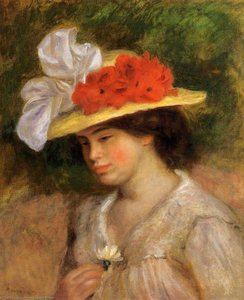
Lady with White Hat


Una impresionante obra maestra impresionista de Pierre-Auguste Renoir que captura la belleza femenina y la luz suave en una escena floral llena de simbolismo.
 Ver más
Explore el vibrante mundo de Pierre-Auguste Renoir (1841-1919), un destacado pintor impresionista celebrado por sus luminosas retratos, escenas de la vida parisina y la belleza femenina. Descubre su legado y las contribuciones artísticas de su familia.
Giclée / Impresión de arte
Impresiones giclée o en lienzo de calidad de museo con producción rápida y opciones de acabado flexibles. ( Comprar pintura hecha a mano Cambiar a imagen digital)




P118B €10

P118H €10

P118W €10

P438Z €10

P508JH €12

P508YH €12

P805H €10

P805Z €10

P919BZ €10

P919G €10

P919XJ €10

P959ZH €10

P968JZ €12

W106C €8

W218G €10

W218JH €8

W218Y €10

W307PJ €10

W316G €10

W316PJ €8

W316Y €10

W398PJ €8

W4111J €10

W500HY €15

W500JH €15

W692G €12

W849H €8

W940BG €15

W953PJ €8




Tamaño estándar
a medida
CM
INCH
Elija entre nuestros tamaños predefinidos que respetan las proporciones originales de la obra.
Loading sizes...

ancho
altura
Introduzca el ancho y el alto que necesite para adaptarse a su marco o pared. Una impresión solo puede recortarse, nunca hacerse más grande que la imagen original, por lo que un tamaño con una forma distinta perderá parte de la obra. Le enviaremos una maqueta digital para su aprobación antes de realizar cualquier impresión. La imagen que se muestra en esta página no refleja el recorte real; solo la maqueta lo hace.
Envío a todo el mundo () en 2 semanas en lugar de las 4/5 semanas estándar. (2 noviembre)

Envío exprés gratuito a todo el mundo

Lienzo de lino de alta calidad

Seguro de envío total

Garantía de reembolso de aranceles aduaneros

Garantía de fidelidad cromática exacta

Política de devolución de 100 días (solo por defectos)

Garantía de devolución del 100% del dinero

Descuento por cantidad
 La opción de vidrio solo está disponible en tamaños inferiores a 110 cm.

Lady with White Hat
Giclée / Impresión de arte
Dimensiones de la reproducción
-


Precio total final
€ 61
Lady with White Hat: A Portrait of Elegance and Impressionistic Light
The Lady with White Hat, a masterpiece created by the renowned French artist Pierre-Auguste Renoir in 1895, transcends mere representation—it captures a fleeting moment of beauty and serenity within the vibrant tapestry of Parisian Impressionism. Available for viewing on /es/art/show/art-8xyrr7-es/ this painting stands as a testament to Renoir’s unparalleled ability to translate light and color into emotive visual experience.Composition and Impressionistic Technique
Renoir's genius lies in his masterful manipulation of brushstrokes—short, broken dashes of pigment applied with loose confidence—that dance across the canvas surface. These strokes aren’t intended to meticulously depict form; rather, they aim to convey the sensation of light itself, as it refracts through the air and illuminates the subject matter. Observe how Renoir skillfully blends shades of pink, peach, and cream to create a luminous skin tone, subtly hinting at the warmth of sunlight filtering through the floral setting. The placement of the woman on the bench—slightly off-center—adds dynamism to the composition, guiding the viewer’s eye across the scene.Symbolism Within Floral Context
The lady herself is adorned with a magnificent white hat embellished with flowers – roses predominantly – symbolizing purity and grace. These blossoms aren't merely decorative; they represent an integral part of the painting's narrative. The abundance of roses speaks to themes of romance, fertility, and springtime—a reflection of the cultural milieu of 1895 Paris, where Impressionist artists sought inspiration in the natural world. Renoir’s meticulous attention to detail—the delicate folds of fabric, the subtle nuances of expression—elevates this portrait beyond a simple likeness; it aspires to evoke an emotional response in the viewer.Historical Resonance and Artistic Influences
Painted during Napoleon III's reign, Paris was experiencing a period of unprecedented artistic ferment. Impressionism emerged as a reaction against academic conventions, prioritizing subjective perception over objective representation. Renoir drew inspiration from fellow Impressionists like Camille Pissarro and Claude Monet, whose explorations of light and color paved the way for his own groundbreaking style. Consider Pissarro’s “Roses in a Glass,” which similarly utilizes broken brushstrokes to capture the ephemeral beauty of floral arrangements—a kindred spirit in capturing fleeting moments of visual splendor.A Legacy of Beauty and Light
The Museo Sorolla in Madrid houses a remarkable collection of paintings by Joaquín Sorolla y Bastida, whose luminous landscapes embody the spirit of Impressionism. Sorolla’s dedication to portraying natural light and atmosphere resonates deeply with Renoir's artistic vision—a shared commitment to capturing the essence of beauty as experienced by the human eye. The enduring appeal of “Lady with White Hat” lies in its ability to transport us back to a bygone era, reminding us of the transformative power of art to illuminate our understanding of both visual aesthetics and human emotion. For those seeking to immerse themselves in Renoir’s oeuvre, https://TopImpressionists.com offers exceptional reproductions—including Expectation /art/list/?Filter=9H5SBB-Pierre-Auguste-Renoir-Expectation-mixed-media-with-silver-and-gol)—allowing admirers worldwide to appreciate the brilliance of this iconic artwork.Preguntas y respuestas
¿Es "Lady with White Hat" una de las obras más populares de Pierre-Auguste Renoir?
"Lady with White Hat" tiene un nivel de popularidad Reconocido regionalmente.
¿Qué colores predominan en "Lady with White Hat" de Pierre-Auguste Renoir?
"Lady with White Hat" se define por una paleta de Tonos tierra con predominio del Madera de deriva (#a67749).
¿Qué paleta de colores utiliza "Lady with White Hat"?
Los colores de "Lady with White Hat" conforman una paleta Tonos tierra. Esta clasificación describe las familias de colores dominantes.
Obras relacionadas


Biografía del artista
vida temprana y carrera
pierre-auguste renoir, un artista francés fundamental, nació el 25 de febrero de 1841 en Limoges, Francia. Jugó un papel crucial a la hora de dar forma al movimiento impresionista, conocido por su luz vibrante y sus colores saturados. La obra de Renoir celebraba la belleza, particularmente la sensualidad femenina, colocándolo en una línea de artistas que se extendía desde Rubens hasta Watteau.legado artístico
El legado de Renoir se extendió más allá de su lienzo, como patriarca de una familia donde el arte florecía en diversas formas. Sus hijos, pierre renoir (1885–1952), el cineasta jean renoir (1894–1979) y el artista ceramista claude renoir (1901–1969), cada uno hizo contribuciones significativas en sus campos. Su nieto, el cineasta claude renoir (1913–1993), avanzó aún más la herencia artística de la familia.obras notables y museos
* dance at bougival, una pintura notable de Renoir, muestra su dominio para capturar la esencia del arte impresionista. * El musée des collettes, ubicado en Cagnes-sur-Mer, Francia, es un destino imprescindible para los amantes del arte. Este museo, que fue la casa de Pierre-Auguste Renoir, sirve como testimonio de su vida y obra, alberga quince de sus pinturas. * El musée maurice denis, otra joya oculta en Francia, presenta una impresionante colección de pinturas postimpresionistas franceses de finales del siglo XIX y principios del siglo XX.explora el arte de Renoir con TopImpressionists
- Descubre el encanto del musée des collettes (Francia) y su arte impresionista en TopImpressionists: [https://TopImpressionists.com/@@/a@d3aupf](https://TopImpressionists.com/@@/a@d3aupf)
- Explora las maravillas del musée maurice denis (Francia) con TopImpressionists: /es/art/show/art-d3aue3-es/
- Visualiza las pinturas de Renoir, incluyendo dance at bougival, en TopImpressionists: [https://TopImpressionists.com/@/pierre-auguste renoir](https://TopImpressionists.com/@/pierre-auguste%20renoir)

Pierre-Auguste Renoir
1841 - 1919 , Francia
Datos clave
- Artistas Que Influyeron:
- Rubens
- Watteau
- Camille Pissarro
- Édouard Manet
- Fecha De Fallecimiento: 3 de diciembre de 1919
- Fecha De Nacimiento: 25 de febrero de 1841
- Lugar De Nacimiento: Limoges, Francia
- Movimiento Artístico: Impresionismo
- Nacionalidad: Francés
- Nombre Completo: Pierre-Auguste Renoir
- Obras Notables:
- Baile en Bougival
- Almuerzo de la fiesta de remo
- Los grandes bañistas
- Dos hermanas
- Jóvenes tocando el piano
Artículos relacionados

Los 10 Maestros Impresionistas que Revolucionaron el Arte | TopImpressionists
Descubre los 10 cuadros impresionistas más influyentes de Monet, Renoir y Degas. Explora la historia, técnica y belleza de este movimiento artístico. Reproducciones de arte en TopImpressionists.com para decorar tu hogar con estilo.

Blanco Sublime: Los 10 Cuadros Más Famosos Dominados por la Luz y el Color
Descubre los 10 cuadros blancos más emblemáticos de la historia del arte. Explora Monet, Van Gogh y Klimt, y su magistral uso de la luz y el color. Encuentra reproducciones de alta calidad e inspírate para tu decoración en .

Las 25 mejores obras de Pierre-Auguste Renoir: El alma del Impresionismo
Explora las 25 mejores obras de Renoir y la luz del impresionismo. ¡Descubre estas obras maestras en TopImpressionists.com!

Los 10 Maestros Impresionistas que Revolucionaron el Arte | TopImpressionists
Descubre los 10 cuadros impresionistas más influyentes de Monet, Renoir y Degas. Explora la historia, técnica y colores vibrantes del impresionismo. Encuentra reproducciones de arte exclusivas en TopImpressionists.com.

The Luminous World of Pierre-Auguste Renoir: An Exploration of Impressionism's Sensuous Embrace
Explore the captivating world of Pierre-Auguste Renoir! Discover his life, iconic Impressionist masterpieces & enduring legacy with our expert guide. High-quality reproductions available.
Explore obras de arte organizadas por temas, estilos y características.


