

Exibido: · Com a moldura:
 Visualizar na parede
 Compartilhar
 Compartilhar
 Detalhes
 Guia
Guia

 Baixar imagem
 Semelhantes
 Raio X
 Ver diaporama
 Perguntas e Respostas
 Estatísticas


€ 240
Reprodução em Óleo Feita à Mão
Óleo sobre tela pintado à mão no tamanho e moldura de sua escolha, feito sob encomenda pelos nossos artistas. ( Alternar para Impressão Alternar para Imagem Digital)
Tamanho
·Tamanho padrão
personalizado
CM
INCH
Escolha entre os nossos tamanhos pré-definidos que respeitam as proporções originais da obra de arte.
Carregando tamanhos...

largura
altura
Insira a largura e a altura desejadas para se ajustarem à sua moldura ou parede. Como esta obra é pintada à mão, para um tamanho com proporções diferentes, o artista poderá pintar um pouco mais ao redor da imagem ou reduzir ligeiramente a composição — você escolhe. Enviamos uma maquete digital para sua aprovação antes de iniciar a pintura. A imagem exibida nesta página não representa o resultado real — apenas a maquete mostra o resultado final.
 Leia mais
Finalizar
·
Branco €1

Bordas esfumaçadas €1

Bordas estendidas €1

P118B €10

P118H €10

P118W €10

P438Z €10

P508JH €12

P508YH €12

P805H €10

P805Z €10

P919BZ €10

P919G €10

P919XJ €10

P959ZH €10

P968JZ €12

W106C €8

W218G €10

W218JH €8

W218Y €10

W307PJ €10

W316G €10

W316PJ €8

W316Y €10

W398PJ €8

W4111J €10

W500HY €15

W500JH €15

W692G €12

W849H €8

W940BG €15

W953PJ €8

H24-GOLD €30

H24-SILVER €30

H36-GOLD €45

H36-SILVER €45
Enviado em um tubo protetor, pronto para ser emoldurado por você.
Extras
opcionalO que os extras incluem?
Exemplos do que pode ser alterado: Substituir o rosto pela foto do cliente; Adicionar um animal de estimação (ex: substituir gato por cachorro); Incluir uma mensagem oculta no fundo; Alterar a paisagem ou elementos do fundo.
Após o pedido, a equipe da TopImpressionists.com enviará um e-mail ao cliente para instruções e fornecerá uma prévia da montagem
Após o pedido, a equipe da TopImpressionists.com enviará um e-mail ao cliente para instruções e fornecerá uma prévia da montagem
Entrega mundial () em 3 a 4 semanas, em vez das 5 semanas padrão. (6 Novembro). Sem comprometer a qualidade.
Verniz de Proteção
Etiqueta de identificação
Detalhes da Placa de Bronze Gravada
This elegant plaque features the artist's name and the title of the artwork, finely engraved for a timeless presentation.
It is made from bronze with a refined, elegant finish. The text is precisely laser-engraved for a sharp and permanent result. Measuring 9x2 cm, the plaque is compact yet easy to read. It's built to be durable and scratch-resistant, offering a professional, museum-quality look. Mounting is simple thanks to the included adhesive backing.
Detalhes da Placa de Acrílico Transparente
The plaque includes essential engraved details such as the artist's name, the title of the artwork, the date it was created, the type of media used-like oil on canvas or watercolor-a brief description of the piece, and a QR code that links to the complete artwork information.
It is crafted from clear acrylic, offering a sleek, modern appearance. The text is UV-engraved in black to ensure strong visual contrast. With a size of 10x15 cm, it ensures optimal readability. It comes equipped with two metal hooks for secure wall mounting. The plaque is designed to be weather-resistant, making it suitable for various environments, and it includes interactive features that work seamlessly with smartphone scanning.
Detalhes da Placa de Acrílico Preto
This elegant plaque includes engraved information such as the artist's name, the title of the artwork, the date it was created, the type of media used (like oil on canvas or watercolor), a short description of the artwork, and a QR code for quick access to more information.
The plaque itself is made from refined black acrylic with a premium finish. The text is laser-engraved in white for high contrast and readability. Its size is 10x15 cm, designed to be easy to read. It comes with two metal hooks for professional mounting. The design is sleek and fits any interior style. It is also weather-resistant and durable, with built-in digital integration for mobile compatibility.
A opção de vidro está disponível apenas para tamanhos inferiores a 110 cm
 A opção de vidro está disponível apenas para tamanhos inferiores a 110 cm
- Envio expresso gratuito para todo o mundo
- Tela de Linho de Alta Qualidade
- Seguro de transporte completo
- Garantia de Reembolso de Impostos Alfandegários
- Garantia de Fidelidade Cromática
- Política de Devolução em 100 Dias (Apenas para Defeitos)
- Garantia de reembolso de 100%
- Oferta de desconto por quantidade


Descrição do Item
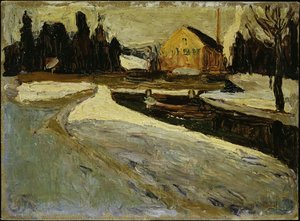
A serene winter scene of the Delaware Canal captured by Pennsylvania Impressionist Frederick Roland Wagner features snow-covered landscapes and tranquil boats, inviting you to bring this peaceful moment into your home.
Biografia do Artista
Discover Frederick R. Wagner (1860-1940), a pioneering Pennsylvania Impressionist painter. Explore his captivating scenes of Philadelphia – harbors, bridges & everyday life – and learn about his legacy at PAFA & beyond.
Sobre a pintura
Wagner began his studies at the Pennsylvania Academy of the Fine Arts under Thomas Eakins and Thomas Anshutz in the early 1880s. Like many of his New Hope colleagues, the artist preferred painting en plein air, especially winter scenes and specialized in railroad and canal views such as this work. In 1913, Wagner exhibited two works in the landmark Armory Show in New York that introduced Americans to trends in European modernism.
Perguntas e Respostas
Em qual museu se encontra a obra original de "Delaware Canal"?
A obra original "Delaware Canal", de Frederick Roland Wagner encontra-se no Reading Public Museum, Reading, Estados Unidos da América. Uma reprodução permite que a obra seja exibida em sua casa.
Qual uso e espaço são recomendados para "Delaware Canal", de Frederick Roland Wagner?
"Delaware Canal" é sugerida para Seasonal, e o espaço recomendado é um(a) Hotel Room.
Que tipo de obra é "Delaware Canal"?
"Delaware Canal", de Frederick Roland Wagner é classificado como WallArt. A categoria descreve o tipo de obra de arte que a peça original representa.
Informações rápidas e quiz de arte
Sobre Frederick Roland Wagner

Frederick Roland Wagner
1860 - 1940, United States of America
Biografia do Artista
Frederick Roland Wagner: Capturing the Soul of Philadelphia
Born in Port Kennedy, Pennsylvania, in 1860, Frederick Roland Wagner emerged as a pivotal figure in early 20th-century American art, specifically within the burgeoning Pennsylvania Impressionist movement. His life and career were inextricably linked to the vibrant, evolving cityscape of Philadelphia, a subject he relentlessly pursued with a keen eye for detail and an ability to imbue everyday scenes with profound emotional resonance. Wagner’s work wasn't merely documentation; it was a deeply felt exploration of urban life, capturing both its grandeur and its inherent melancholy.
Wagner’s artistic journey began under the tutelage of Thomas Eakins at the Pennsylvania Academy of the Fine Arts, an institution that profoundly shaped his approach to painting. This early immersion in academic training provided him with a solid technical foundation, but it was Wagner's subsequent engagement with the burgeoning Impressionist circle – including Robert Henri and William Glackens – that truly ignited his artistic spirit. These figures encouraged a shift away from rigid realism towards capturing fleeting moments of light and color, emphasizing subjective experience over objective representation. He embraced this new approach, developing a distinctive style characterized by loose brushwork, vibrant palettes, and an intimate portrayal of Philadelphia’s industrial heartland.
Early life and education saw Wagner demonstrating anatomy at the Pennsylvania Academy, showcasing his meticulous observation skills – a trait that undoubtedly informed his ability to render figures and architectural details with remarkable accuracy. He spent time studying in Europe before returning to America, where he honed his craft through independent study and experimentation. His work quickly gained recognition within the Pennsylvania art community, earning him inclusion in prestigious exhibitions such as those of the Pennsylvania Academy and the Corcoran Gallery of Art. These venues provided a crucial platform for showcasing his evolving style and establishing his reputation.
The Urban Landscape: A Philadelphia Portrait
Wagner’s artistic focus centered almost exclusively on scenes within Philadelphia – its canals, bridges, train stations, harbors, and bustling streets. He wasn't interested in grand historical narratives or idealized landscapes; instead, he sought to capture the essence of urban life as it unfolded before him. His paintings of the Delaware Canal, exemplified by “Delaware Canal and Canal at Lumberville,” are particularly noteworthy for their evocative atmosphere and subtle shifts in light and shadow. These works aren’t simply depictions of physical spaces; they're meditations on time, industry, and the human experience within a rapidly changing environment.
His series depicting scenes like “Broad Street Station, Spring” offer a glimpse into the daily rhythms of Philadelphia – the arrival of trains, the flow of pedestrians, the interplay of light and color. Wagner’s compositions often feature figures rendered with remarkable sensitivity, suggesting a quiet awareness of their presence within the larger urban landscape. He skillfully used atmospheric perspective to create a sense of depth and distance, drawing the viewer into the heart of his scenes.
Technique and Style
Wagner's technique was characterized by a loose, expressive brushstroke—a hallmark of Impressionism. He favored working outdoors ("en plein air") whenever possible, allowing him to directly observe and capture the nuances of natural light. His palette was generally bright and vibrant, utilizing complementary colors to create visual excitement and depth. He often employed a technique of applying paint in thin layers, building up color gradually to achieve a luminous effect.
Despite his embrace of Impressionist principles, Wagner’s work retained a strong sense of realism. He meticulously rendered architectural details, figures, and textures, demonstrating a remarkable attention to detail. However, he never sacrificed spontaneity or emotional expression in the pursuit of accuracy. His paintings are imbued with a palpable sense of immediacy—as if he were capturing a fleeting moment in time.
Recognition and Legacy
Wagner’s contributions to American art were recognized throughout his career. He received the Pennsylvania Academy's fellowship prize in 1914, a testament to his artistic merit and dedication. He also earned an honorable mention at the International Exhibition of the Carnegie Institute in Pittsburgh in 1922, further solidifying his place within the broader American art scene. His works are now held in prestigious institutions such as the Philadelphia Museum of Art, the Reading Museum, the Woodmere Art Museum, and the James A. Michener Art Museum, ensuring that his legacy will continue to inspire future generations of artists.
Frederick Roland Wagner’s paintings offer a unique window into the soul of Philadelphia at the turn of the 20th century. His ability to capture the beauty and complexity of urban life—its grandeur, its melancholy, and its inherent humanity—solidifies his position as one of the most important figures in Pennsylvania Impressionism. His work remains a powerful reminder of the enduring appeal of capturing everyday moments with sensitivity and artistic vision.
Informações rápidas sobre Frederick Roland Wagner
- Full Name: Frederick Roland Wagner
- Nationality: American
- Date Of Birth: 1860
- Date Of Death: 1940
- Place Of Birth: Port Kennedy, United States of America
- Notable Artworks:
- Delaware Canal
- Canal at Lumberville
- Artistic Movement Or Style: Pennsylvania Impressionist
- Artists Who Influenced This Artist: ['Thomas Eakins']
Obras Relacionadas




Frederick Roland Wagner
Delaware Canal
() ·
Com a moldura: · Pintura a óleo sobre linho feita à mão
Total