

 Visualizar na parede
 Compartilhar
 Compartilhar
 Detalhes
 Guia
Guia

 Baixar imagem
 Semelhantes
 Raio X
 Ver diaporama
 Perguntas e Respostas
 Estatísticas
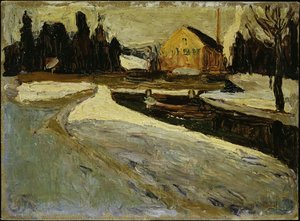
Delaware Canal


A serene winter scene of the Delaware Canal captured by Pennsylvania Impressionist Frederick Roland Wagner features snow-covered landscapes and tranquil boats, inviting you to bring this peaceful moment into your home.
 Ler mais
Discover Frederick R. Wagner (1860-1940), a pioneering Pennsylvania Impressionist painter. Explore his captivating scenes of Philadelphia – harbors, bridges & everyday life – and learn about his legacy at PAFA & beyond.
Obtenha um arquivo pronto para impressão que vai muito além da visualização na web. Cada imagem digital que vendemos provém de um arquivo mestre de alta resolução em nosso banco de dados — geralmente entre 5.000 e 15.000 pixels de largura — para que você possa imprimir em grandes formatos, realizar cortes precisos ou reproduzir detalhes minuciosos com total confiança.
Nenhum arquivo sai do nosso estúdio sem passar por um cuidadoso processo de revisão. Um especialista digital verifica as cores em relação à pintura original e as corrige se necessário, aumentando então a clareza e o detalhe com ferramentas profissionais de retoque — sempre mantendo a fidelidade às pinceladas e ao estilo do artista. O resultado é uma imagem que se assemelha à pintura, e não a um scan com filtros.
Aprovação antes da finalização: nosso especialista enviará a imagem por e-mail em até 72 horas para sua revisão. Não ficou satisfeito? Solicite melhorias ou correções, ou peça o reembolso caso a qualidade não atenda às suas expectativas.
Esta é a qualidade em que confiam editoras, estúdios de design, galerias e gráficas.
Imagem Digital
Baixe um arquivo de alta resolução para exibição pessoal, impressão e projetos criativos. ( Alternar para Impressão Comprar pintura feita à mão)
Incluído em cada compra de imagem digital
Entrega Digital Especializada e Garantida
Ao escolher o TopImpressionists.com, você não está apenas adquirindo uma imagem — você está recebendo uma obra de arte digital profissionalmente aprimorada, elaborada com precisão e com garantia de satisfação. Aqui está tudo o que acompanha seu pedido, automaticamente:

Entrega rápida por e-mail
O seu arquivo de imagem digital em alta resolução será enviado por e-mail em até 72 horas após o pedido — pronto para uso imediato.

Arquivo Digital com IA Otimizado
Sua obra de arte é otimizada profissionalmente por meio de ferramentas avançadas de IA e edição manual, garantindo o máximo de detalhes, clareza e precisão de cores.

Reenvio gratuito vitalício
Apagou ou perdeu o seu ficheiro acidentalmente? Não se preocupe – nós reenviamos para si a qualquer momento, gratuitamente.

Sem Taxas de Importação - Sempre
Desfrute da sua obra de arte instantaneamente, sem taxas alfandegárias, impostos ou custos de entrega — downloads digitais são sempre isentos de taxas.

Garantia de Fidelidade de Cores
Garantimos que sua imagem digital reflita as cores originais com a maior fidelidade possível, utilizando ferramentas profissionais e gerenciamento de cores.

Garantia de satisfação de 100 dias
Se não estiver satisfeito com a sua imagem digital, nós a revisaremos ou reembolsaremos 100% dentro de 100 dias — sem perguntas.

Garantia de Reembolso 100%
Não está satisfeito? Receba o reembolso total em até 100 dias após o recebimento do seu arquivo digital — sem perguntas.

Descontos para pedidos em lote
Compre 3 imagens, economize 10% - Compre 5, economize 15% - Compre 10+, economize 20%. Ideal para projetos criativos, galerias e agências.
Wagner began his studies at the Pennsylvania Academy of the Fine Arts under Thomas Eakins and Thomas Anshutz in the early 1880s. Like many of his New Hope colleagues, the artist preferred painting en plein air, especially winter scenes and specialized in railroad and canal views such as this work. In 1913, Wagner exhibited two works in the landmark Armory Show in New York that introduced Americans to trends in European modernism.
Perguntas e Respostas
Em qual museu se encontra a obra original de "Delaware Canal"?
A obra original "Delaware Canal", de Frederick Roland Wagner encontra-se no Reading Public Museum, Reading, Estados Unidos da América. Uma reprodução permite que a obra seja exibida em sua casa.
Qual uso e espaço são recomendados para "Delaware Canal", de Frederick Roland Wagner?
"Delaware Canal" é sugerida para Seasonal, e o espaço recomendado é um(a) Hotel Room.
Que tipo de obra é "Delaware Canal"?
"Delaware Canal", de Frederick Roland Wagner é classificado como WallArt. A categoria descreve o tipo de obra de arte que a peça original representa.
Obras Relacionadas




Biografia do Artista
Frederick Roland Wagner: Capturing the Soul of Philadelphia
Born in Port Kennedy, Pennsylvania, in 1860, Frederick Roland Wagner emerged as a pivotal figure in early 20th-century American art, specifically within the burgeoning Pennsylvania Impressionist movement. His life and career were inextricably linked to the vibrant, evolving cityscape of Philadelphia, a subject he relentlessly pursued with a keen eye for detail and an ability to imbue everyday scenes with profound emotional resonance. Wagner’s work wasn't merely documentation; it was a deeply felt exploration of urban life, capturing both its grandeur and its inherent melancholy.
Wagner’s artistic journey began under the tutelage of Thomas Eakins at the Pennsylvania Academy of the Fine Arts, an institution that profoundly shaped his approach to painting. This early immersion in academic training provided him with a solid technical foundation, but it was Wagner's subsequent engagement with the burgeoning Impressionist circle – including Robert Henri and William Glackens – that truly ignited his artistic spirit. These figures encouraged a shift away from rigid realism towards capturing fleeting moments of light and color, emphasizing subjective experience over objective representation. He embraced this new approach, developing a distinctive style characterized by loose brushwork, vibrant palettes, and an intimate portrayal of Philadelphia’s industrial heartland.
Early life and education saw Wagner demonstrating anatomy at the Pennsylvania Academy, showcasing his meticulous observation skills – a trait that undoubtedly informed his ability to render figures and architectural details with remarkable accuracy. He spent time studying in Europe before returning to America, where he honed his craft through independent study and experimentation. His work quickly gained recognition within the Pennsylvania art community, earning him inclusion in prestigious exhibitions such as those of the Pennsylvania Academy and the Corcoran Gallery of Art. These venues provided a crucial platform for showcasing his evolving style and establishing his reputation.
The Urban Landscape: A Philadelphia Portrait
Wagner’s artistic focus centered almost exclusively on scenes within Philadelphia – its canals, bridges, train stations, harbors, and bustling streets. He wasn't interested in grand historical narratives or idealized landscapes; instead, he sought to capture the essence of urban life as it unfolded before him. His paintings of the Delaware Canal, exemplified by “Delaware Canal and Canal at Lumberville,” are particularly noteworthy for their evocative atmosphere and subtle shifts in light and shadow. These works aren’t simply depictions of physical spaces; they're meditations on time, industry, and the human experience within a rapidly changing environment.
His series depicting scenes like “Broad Street Station, Spring” offer a glimpse into the daily rhythms of Philadelphia – the arrival of trains, the flow of pedestrians, the interplay of light and color. Wagner’s compositions often feature figures rendered with remarkable sensitivity, suggesting a quiet awareness of their presence within the larger urban landscape. He skillfully used atmospheric perspective to create a sense of depth and distance, drawing the viewer into the heart of his scenes.
Technique and Style
Wagner's technique was characterized by a loose, expressive brushstroke—a hallmark of Impressionism. He favored working outdoors ("en plein air") whenever possible, allowing him to directly observe and capture the nuances of natural light. His palette was generally bright and vibrant, utilizing complementary colors to create visual excitement and depth. He often employed a technique of applying paint in thin layers, building up color gradually to achieve a luminous effect.
Despite his embrace of Impressionist principles, Wagner’s work retained a strong sense of realism. He meticulously rendered architectural details, figures, and textures, demonstrating a remarkable attention to detail. However, he never sacrificed spontaneity or emotional expression in the pursuit of accuracy. His paintings are imbued with a palpable sense of immediacy—as if he were capturing a fleeting moment in time.
Recognition and Legacy
Wagner’s contributions to American art were recognized throughout his career. He received the Pennsylvania Academy's fellowship prize in 1914, a testament to his artistic merit and dedication. He also earned an honorable mention at the International Exhibition of the Carnegie Institute in Pittsburgh in 1922, further solidifying his place within the broader American art scene. His works are now held in prestigious institutions such as the Philadelphia Museum of Art, the Reading Museum, the Woodmere Art Museum, and the James A. Michener Art Museum, ensuring that his legacy will continue to inspire future generations of artists.
Frederick Roland Wagner’s paintings offer a unique window into the soul of Philadelphia at the turn of the 20th century. His ability to capture the beauty and complexity of urban life—its grandeur, its melancholy, and its inherent humanity—solidifies his position as one of the most important figures in Pennsylvania Impressionism. His work remains a powerful reminder of the enduring appeal of capturing everyday moments with sensitivity and artistic vision.

Frederick Roland Wagner
1860 - 1940 , United States of America
Breve Biografia
- Full Name: Frederick Roland Wagner
- Nationality: American
- Date Of Birth: 1860
- Date Of Death: 1940
- Place Of Birth: Port Kennedy, United States of America
- Notable Artworks:
- Delaware Canal
- Canal at Lumberville
- Artistic Movement Or Style: Pennsylvania Impressionist
- Artists Who Influenced This Artist: ['Thomas Eakins']