

Shown: · With its frame:
 Visualizar na parede
 Compartilhar
 Compartilhar
 Detalhes
 Guia
Guia

 Baixar imagem
 Semelhantes
 Raio X
 Ver diaporama
 Q&A
Q&A Estatísticas


€ 239
Reprodução em Óleo Feita à Mão
Óleo sobre tela pintado à mão no tamanho e moldura de sua escolha, feito sob encomenda pelos nossos artistas. ( Alternar para Impressão Alternar para Imagem Digital)
Size
·Tamanho padrão
personalizado
CM
INCH
Escolha entre os nossos tamanhos pré-definidos que respeitam as proporções originais da obra de arte.
Loading sizes...

largura
altura
Insira a largura e a altura desejadas para se ajustarem à sua moldura ou parede. Como esta obra é pintada à mão, para um tamanho com proporções diferentes, o artista poderá pintar um pouco mais ao redor da imagem ou reduzir ligeiramente a composição — você escolhe. Enviamos uma maquete digital para sua aprovação antes de iniciar a pintura. A imagem exibida nesta página não representa o resultado real — apenas a maquete mostra o resultado final.
 Leia mais
Finish
·
White €1

Blurside €1

Extended €1

P118B €10

P118H €10

P118W €10

P438Z €10

P508JH €12

P508YH €12

P805H €10

P805Z €10

P919BZ €10

P919G €10

P919XJ €10

P959ZH €10

P968JZ €12

W106C €8

W218G €10

W218JH €8

W218Y €10

W307PJ €10

W316G €10

W316PJ €8

W316Y €10

W398PJ €8

W4111J €10

W500HY €15

W500JH €15

W692G €12

W849H €8

W940BG €15

W953PJ €8

H24-GOLD €30

H24-SILVER €30

H36-GOLD €45

H36-SILVER €45
Shipped in a protective tube, ready for your own framer.
Above 105 cm the frame is shipped as a kit for a professional framer — read the details.
Extras
optionalWhat do the extras include?
Examples of what can be changed: Replace face with customer photo; Add pet (e.g., replace cat with dog); Include hidden message in background; Change background landscape or elements.
After order, TopImpressionists.com team will email client for instructions and provide a mockup preview
After order, TopImpressionists.com team will email client for instructions and provide a mockup preview
Entrega mundial () em 3 a 4 semanas, em vez das 5 semanas padrão. (30 Outubro). Sem comprometer a qualidade.
Verniz de Proteção
Etiqueta de identificação
Detalhes da Placa de Bronze Gravada
This elegant plaque features the artist's name and the title of the artwork, finely engraved for a timeless presentation.
It is made from bronze with a refined, elegant finish. The text is precisely laser-engraved for a sharp and permanent result. Measuring 9x2 cm, the plaque is compact yet easy to read. It's built to be durable and scratch-resistant, offering a professional, museum-quality look. Mounting is simple thanks to the included adhesive backing.
Detalhes da Placa de Acrílico Transparente
The plaque includes essential engraved details such as the artist's name, the title of the artwork, the date it was created, the type of media used-like oil on canvas or watercolor-a brief description of the piece, and a QR code that links to the complete artwork information.
It is crafted from clear acrylic, offering a sleek, modern appearance. The text is UV-engraved in black to ensure strong visual contrast. With a size of 10x15 cm, it ensures optimal readability. It comes equipped with two metal hooks for secure wall mounting. The plaque is designed to be weather-resistant, making it suitable for various environments, and it includes interactive features that work seamlessly with smartphone scanning.
Detalhes da Placa de Acrílico Preto
This elegant plaque includes engraved information such as the artist's name, the title of the artwork, the date it was created, the type of media used (like oil on canvas or watercolor), a short description of the artwork, and a QR code for quick access to more information.
The plaque itself is made from refined black acrylic with a premium finish. The text is laser-engraved in white for high contrast and readability. Its size is 10x15 cm, designed to be easy to read. It comes with two metal hooks for professional mounting. The design is sleek and fits any interior style. It is also weather-resistant and durable, with built-in digital integration for mobile compatibility.
A opção de vidro está disponível apenas para tamanhos inferiores a 110 cm
 A opção de vidro está disponível apenas para tamanhos inferiores a 110 cm
- Envio expresso gratuito para todo o mundo
- Tela de Linho de Alta Qualidade
- Seguro de transporte completo
- Garantia de Reembolso de Impostos Alfandegários
- Garantia de Fidelidade Cromática
- Política de Devolução em 100 Dias (Apenas para Defeitos)
- Garantia de reembolso de 100%
- Oferta de desconto por quantidade


Descrição do Item
Paul Sérusier's 'The Grammar' (1892) is an iconic Cloisonnism painting, pioneering abstract art & inspiring the Nabis movement. Explore its symbolism and artistic innovation.
Biografia do Artista
Paul Sérusier (1864-1927) foi um pintor francês pioneiro na abstração e influente no movimento Nabis. Conhecido por sua técnica Cloisonnism e obras como 'O Talismã', Sérusier revolucionou a arte com suas cores vibrantes e formas inovadoras.
About the painting
The Grammar: A Pioneering Exploration of Abstraction
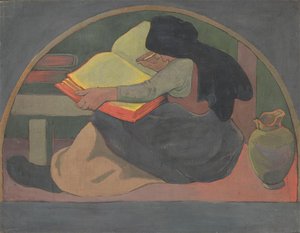
Paul Sérusier’s “Grammar,” painted in 1892, stands as a pivotal work not just within the artist's oeuvre but also as a foundational piece in the development of modern art. More than simply a portrait, it’s an intensely personal and experimental exploration of color, form, and the very nature of representation – a bold step towards abstraction that profoundly influenced generations of artists to come. The painting depicts a woman seated on the ground, absorbed in reading a book, a scene rendered with remarkable intimacy and a deliberate departure from traditional academic styles.
Sérusier’s artistic journey was deeply intertwined with the burgeoning Nabis movement, a group of Symbolist painters who sought to move beyond mere imitation of nature towards expressing inner emotions and spiritual truths. He initially studied at the Académie Julian, but it was his summer sojourn in Pont-Aven, Brittany, that proved transformative. There, under the tutelage of Paul Gauguin – a figure whose influence extended far beyond technique – Sérusier encountered the revolutionary approach of Cloisonnism, championed by Gauguin himself. This style, characterized by sharply defined outlines and areas of flat color applied in small, separate strokes, aimed to mimic the appearance of stained glass, creating a sense of luminous clarity and symbolic resonance.
Cloisonnism and the Language of Color
“Grammar” exemplifies this Cloisonnism technique with striking precision. The woman’s figure is not rendered through subtle gradations of tone but rather defined by bold, distinct outlines – a deliberate simplification that prioritizes color and form over meticulous detail. Sérusier employs a vibrant palette, dominated by deep blues, greens, and ochres, creating an atmosphere both serene and slightly melancholic. The colors aren’t blended; instead, they are applied in small, separate strokes, building up layers of hue and texture. This technique, combined with the flattened perspective, creates a sense of immediacy and directness, as if the painting is capturing a fleeting moment of contemplation.
Crucially, Sérusier’s use of color isn't merely descriptive; it carries symbolic weight. The blues evoke a sense of introspection and mystery, while the greens suggest connection to nature – a key theme in Symbolist art. The muted ochres contribute to the painting’s overall feeling of quietude and contemplation. The deliberate choice of colors, rather than realistic representation, is central to the work's expressive power.
A Study in Form and Abstraction
Beyond its technical mastery, “Grammar” represents a significant shift towards abstraction. While not entirely devoid of recognizable forms – the woman’s figure, the book, the surrounding objects – the painting prioritizes the exploration of color and form over strict representation. The simplified shapes, flattened perspective, and emphasis on pure color anticipate later developments in abstract art, foreshadowing the work of artists like Kandinsky and Mondrian. It's a deliberate move away from photographic realism towards a more subjective and expressive approach to visual language.
The painting’s title, “Grammar,” is particularly intriguing. It suggests that Sérusier was not simply depicting a scene but rather exploring the fundamental building blocks of artistic expression – the elements of color, line, and form – in a way that transcends traditional representation. The book itself becomes a symbol of knowledge and contemplation, inviting the viewer to engage with the painting on a deeper level.
Legacy and Inspiration
“Grammar” remains a vital work in the history of modern art, demonstrating Sérusier’s pioneering spirit and his profound influence on subsequent generations. It's a testament to the power of abstraction to convey emotion, ideas, and spiritual truths. Reproductions of this evocative painting continue to inspire artists and collectors alike, offering a glimpse into the heart of artistic innovation and the enduring quest for new forms of visual expression.
Perguntas e Respostas
Posso usar realidade aumentada para ver "The Grammar", de Paul Sérusier no meu ambiente?
Visualize "The Grammar", de Paul Sérusier na sua própria parede através da página de Prévia em RA da obra, utilizando realidade aumentada em um dispositivo compatível.
De que forma o estilo de "The Grammar" se relaciona com a época de seu criador?
"The Grammar", de Paul Sérusier insere-se no movimento Cloisonnism / Nabis, dentro da era Século XIX de seu criador.
Qual é a saturação e a intensidade de "The Grammar", de Paul Sérusier?
A cor de "The Grammar" apresenta Muted de saturação e Monochromatic de intensidade.
Quick facts and art quiz
About Paul Sérusier

Paul Sérusier
1864 - 1927, França
Biografia do Artista
Early Life and Artistic Foundations
Paul Sérusier, a pivotal figure in the evolution of modern art, was born on November 9th, 1864, in the heart of Paris. His early years were steeped in the cultural richness of the capital, yet his artistic journey began unexpectedly, far removed from the traditional avenues of formal training. Sérusier’s father, a successful businessman of Flemish descent involved in the perfume industry, envisioned a career for his son within the commercial world. However, young Paul harbored an undeniable passion for art, a desire that ultimately led him to abandon his family's expectations and pursue his artistic calling. He enrolled at the Lycée Condorcet, a prestigious secondary school renowned for its emphasis on philosophy and classical studies – an education that would subtly shape his later approach to art, imbuing it with intellectual depth and a nuanced understanding of form. It was during this period that he encountered Maurice Denis, a fellow student who would become a lifelong friend and collaborator, profoundly influencing Sérusier’s artistic development. The summer of 1888 marked a transformative moment in Sérusier's life: his journey to Pont-Aven, a small village nestled in the Breton countryside. This pilgrimage proved crucial, as it introduced him to a vibrant community of artists—Paul Gauguin, Emile Bernard, and others—who were challenging conventional artistic norms and experimenting with new ways of seeing and representing the world.The Nabis Movement and Pioneering Techniques
Pont-Aven became the epicenter of a groundbreaking artistic movement known as the Nabis (meaning “prophets” in Hebrew). Under the guidance of Paul Gauguin, Sérusier began to shed his earlier academic training and embrace a radically new approach to painting. Gauguin encouraged him to move beyond mere imitation of nature, urging him instead to capture the essence of his impressions—the feeling, the color, the emotion—rather than meticulously replicating visual details. This shift was further solidified by conversations with Emile Bernard, who introduced Sérusier to the principles of cloisonnism, a technique characterized by bold outlines and flat areas of color applied in distinct compartments, reminiscent of stained glass windows. This innovative approach, combined with Gauguin’s emphasis on simplification and symbolic representation, culminated in Sérusier's iconic painting, “The Talisman” (1888). This work stands as a seminal example of cloisonnism, pushing the boundaries of abstraction and foreshadowing the developments of later avant-garde movements. The painting’s seemingly simple composition—a depiction of a Breton landscape—is in fact a complex exploration of color, form, and symbolism, reflecting Sérusier's evolving artistic vision.Key Works and Artistic Evolution
Sérusier’s oeuvre is characterized by a remarkable fluidity and experimentation. Beyond “The Talisman,” he produced a series of paintings that demonstrate his ongoing exploration of color, line, and composition. "L'Averse" (1893) showcases his ability to capture the atmospheric effects of Breton weather, while "Portrait of Paul Ranson" (1890) reveals his interest in portraying human subjects with a sense of immediacy and psychological depth. “Melancholy” (1890), a hauntingly evocative work, exemplifies Sérusier’s capacity to convey complex emotions through subtle color harmonies and carefully constructed forms. Later in his career, Sérusier continued to refine his style, incorporating elements of synthetism—a technique that sought to reduce natural forms to their essential geometric components—and exploring the expressive potential of abstraction. His work during this period reflects a growing interest in spirituality and symbolism, drawing inspiration from Theosophical ideas and other esoteric traditions. Notably, Sérusier also served as an instructor at the École Ranson, founded by his fellow Nabi Paul Ranson, where he instilled his innovative approach to painting in a new generation of artists.Legacy and Historical Significance
Paul Sérusier’s contribution to the development of modern art is profound and multifaceted. He was not merely a follower of Gauguin; rather, he played a crucial role in shaping the direction of the Nabis movement and, more broadly, in paving the way for subsequent avant-garde movements such as Fauvism and Cubism. His pioneering use of cloisonnism—a technique that emphasized simplified forms and bold outlines—demonstrated a radical departure from traditional artistic conventions and opened up new possibilities for abstract expression. Sérusier’s emphasis on capturing the essence of impressions, rather than simply replicating visual reality, profoundly influenced his contemporaries and successors. His legacy extends beyond his individual paintings; he is remembered as a key figure in the intellectual and aesthetic ferment that characterized late 19th-century Paris—a period marked by experimentation, innovation, and a profound questioning of established artistic norms. Paul Sérusier passed away on October 7, 1927, leaving behind a body of work that continues to inspire and challenge viewers today.Quick facts about Paul Sérusier
- Artistic Movement Or Style: Pós-Impressionismo
- Artists Or Movements Influenced By This Artist: ['Nabis']
- Artists Who Influenced This Artist:
- Paul Gauguin
- Maurice Denis
- Date Of Birth: 9 de novembro de 1864
- Date Of Death: 7 de outubro de 1927
- Full Name: Louis-Paul-Henri Sérusier
- Nationality: Francês
- Notable Artworks:
- O Talismã
- L'Averse
- Place Of Birth: Paris, França
Obras Relacionadas




Explore obras de arte organizadas por temas, estilos e características.


Paul Sérusier
The Grammar
() ·
With its frame: · Hand-painted in oil on linen
Total