

 Previzualizare
 Trimite prin felicitare
 Distribuie
 Detalii despre lucrare
 Ghid
Ghid

 Descarcă imaginea
 Produse similare
 Radiografie
 Galerie foto
 Întrebări și răspunsuri
 Statistici
Extensive Landscape

- 15.0 x 44.0 cm


Experience Charles-François Daubigny’s ‘Extensive Landscape,’ an Impressionistic panorama of rolling hills and distant mountains rendered in earthy tones with loose brushstrokes – a tranquil masterpiece perfect for art lovers seeking a serene addition to their collection.
 Vezi mai mult
Descoperiți operele lui Charles-François Daubigny (1817-1878), un precursor al impresionismului și pictor de referință al Școlii de la Barbizon. Admirați peisaje evocatoare, lumină și atmosfera în ulei!
Giclée / Imprimare artistică
Printuri giclée sau pe canvas de calitate muzeală, cu proces de producție rapid și opțiuni flexibile de finisare. ( Comandă pictură realizată manual Comută pe Imagine Digitală)




P118B lei10

P118H lei10

P118W lei10

P438Z lei10

P508JH lei12

P508YH lei12

P805H lei10

P805Z lei10

P919BZ lei10

P919G lei10

P919XJ lei10

P959ZH lei10

P968JZ lei12

W106C lei8

W218G lei10

W218JH lei8

W218Y lei10

W307PJ lei10

W316G lei10

W316PJ lei8

W316Y lei10

W398PJ lei8

W4111J lei10

W500HY lei15

W500JH lei15

W692G lei12

W849H lei8

W940BG lei15

W953PJ lei8




Standard
personalizat
CM
INCH
Alegeți dintre dimensiunile noastre prestabilite, care respectă proporțiile originale ale operei de artă.
Loading sizes...

lățime
înălțime
Introduceți lățimea și înălțimea necesare pentru a se potrivi ramei sau peretelui dumneavoastră. O printare poate fi doar tăiată, niciodată extinsă dincolo de dimensiunea imaginii originale, astfel încât o dimensiune cu o formă diferită va pierde o parte din imagine. Vă trimitem o simulare digitală pentru aprobare înainte de a imprima orice. Imaginea afișată pe această pagină nu prezintă tăierea reală — doar simularea arată acest lucru.
Livrare în întreaga lume () în 2 săptămâni, în loc de cele 4/5 săptămâni standard. (7 Noiembrie)

Livrare expres gratuită la nivel mondial

Pânză de in de înaltă calitate

Asigurare completă pentru transport

Garanție de rambursare a taxelor vamale

Garanția fidelității culorilor

Politica de retur în 100 de zile (doar pentru defecte de fabricație)

Garanție de rambursare 100%

Ofertă pentru comenzi multiple
 Opțiunea cu sticlă este disponibilă doar pentru dimensiuni de sub 110 cm

Extensive Landscape
Giclée / Imprimare artistică
Dimensiune reproducere
-


Preț total calculat
lei 334
Charles-François Daubigny: Capturing Tranquility in ‘Extensive Landscape’
Charles-François Daubigny (1817–1878), a pivotal figure in the Barbizon school and considered a precursor to Impressionism, stands as an emblem of Romantic landscape painting. His artwork “Extensive Landscape,” housed at Hatchlands Park, exemplifies his masterful approach to portraying the grandeur and serenity of the French countryside—a pursuit deeply rooted in observation and emotion.
Daubigny’s artistic journey began with formal training under luminaries like Jean-Victor Bertin and Paul Delaroche, yet he swiftly rejected academic conventions, prioritizing direct engagement with nature. A transformative trip to Italy in 1836 instilled within him a profound appreciation for the expansive vistas of the Italian Alps—a fascination that would permeate his subsequent canvases. Returning to Paris, he established a vibrant artistic community alongside fellow painters like Henri Mignan and Hippolyte Lavoignat, fostering an environment conducive to experimentation and innovation.
The painting itself presents a panoramic view of rolling hills beneath a sky dappled with clouds—a scene meticulously rendered in oil paints on canvas. Daubigny’s technique is characterized by loose brushstrokes that prioritize capturing the overall impression of light and atmosphere, aligning perfectly with the burgeoning Impressionist movement. Visible impasto creates texture on the hillside surface, subtly hinting at foliage and conveying a palpable sense of materiality.
Color plays a crucial role in establishing mood and depth. The palette leans heavily into earthy tones—browns, greens, grays—reflecting the muted hues of the natural world. Warm shades dominate the foreground hill, contrasting with cooler blues and greys that delineate the distant mountains and sky. This deliberate use of color contributes to an overarching feeling of tranquility and contemplation.
Beyond its aesthetic beauty, “Extensive Landscape” embodies symbolic elements reflecting Daubigny’s Romantic sensibilities. The expansive horizon evokes a sense of awe at nature's immensity—a reminder of humanity’s place within the grand scheme of existence. Furthermore, Daubigny’s meticulous attention to detail and atmospheric perspective underscores his commitment to portraying reality as perceived by the senses, cementing his legacy as one of the most influential landscape painters of his era.
Inspired by artists like Gustave Courbet and influenced by Vincent van Gogh—who famously recreated Daubigny's Garden—the painting’s enduring appeal lies in its ability to transport viewers to a moment of serene contemplation amidst the beauty of the French countryside. It serves as an exquisite example of Impressionistic technique and artistic vision.
Întrebări și răspunsuri
În ce tehnică este realizată lucrarea "Extensive Landscape" de Charles-François Daubigny?
"Extensive Landscape" este realizat în Oil On Canvas."
Ce atmosferă ar aduce "Extensive Landscape" într-un spațiu?
Atmosfera Serene a operei "Extensive Landscape" de Charles-François Daubigny se potrivește perfect spațiului recomandat: un Living Room.
Unde pot găsi statistici despre "Extensive Landscape" de Charles-François Daubigny?
Statistici despre "Extensive Landscape" de Charles-François Daubigny se regăsesc pe pagina Statistici a operei de artă: vizitele lunare ale acesteia, vizitele lucrărilor artistului și distribuția pe țări și limbi pentru vizitatorii recenti.
Opere similare
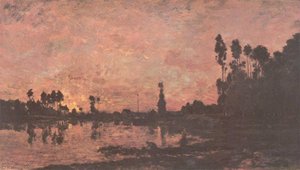


Biografie artist
A Pioneer of Atmospheric Impressionism: The Life and Art of Charles-François Daubigny
Charles-François Daubigny, born in Paris in 1817, emerged from a family deeply intertwined with the world of art—his father, Edmé François Daubigny, and uncle, Pierre Daubigny, both established painters. This familial legacy provided him with an early foundation, yet Charles quickly sought to forge his own distinctive path, moving beyond the constraints of academic tradition toward a more direct and intimate engagement with the natural world. His initial training under Paul Delaroche instilled in him valuable technical skills, but it was a transformative journey through Italy in 1836, undertaken independently alongside fellow artist Henri Mignan, that truly ignited his artistic vision. This experience profoundly shaped his perspective, fostering an appreciation for landscape not as idealized scenery, but as a vibrant, ever-changing entity—a living, breathing testament to nature’s power and beauty. Returning to Paris, Daubigny skillfully balanced commercial commissions – illustrating books and adorning decorative panels – with his burgeoning passion for *plein air* painting, a practice that would become the cornerstone of his artistic career. He found himself part of a thriving artistic community centered at the Rue des Amandiers-Popincourt, fostering collaboration and shared exploration of innovative approaches to art.The Barbizon Circle and the Embrace of Nature
Daubigny’s artistic trajectory took a decisive turn in 1843 when he settled in Barbizon, a small hamlet nestled within the heart of the Forest of Fontainebleau. This marked his formal association with the Barbizon School, a group of artists who deliberately rejected the polished, artificial aesthetic of academic painting, instead championing direct observation and honest representation of rural life and the landscape. Unlike earlier landscape painters who often sketched outdoors before completing their works in the studio, the Barbizon artists – including Théodore Rousseau, Jean-François Millet, and Camille Corot – embraced *en plein air* painting as a fundamental principle. Daubigny’s friendship with Corot proved particularly influential; together they spent countless hours exploring the forests of Fontainebleau, meticulously capturing the subtle nuances of light, shadow, and atmosphere—a shared dedication to rendering nature's ephemeral qualities. A unique aspect of Daubigny’s practice was his invention of the “Botin,” a specially designed boat that he utilized to navigate the rivers – primarily the Seine and the Oise – allowing him unparalleled access to diverse landscapes and fostering an incredibly intimate connection with the natural world. This mobile studio became inextricably linked to his artistic process, symbolizing his commitment to painting directly from life and experiencing nature firsthand.A Bridge Between Realism and Impressionism
Daubigny’s work occupies a fascinating and somewhat ambiguous position within 19th-century art history—he can be considered both a key figure of the Barbizon School and a crucial precursor to the burgeoning Impressionist movement. While firmly rooted in the Barbizon tradition's emphasis on faithful representation and sincerity, his paintings increasingly demonstrated an awareness of fleeting moments, subjective perception, and atmospheric effects – qualities that would later become hallmarks of Impressionism. He experimented with innovative techniques such as *cliché verre*, a process combining photography and printmaking, showcasing a willingness to embrace new technologies and artistic possibilities. His landscapes are characterized by broad, loose brushstrokes, a muted color palette, and a deliberate focus on capturing the transient qualities of light and weather. Paintings like “Harvest” (1857) and “The Ponds of Gylieu” (1864) exemplify his ability to evoke mood and atmosphere, transporting the viewer into the very heart of the French countryside. He wasn’t simply recording what he saw; he was conveying *how* it felt to be present in that moment—the scent of damp earth, the warmth of the sun, the rustle of leaves.Notable Works and Lasting Influence
Charles-François Daubigny left behind a substantial body of work that continues to captivate viewers today. His most celebrated paintings include “Harvest” (1857), a vibrant depiction of rural life bathed in golden light; "The Ponds of Gylieu" (1864), showcasing his mastery of landscape and atmospheric perspective; “Moonlight” (1865), a hauntingly beautiful portrayal of nocturnal scenes with subtle shifts in light; and “Auvers-sur-Oise” (1868), a captivating depiction of the French countryside. Beyond these individual works, Daubigny’s influence extended far beyond his immediate circle of students – including his son, Karl, Achille Oudinot, and Hippolyte Camille Delpy – inspiring generations of landscape painters to embrace *plein air* painting and prioritize direct observation. He played a pivotal role in fostering connections between the Barbizon School and the nascent Impressionist movement, introducing artists like Claude Monet and Paul Cézanne to new ways of seeing and representing the world. Daubigny’s commitment to capturing the essence of nature, his innovative techniques, and his willingness to experiment cemented his place as a pivotal figure in the transition from realism to modern art—a true pioneer whose legacy continues to resonate within the realm of landscape painting. His paintings are now treasured possessions in museums across Europe, offering a glimpse into the soul of 19th-century France.A Final Note
Daubigny’s life and work were marked by a deep love for nature and an unwavering dedication to his artistic vision. He died in Paris in 1878, leaving behind a rich artistic legacy that continues to inspire artists and art lovers alike. His paintings serve as a reminder of the power of observation, the beauty of the natural world, and the enduring spirit of innovation within the realm of art.
Charles-François Daubigny
1817 - 1878 , Franța
Detalii rapide
- Artistic Movement Or Style: Școala de la Barbizon, Impressionism
- Artists Or Movements Influenced By This Artist:
- Impressionism
- Barbizon
- Artists Who Influenced This Artist:
- Corot
- Courbet
- Date Of Birth: 15 Feb 1817
- Date Of Death: 19 Feb 1878
- Full Name: Charles-François Daubigny
- Nationality: Francez
- Notable Artworks:
- Harvest (1857)
- Pontișor Gylieu (1864)
- Lumină (1865)
- Auvers-sur-Oise (1868)
- Place Of Birth: Paris, Franța
Articole similare

Beyond the Light: Capturing Raw Emotion and Subjective Vision in Post-Impressionist Landscapes
Explore the profound emotional depth of Post-Impressionist landscapes. Discover how masters like Van Gogh moved beyond light to capture raw human feeling through vibrant color and expressive texture in this expert art history retrospective.
Golden Fields & Sun-Drenched Meadows: Capturing the Soul of Impressionist Landscapes
Immerse yourself in the luminous world of Impressionist landscapes. Discover how masters like Monet and Gauguin captured ephemeral light through plein air painting, and learn to bring the soul of sun-drenched meadows into your home with exquisite, hand-painted oil reproductions.

Capturing the Soul: The Most Emotionally Moving Impressionist and Post-Impressionist Masterpieces
Discover the profound emotional depth of Impressionist and Post-Impressionist masterpieces. Explore how legends like Monet, Van Gogh, and Gauguin captured light and soul through evocative landscapes and vibrant brushwork for a timeless connection to art history.

The Beauty of Impermanence: Capturing Decay through Impressionist Eyes
Explore the profound beauty of impermanence through Impressionist and Post-Impressionist eyes. Discover how masters like Monet and Van Gogh captured fleeting light and the poetic essence of nature's transitions in our deep dive into art history and emotional landscapes.

The Timeless Charm of Oil on Board: Reimagining Texture and Light through the Impressionist Lens
Discover the profound intimacy of oil on panel. Explore how Impressionist masters used rigid supports to capture light, texture, and impasto depth through exquisite, handmade oil reproductions for discerning collectors.
Explorați opere de artă organizate pe teme, stiluri și caracteristici.


