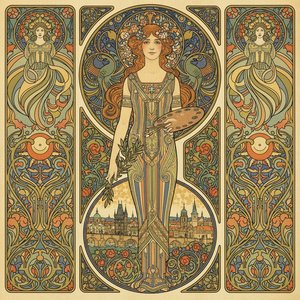
Eugène Gaillard: The Sculptor of Organic Forms
Eugène Gaillard (1862–1933) was a French Art Nouveau designer, architect and advocate of modern design. He abandoned a career in law for that of interior design and decoration. He was employed for some time by Siegfried Bing along with Georges de Feure and Edouard Colonna to work on his pavilion at the 1900 Paris Universal Exposition. Gaillard’s artistic vision stemmed from a fascination with nature, specifically the flowing lines of vines, flowers, and water lilies—elements that would become central to his distinctive sculptural style. This preoccupation wasn't merely aesthetic; it reflected a broader philosophical belief in harmony between humanity and the natural world, a sentiment deeply ingrained within the Art Nouveau movement itself.- Early Life & Education: Born in Paris in 1862, Gaillard received a legal education but quickly realized his passion lay elsewhere—in crafting beautiful objects that celebrated organic forms.
- Collaboration with Siegfried Bing: His association with Bing was pivotal to establishing Art Nouveau’s influence on Parisian design. Together they explored innovative materials and techniques, pushing the boundaries of conventional craftsmanship.
- The Pavilion at the Paris Exposition Universelle (1900): Gaillard's involvement in the Universal Exposition showcased his talent as an architect and designer, cementing his reputation as a pioneer of modern aesthetics. The pavilion’s intricate sculptural decorations embodied his signature style—a masterful blend of natural motifs and refined artistry.
Sculptural Style & Technique: Whiplash Line & Luxurious Materials
Gaillard's sculptures are instantly recognizable for their “whiplash line”—a dynamic curve that mimics the movement of plant stems—a technique he perfected to convey fluidity and vitality. He skillfully utilized rare and expensive woods like ebony and rosewood, combined with veneers crafted from exotic materials such as alabaster and ivory. These choices weren’t simply matters of taste; they represented a deliberate effort to elevate craftsmanship and create objects of unparalleled beauty and prestige. Gaillard's meticulous attention to detail—polished surfaces, intricate carving, and masterful gilding—transformed ordinary materials into extraordinary works of art.- Emphasis on Organic Forms: Gaillard’s sculptures prioritized flowing lines and undulating curves, mirroring the rhythms of nature.
- Material Choices & Craftsmanship: He favored luxurious veneers and employed advanced polishing techniques to achieve a luminous finish that accentuated the sculptural form.
Notable Works & Legacy
Gaillard’s furniture designs—particularly his cabinets and consoles—became iconic examples of Art Nouveau elegance. Pieces like the “Cabinet” exhibited at the Paris Exposition Universelle exemplify his ability to synthesize architectural principles with decorative artistry. His influence extended beyond furniture; he designed buildings, including Château Gaillard in Normandy, demonstrating his versatility as an architect. Furthermore, Gaillard’s work inspired subsequent generations of designers and artists who embraced organic forms and refined craftsmanship—a testament to his enduring contribution to the artistic landscape of the late 19th century.- Château Gaillard: A monumental castle ruin overlooking the Seine, showcasing Gaillard's architectural prowess.
- Furniture Designs: His cabinets and consoles are celebrated for their sculptural elegance and masterful craftsmanship.
Influence & Artistic Context
Gaillard’s artistic sensibilities aligned perfectly with the broader currents of Art Nouveau, a movement characterized by its rejection of industrial uniformity and its celebration of beauty derived from natural forms. He stood alongside luminaries like Alphonse Mucha and Gustav Klimt, sharing a commitment to creating art that transcended mere decoration—aiming instead for an immersive experience that engaged both intellect and emotion. Gaillard’s legacy continues to resonate today, reminding us of the transformative power of artistic vision and the enduring allure of handcrafted excellence.Вопросы и ответы
Где можно найти работы Eugène Gaillard, сгруппированные по ключевым словам?
Работы Eugène Gaillard можно найти по ключевым словам на странице художника По ключевым словам. Каждое ключевое слово объединяет соответствующие произведения искусства.
Где можно найти работы Eugène Gaillard, распределенные по цветам?
Страница Спектральный индекс художника Eugène Gaillard позволяет просматривать его работы, распределенные по цветам.
Где я могу посмотреть работы Eugène Gaillard, подобранные по настроению?
На странице Подбор по настроению художника Eugène Gaillard произведения автора распределены по настроению.
Как я могу проследить творческий путь Eugène Gaillard по годам?
На странице Хронология работ представлены работы Eugène Gaillard, упорядоченные по датам, год за годом.