

Shown: · With its frame:
 Náhľad v interiéri
 Odoslať ako digitálnu kartu
 Zdieľať
 Podrobnosti o dielo
 Príručka

 Stiahnuť obraz
 Podobné položky
 RTG skúška
 Prehliadanie diapozoje
 Q&A
Q&A Štatistiky

€ 239
Ručne maľovaná olejová reprodukcia
Ručne maľovaný olej na plátne vo vašej zvolenej veľkosti a v ráme, vyrobený na mieru našimi umelcami. ( Prepnúť na tlač Prepnúť na digitálny obraz)
Size
·Štandardné
na mieru
CM
INCH
Vyberte si z našich preddefinovaných rozmerov, ktoré zodpovedajú pôvodným pomeroḿ diela.
Loading sizes...

šírka
výška
Zadajte šírku a výšku, ktoré potrebujete, aby sa dielo hodilo k vášmu rámu alebo stene. Keďže ide o ručnú maľbu, pri rozmeroch s odlišným pomerom strán môže umelec namalovať o niečo viac okolo obrázka alebo ho mierne orezatú — výber patrí vám. Pred začatím maľovania vám pošleme digitálnu ukážku na schválenie. Obrázok zobrazený na tejto stránke nenahrádza reálny výsledok — ten zobrazuje iba digitálna ukážka.
 Zobraziť viac
Finish
·
White €1

Blurside €1

Extended €1

P118B €10

P118H €10

P118W €10

P438Z €10

P508JH €12

P508YH €12

P805H €10

P805Z €10

P919BZ €10

P919G €10

P919XJ €10

P959ZH €10

P968JZ €12

W106C €8

W218G €10

W218JH €8

W218Y €10

W307PJ €10

W316G €10

W316PJ €8

W316Y €10

W398PJ €8

W4111J €10

W500HY €15

W500JH €15

W692G €12

W849H €8

W940BG €15

W953PJ €8

H24-GOLD €30

H24-SILVER €30

H36-GOLD €45

H36-SILVER €45
Shipped in a protective tube, ready for your own framer.
Above 105 cm the frame is shipped as a kit for a professional framer — read the details.
Extras
optionalWhat do the extras include?
Examples of what can be changed: Replace face with customer photo; Add pet (e.g., replace cat with dog); Include hidden message in background; Change background landscape or elements.
After order, TopImpressionists.com team will email client for instructions and provide a mockup preview
After order, TopImpressionists.com team will email client for instructions and provide a mockup preview
Celosvetová doprava () za 3 až 4 týždne namiesto štandardných 5 týždňov. (31 október). Bez kompromisov v kvalite.
Ochranný lak
Popisné označenie
Detaily vygravírovaného bronzového pláka
This elegant plaque features the artist's name and the title of the artwork, finely engraved for a timeless presentation.
It is made from bronze with a refined, elegant finish. The text is precisely laser-engraved for a sharp and permanent result. Measuring 9x2 cm, the plaque is compact yet easy to read. It's built to be durable and scratch-resistant, offering a professional, museum-quality look. Mounting is simple thanks to the included adhesive backing.
Detaily transparentnej akrylovej plăty
The plaque includes essential engraved details such as the artist's name, the title of the artwork, the date it was created, the type of media used-like oil on canvas or watercolor-a brief description of the piece, and a QR code that links to the complete artwork information.
It is crafted from clear acrylic, offering a sleek, modern appearance. The text is UV-engraved in black to ensure strong visual contrast. With a size of 10x15 cm, it ensures optimal readability. It comes equipped with two metal hooks for secure wall mounting. The plaque is designed to be weather-resistant, making it suitable for various environments, and it includes interactive features that work seamlessly with smartphone scanning.
Detaily čiernej akrylovej plăty
This elegant plaque includes engraved information such as the artist's name, the title of the artwork, the date it was created, the type of media used (like oil on canvas or watercolor), a short description of the artwork, and a QR code for quick access to more information.
The plaque itself is made from refined black acrylic with a premium finish. The text is laser-engraved in white for high contrast and readability. Its size is 10x15 cm, designed to be easy to read. It comes with two metal hooks for professional mounting. The design is sleek and fits any interior style. It is also weather-resistant and durable, with built-in digital integration for mobile compatibility.
Možnosť skla je dostupná len pri rozmeroch pod 110 cm
 Možnosť skla je dostupná len pri rozmeroch pod 110 cm
- Bezplatná expresná doprava po celom svete
- Vysokokvalitné lnianske plátno
- Kompletné poistenie prepravy
- Záruka vrátenia colného poplatku
- Záruka presného farebného zhodnutia
- 100-dená politika vrátenia tovaru (iba pri vadách)
- 100% záruka vrátenia peňazí
- Zľava pri väčšom množstve


Popis zberateľského predmetu
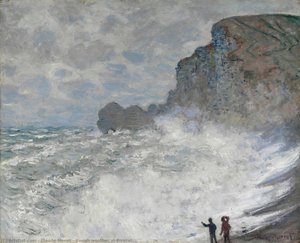
Experience Claude Monet's 'Stormy Seascape' (1883). Captivating waves crash against the shore, showcasing Impressionism’s power & beauty. Own a stunning hand-painted reproduction.
Biografia umelca
Objavte svet Clauda Moneta, majstra impresionizmu, známeho zachytávaním prchavého svetla a farieb prostredníctvom ikonických krajín, ako sú Vodné lisy a Seny.
About the painting
A Tempestuous Vision: Claude Monet’s “Stormy Seascape”
Claude Monet's "Stormy Seascape," painted in 1883, isn’t merely a depiction of the ocean; it’s an immersive experience. This captivating work, housed within the collection of TopImpressionists and available as a meticulously hand-painted reproduction, transports us to the rugged coast of Normandy, where the raw power of nature collides with the quiet contemplation of human observers. Monet, a pivotal figure in the Impressionist movement, wasn't interested in precise representation but rather in capturing the *feeling* of a scene – the fleeting light, the shifting atmosphere, and the emotional resonance of a moment. “Stormy Seascape” exemplifies this philosophy brilliantly, offering a glimpse into Monet’s artistic process and his profound connection to the natural world.
The painting immediately draws the eye to the dynamic interplay of water and sky. Two figures stand on the shoreline, dwarfed by the immense waves that relentlessly crash against the rocks below. They are not heroic adventurers battling the elements; rather, they appear absorbed in a shared moment of observation, suggesting a sense of tranquility amidst the chaos. This deliberate choice – the juxtaposition of human presence with overwhelming nature – is central to the painting’s emotional impact. It invites us to consider our own relationship with the forces beyond our control, and the solace we can find in simply witnessing their grandeur.
Impressionism at its Finest: Light, Color, and Brushstroke
Monet's signature Impressionistic style is vividly displayed in “Stormy Seascape.” He abandons traditional techniques of precise detail and linear perspective, opting instead for a broken application of color and loose, visible brushstrokes. The waves aren’t rendered as solid forms but as shimmering masses of blues, greens, and whites – an explosion of pigment that conveys their movement and energy with remarkable immediacy. Notice how Monet uses short, choppy strokes to depict the foam cresting on the waves, creating a sense of constant motion. Similarly, the sky is fragmented into patches of gray and blue, suggesting the turbulent weather conditions.
Crucially, Monet wasn’t simply recording what he *saw*; he was capturing how light interacts with the scene. The painting is bathed in a diffused, atmospheric glow, characteristic of Impressionist works. This effect is achieved through layering colors and allowing them to blend optically – creating an illusion of depth and luminosity without resorting to traditional shading techniques. The overall impression isn’t one of sharp clarity but rather of hazy, evocative beauty.
A Historical Context: Seascapes and the Romantic Ideal
Monet's fascination with seascapes wasn’t a singular event; it was part of a broader artistic trend during the 19th century. The sea had long held a powerful allure for artists, representing both the sublime beauty and the terrifying indifference of nature. Romantic painters like Caspar David Friedrich often depicted solitary figures confronting vast landscapes, exploring themes of human insignificance in the face of overwhelming forces. Monet, however, moved beyond this purely melancholic interpretation, focusing instead on capturing the *experience* of being present in a dramatic natural setting.
His choice to depict two people observing the storm is particularly significant. It echoes the Romantic tradition of shared experience and communion with nature, but also subtly suggests a modern sensibility – an appreciation for beauty even amidst adversity. The figures are not overwhelmed by the storm; they seem to find a sense of peace and connection within it.
Reproductions: Bringing Monet’s Vision Home
TopImpressionists is proud to offer meticulously crafted, hand-painted oil reproductions of “Stormy Seascape,” allowing you to bring this iconic artwork into your own home. Each reproduction faithfully captures the nuances of Monet's brushwork and color palette, ensuring that you experience the painting’s emotional depth and visual beauty firsthand. These aren’t simply copies; they are artistic interpretations created by skilled artisans who share a deep appreciation for Monet’s legacy.
For those seeking to delve deeper into Monet’s life and work, we encourage you to explore related reproductions on TopImpressionists, including “Stormy Weather at Etretat,” and to visit the National Gallery of Victoria in Melbourne, Australia, where these masterpieces are proudly displayed. You can also find further information about Claude Monet's artistic journey on Wikipedia: Claude Monet on Wikipedia.
Otázky a odpovede
Aká veľkosť tlače diela „Stormy Seascape“ od Claude Monet sa hodí do odporúčanej miestnosti?
Pre miestnosť typu Obývací izba sa pre dielo „Stormy Seascape“ odporúča veľkosť tlače Veľký formát.
Ako si môžem pozrieť náhľad reprodukcie diela „Stormy Seascape“ od Claude Monet?
Stránka s náhľadom diela „Stormy Seascape“ (Náhľad diela) vám umožňuje prezrieť si umelostné dielo ešte pred objednávkou.
Aká je dominantná farba diela „Stormy Seascape“ od Claude Monet?
„Stormy Seascape“ skloní sa k Spektrum od zelenej po fialovú odtieňu.
Quick facts and art quiz
About Claude Monet

Claude Monet
1840 - 1926, Francúzsko
Biografia umelca
Život ponorený do svetla: Svet Clauda Moneta
Oscar-Claude Monet, meno neoddeliteľne spojené s impresionizmom, nebol len maliar krajín; bol kronikárom prchavých okamihov, básnikom svetla a farieb. Narodil sa v Paríži 14. novembra 1840 roku, no jeho raný život nabral nečakaný smer, keď sa jeho rodina v pięťich rokoch presťahovala do Le Havre v Normandii. Hoci ho otec pôvodne zamýšľal pripraviť na obchodnú dráhu, mladý Claude rýchlo odhalil svoj vrodený umelecký talent, ktorý sa najprv prejavil uhľovými karikatúrami predávanými miestne – čo bolo svedectvom nielen jeho zručnosti, ale aj podnikateľského ducha. Avšak kľúčovým momentom bolo stretnutie s Eugénom Boudinom. Boudin Moneta nenaučil len to,
Monetova formálna príprava začala v Paríži, krátko na Académie Suisse a neskôr u Charlesa Gleyra. Práve tu nadviazal trvalé priateľstvá s kolegami umelcami, ako bol Auguste Renoir, čo bol vzťah založený na zdieľaných umeleckých frustráciách a túžbe vybojovať si slobodu od obmedzení tradičného akademického maliarstva. Jeho rané práce, hoci prejavovali technickú zručnosť, ešte nemali ten výrazný hlas, ktorý by jeho štýl neskôr charakterizoval. Následovalo obdobie nepokoja – francúzsko-pruská vojna prinútila Moneta hľadať útočisko v Londýne, kde sa ponorel do tvorby anglických majstrov krajinnej maľby, ako bol J.M.W. Farison, a začal osvojiť ich atmosférické efekty a inovatívne využitie farieb.
Zrod estetickej revolúcie
Po návrate do Francúzska sa Monet stal centrálnou postavou rodiacej sa umeleckej rebélie. Neuspokojený konzervatívnymi štandardmi Salonu, spojil sily s ďalšími rovnomyšliennymi umelcami, aby organizoval nezávislé výstavy. Výstava z roku 1874 sa ukázala ako zlomový moment nielen pre Moneta, ale pre celý svet umenia. Práve tu bola vystavená jeho maľba „Impression, soleil levant“ (Impression, východ slnka) – zastretá zobrazenie prístavu v Le Havre za úsvitu – z ktorej vznikol i urážlivý výraz „impresionizmus“. Názov však pretrval a vyvinul sa do znamenia ctnosti pre hnutie, ktoré sa snažilo zachytiť subjektívny
Monetov charakteristický štýl v tomto období rozkvitol: voľné, viditeľné ťahy štetcom, živé a často nemiešané farby nanázané vedľa seba (technika známa ako „rozbitá farba“) a neúprosná zameranosť na zachytenie pomíjavých vlastností svetla. Neúnavne sa venoval svojej praxi
Giverny: Raj svetla a odrazov
V roku 1883 sa Monet usadil v Giverny, na severozápade od Paríža, kde si vytvoril dom a záhradu, ktoré sa stali jeho svätyštím aj najväčším zdrojom inšpirácie. S nesmiernou dôraznosťou premenil tento majetok na vznešený raj plný exotických kvetov, vŕb a, čo je najslávnejšie, jazera s vodnými laliami, ktoré pretína japonský most. Nešlo len o dekoratívnu záhradu; bol to živý laboratórny priestor, kde sa Monet mohol pod kontrolovanými podmienkami skúmať vplyv svetla na vodu, lístie a odrazy.
Posledné desaťročia jeho života boli takmer úplne zasadené do maľovania jazera s vodnými laliami v Giverny. Vydal sa na tvorbu monumentálnej série Vodné lalie (Nymphéas), kde vytváral obrovské plátna zobrazujúce hladinu jazera ako neustále sa meniace tkanivo farieb a svetla. Neboli to len maľby kvetov; boli to imerzívne zážitky, navrhnuté tak, aby diváka pohltili svetom pokojnej krásy a kontemplatívneho ticha. Rozsah týchto diel je dychberúci, posúva hranice tradičnej maľby a predz ná mestý abstraktný expresionizmus.
Odkaz: Trvalý dopad na dejiny umenia
Dopad Clauda Moneta na dejiny umenia je neúmerný. Nebol len zakladateľom impresionizmu; zásadne zmenil spôsob, akým umelci vnímajú a predstavujú svet okolo nich. Jeho dôraz na subjektívnu skúsenosť, prijatie maľovania
Monet dosiahol počas svojho života značný komerčný úspech – čo bolo pre avantgardných umelcov jeho éry vzácne. Jeho dielo naďalej vyvoláva úžas a očaruje divákov po celom svete, čím si upevnil svoje miesto medzi najdôležitejšie postavy západného umenia. Zomrel 5. decembra 1926 a zanechal po sebe odkaz, ktorý rezonuje naprieč generáciami umelcov aj milovníkov umenia. Významné zbierky jeho majstrovských diel sú uchovávateľné v prestížnych inštitúcie, ako je Musée d'Orsay a Musée Marmottan Monet v Paríži, čo zabezpečuje, že jeho vízia bude naďalej osviecať svet.
Kľúčové umelecké techniky
- <Maľba en plein air: Kľúčová pre jeho vývoj, umožňujúca priamu pozorovanie svetla a atmosféry.
- <Rozbitá farba: Nanášanie malých ťahov čistej farby vedľa seba pre optické miešanie.
- <Sériové maľovanie: Zobrazovanie rovnakého predmetu za odlišných svetelných a poveternostných podmienok – demonštrácia transformatívnej sily času a svetla.
Quick facts about Claude Monet
- Artistic Movement Or Style: Impresionizmus
- Artists Or Movements Influenced By This Artist: ['Moderné umenie']
- Artists Who Influenced This Artist:
- Eugène Boudin
- J.M.W. Turner
- Date Of Birth: 14. november 1840
- Date Of Death: 5. december 1926
- Full Name: Oscar-Claude Monet
- Nationality: Francúz
- Notable Artworks:
- Impresia, východ slnka
- Vodné ľalie
- Senožety
- Rouenská katedrála
- Place Of Birth: Paríž, Francúzsko
Podobné diela




Preskúmajte umelecká diela usporiadané podľa tém, štýlov a charakteristík.


Claude Monet
Stormy Seascape
() ·
With its frame: · Hand-painted in oil on linen
Total