

Zobrazené: · Včetně rámov:
 Náhľad v interiéri
 Odoslať ako digitálnu kartu
 Zdieľať
 Podrobnosti o dielo
 Príručka

 Stiahnuť obraz
 Podobné položky
 RTG skúška
 Prehliadanie diapozoje
 Otázky a odpovede
 Štatistiky
- 340.0 x 378.0 cm


€ 239
Ručne maľovaná olejová reprodukcia
Ručne maľovaný olej na plátne vo vašej zvolenej veľkosti a v ráme, vyrobený na mieru našimi umelcami. ( Prepnúť na tlač Prepnúť na digitálny obraz)
Veľkosť
·Štandardné
na mieru
CM
INCH
Vyberte si z našich preddefinovaných rozmerov, ktoré zodpovedajú pôvodným pomeroḿ diela.
Načítavanie veľkostí...

šírka
výška
Zadajte šírku a výšku, ktoré potrebujete, aby sa dielo hodilo k vášmu rámu alebo stene. Keďže ide o ručnú maľbu, pri rozmeroch s odlišným pomerom strán môže umelec namalovať o niečo viac okolo obrázka alebo ho mierne orezatú — výber patrí vám. Pred začatím maľovania vám pošleme digitálnu ukážku na schválenie. Obrázok zobrazený na tejto stránke nenahrádza reálny výsledok — ten zobrazuje iba digitálna ukážka.
 Zobraziť viac
Dokončenie
·
Biele okraje €1

rozostrené okraje €1

Vytiahnutý okraj €1

P118B €10

P118H €10

P118W €10

P438Z €10

P508JH €12

P508YH €12

P805H €10

P805Z €10

P919BZ €10

P919G €10

P919XJ €10

P959ZH €10

P968JZ €12

W106C €8

W218G €10

W218JH €8

W218Y €10

W307PJ €10

W316G €10

W316PJ €8

W316Y €10

W398PJ €8

W4111J €10

W500HY €15

W500JH €15

W692G €12

W849H €8

W940BG €15

W953PJ €8

H24-GOLD €30

H24-SILVER €30

H36-GOLD €45

H36-SILVER €45
Dodávané v ochrannom tubuse, pripravené na vlastné orezanie a paspartu u vášho kaderníka.
Dodatkové služby
voliteľnéČo si všetko zahŕňajú extra položky?
Príklady toho, čo je možné zmeniť: nahradenie tváre fotkou zákazníka; pridanie domáceho miláčika (napr. nahradenie mačky psom); začlenenie skrytého správy do pozadia; zmena krajiny alebo prvkov v pozadí.
Po objednávke vám tím TopImpressionists.com pošle e-mail s pokynmi a poskytne náhľad návrhu
Po objednávke vám tím TopImpressionists.com pošle e-mail s pokynmi a poskytne náhľad návrhu
Celosvetová doprava () za 3 až 4 týždne namiesto štandardných 5 týždňov. (4 november). Bez kompromisov v kvalite.
Ochranný lak
Popisné označenie
Detaily vygravírovaného bronzového pláka
This elegant plaque features the artist's name and the title of the artwork, finely engraved for a timeless presentation.
It is made from bronze with a refined, elegant finish. The text is precisely laser-engraved for a sharp and permanent result. Measuring 9x2 cm, the plaque is compact yet easy to read. It's built to be durable and scratch-resistant, offering a professional, museum-quality look. Mounting is simple thanks to the included adhesive backing.
Detaily transparentnej akrylovej plăty
The plaque includes essential engraved details such as the artist's name, the title of the artwork, the date it was created, the type of media used-like oil on canvas or watercolor-a brief description of the piece, and a QR code that links to the complete artwork information.
It is crafted from clear acrylic, offering a sleek, modern appearance. The text is UV-engraved in black to ensure strong visual contrast. With a size of 10x15 cm, it ensures optimal readability. It comes equipped with two metal hooks for secure wall mounting. The plaque is designed to be weather-resistant, making it suitable for various environments, and it includes interactive features that work seamlessly with smartphone scanning.
Detaily čiernej akrylovej plăty
This elegant plaque includes engraved information such as the artist's name, the title of the artwork, the date it was created, the type of media used (like oil on canvas or watercolor), a short description of the artwork, and a QR code for quick access to more information.
The plaque itself is made from refined black acrylic with a premium finish. The text is laser-engraved in white for high contrast and readability. Its size is 10x15 cm, designed to be easy to read. It comes with two metal hooks for professional mounting. The design is sleek and fits any interior style. It is also weather-resistant and durable, with built-in digital integration for mobile compatibility.
Možnosť skla je dostupná len pri rozmeroch pod 110 cm
 Možnosť skla je dostupná len pri rozmeroch pod 110 cm
- Bezplatná expresná doprava po celom svete
- Vysokokvalitné lnianske plátno
- Kompletné poistenie prepravy
- Záruka vrátenia colného poplatku
- Záruka presného farebného zhodnutia
- 100-dená politika vrátenia tovaru (iba pri vadách)
- 100% záruka vrátenia peňazí
- Zľava pri väčšom množstve


Popis zberateľského predmetu
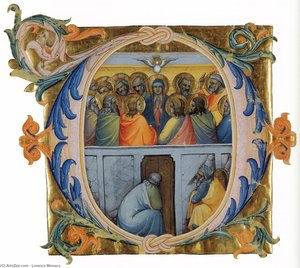
Lorenzo Monaco's 'Antiphonary Folio' (1396) showcases stunning illuminated details of a religious scene, reflecting the monk’s artistic vision and early Renaissance style.
Biografia umelca
Lorenzo Monaco (1370–1425) bol sienenský maliar a iluminátor vrcholného gotiky, ktorý preradil cestu k renesansu. Poznáte jeho duchovné výtvory, iluminované rukopisy a jedinečný štýl?
O tomto obraze
A Monastic Vision: Lorenzo Monaco’s Antiphonary Page
Within the hallowed halls of the Biblioteca Laurenziana in Florence resides a fragment of extraordinary beauty – a page from Lorenzo Monaco's Antiphonary, dating back to 1396. More than just a liturgical manuscript illumination, this piece offers a profound glimpse into the artistic and spiritual world of late medieval Italy, revealing the quiet intensity and contemplative nature of a Camaldolese monk’s vision. It is a testament to a time when art served not merely as decoration but as a conduit for faith, meticulously crafted with tempera and gold on parchment – materials that themselves speak volumes about the piece's value and enduring quality.
The image itself depicts a scene of profound significance: Pentecost. Monaco masterfully captures the moment when the Holy Spirit descends upon the apostles, transforming them into witnesses to Christ’s resurrection. The composition is remarkably balanced, despite the dense grouping of figures within the oval initial. A carefully constructed architectural setting – a simple house with an open doorway – provides a grounding element, while the vibrant colors—a rich palette dominated by reds, blues, and golds—create a luminous atmosphere that seems to radiate divine light. Notice particularly the subtle use of perspective; though not adhering to the emerging principles of linear perspective, Monaco skillfully employs atmospheric shading and spatial relationships to create a sense of depth and realism within the confines of the illuminated initial.
The Monk-Artist: Lorenzo Monaco’s Unique Style
Lorenzo Monaco's identity as a monk profoundly shaped his artistic practice. Born Piero di Giovanni around 1370 in Siena, he entered the Camaldolese order at Santa Maria degli Angeli and dedicated his life to prayer and illumination. This monastic commitment instilled within him a distinctive style characterized by a restrained palette, elongated figures, and a profound sense of introspection. Unlike the more flamboyant styles prevalent during the period, Monaco’s work possesses a quiet dignity and emotional restraint—a reflection of the contemplative life he led.
His artistic journey began under the tutelage of masters like Giotto, Spinello Aretino, and Agnolo Gaddi in Florence. However, it was his embrace of monasticism that truly defined him as “Lorenzo Monaco,” or “Lawrence the Monk.” This dedication to a life of contemplation profoundly influenced the character of his work, imbuing it with an introspective quality rarely found in secular art of the time. He wasn’t simply replicating religious scenes; he was translating spiritual experience into visual form, creating images that resonated with a deep sense of faith and humility.
Symbolism and Spiritual Resonance
The Antiphonary page is replete with symbolic details that enrich its meaning. The figures themselves—the Virgin Mary, the apostles, and the two onlookers—represent key elements of Christian theology and narrative. The presence of Matthias, chosen to replace Judas, subtly underscores themes of redemption and forgiveness. The architectural setting, a humble dwelling, symbolizes the arrival of grace in an ordinary space. The birds scattered throughout the scene are often interpreted as symbols of the Holy Spirit, further emphasizing the central event depicted.
Beyond these specific symbols, the entire page exudes a sense of spiritual resonance. The muted colors and elongated figures create a dreamlike atmosphere, inviting viewers to contemplate the mysteries of faith. The careful attention to detail—from the folds of the drapery to the expressions on the faces—demonstrates Monaco’s mastery of his craft and his deep understanding of the subject matter. It's not merely a depiction of an event; it is an invitation into a sacred space, a moment of quiet contemplation within the heart of faith.
A Legacy of Monastic Art
Lorenzo Monaco’s Antiphonary page stands as a remarkable example of monastic art—a testament to the enduring power of faith and beauty. Its creation reflects the artistic priorities of the Camaldolese order, where illumination was not simply an embellishment but a vital component of liturgical worship. The piece's survival through centuries speaks to its quality and significance, offering us a rare glimpse into the creative spirit of a dedicated monk-artist who sought to capture the essence of faith in his art.
Otázky a odpovede
Kde môžem kúpiť ručne maľovanú reprodukciu diela „Antiphonary (Cod. Cor. 1, folio 111v)“ od Lorenzo Monaco?
Ručne maľovanú reprodukciu diela „Antiphonary (Cod. Cor. 1, folio 111v)“ od Lorenzo Monaco si môžete objednať priamo na jeho stránke Ručne maľovaná reprodukcia: ručne maľovaná olejná reprodukcia na ľanovom plátne, vyrábanú na mieru.
Patrí „Antiphonary (Cod. Cor. 1, folio 111v)“ od Lorenzo Monaco medzi vyhľadávané diela v rámci International Gothic?
„Antiphonary (Cod. Cor. 1, folio 111v)“ je v katalógu zaznamenané ako Recognized medzi dielami zastúpenými v rámci International Gothic.
Ako si môžem pozrieť „Antiphonary (Cod. Cor. 1, folio 111v)“ od Lorenzo Monaco v formie prezentácie?
Dielo „Antiphonary (Cod. Cor. 1, folio 111v)“ od Lorenzo Monaco si môžete pozrieť v formie diaporama na stránke Prehliadanie diela.
Rýchle fakty a umelecký kvíz
O umelcovite Lorenzo Monaco

Lorenzo Monaco
1370 - 1425, Taliansko
Biografia umelca
Lorenzo Monaco (1370–1425): A Florentine Painter Bridging Gothic Elegance & Early Renaissance Innovation
Lorenzo Monaco, born Piero di Giovanni around 1370 in Siena, occupies a fascinating and pivotal position in the transition from the Gothic grace of the Trecento to the burgeoning Renaissance ideals of the Quattrocento. Though biographical details remain scarce, his artistic journey reveals a compelling story of adaptation, innovation, and deeply felt spirituality. Apprenticed in Florence, he absorbed the lessons of masters like Giotto, Spinello Aretino, and Agnolo Gaddi – artists who established a foundation of narrative clarity and emotional resonance. However, it was his embrace of monastic life in 1390, joining the Camaldolese order at Santa Maria degli Angeli, that truly shaped both his artistic identity and earned him the name by which he is best known: Lorenzo Monaco, or “Lawrence the Monk.” This commitment to a contemplative existence profoundly influenced the character of his work, imbuing it with an introspective quality and a focus on devotional themes.Early Training & Gothic Influences
Lorenzo Monaco’s formative years were spent in Florence, where he received comprehensive artistic training under the tutelage of prominent masters. Giotto’s influence is palpable in his early paintings—particularly the predella of Santa Maria degli Angeli—characterized by a masterful command of narrative clarity and emotional expression. He diligently studied the techniques employed by Spinello Aretino and Agnolo Gaddi, absorbing their refined linearism and attention to detail. These artists had established a tradition of portraying biblical scenes with dignity and solemnity, prioritizing psychological realism over mere decorative splendor. Monaco’s initial stylistic choices reflected this heritage—a restrained palette dominated by muted hues and an emphasis on delicate ornamentation—demonstrating a respect for the aesthetic conventions of his time. The International Gothic style prevailed throughout Europe during this period, shaping Monaco's artistic vision and informing his approach to composition and color.The Camaldolese Order & Spiritual Transformation
In 1390 Lorenzo Monaco entered the Camaldolese monastery of Santa Maria degli Angeli, marking a decisive turning point in his life and artistic career. This monastic vocation instilled within him a profound sense of spirituality that would permeate his subsequent work—a preoccupation with themes of faith, humility, and contemplation. He dedicated himself to liturgical art, producing illuminated manuscripts and panel paintings for the monastery’s chapel, demonstrating an unwavering devotion to religious expression. The Camaldolese Order's emphasis on asceticism and prayer undoubtedly influenced Monaco’s artistic sensibilities, fostering a stylistic preference for understated elegance and symbolic resonance. His work became imbued with an ethereal quality of light—a characteristic feature of Gothic art—reflecting his inner spiritual life and conveying profound emotional depth.Evolution Towards Renaissance Style
From around 1404 Monaco's style began to shift noticeably, embracing elements that foreshadowed the burgeoning Renaissance aesthetic. He absorbed influences from contemporaries like Lorenzo Ghiberti and Gherardo Starnina, incorporating their sophisticated compositional techniques and meticulous attention to detail. The *Pietà* in Florence’s Galleria dell’Accademia exemplifies this transition—characterized by elongated figures draped in sinuous drapery, sharp edges, and a luminous palette infused with gold leaf and lapis lazuli. Monaco skillfully blended Gothic elegance with Renaissance stirrings, creating a distinctive visual language that distinguished him from his predecessors. He experimented with spatial arrangements—moving away from the flattened perspectives of Gothic art toward more realistic depictions of space—though he retained his commitment to conveying emotional intensity through stylized forms and expressive gestures.Major Achievements & Legacy
Lorenzo Monaco achieved considerable renown during his lifetime, securing commissions for monumental frescoes in churches throughout Tuscany and producing numerous illuminated manuscripts that stand as masterpieces of medieval artistry. His most celebrated works include the *Coronation of the Virgin*, housed in the Uffizi Gallery—a vibrant tapestry of saints rendered with remarkable dynamism and color—and the *Polyptych of Monteoliveto*, which showcases his mastery of monumental painting and exemplifies the spiritual fervor of the Quattrocento. Perhaps Monaco’s crowning achievement is the *Adoration of the Magi* (1420-1422), a fresco in the Palazzo Vecchio that demonstrates his innovative use of foreshortening—creating a compelling visual illusion without resorting to strict geometrical perspective—and conveying profound emotional depth. Giorgio Vasari, writing in his *Lives of the Artists*, acknowledged Monaco’s talent while noting his untimely death from an unidentified infection around 1425. Despite his brief career, Lorenzo Monaco left an indelible mark on Florentine art history—establishing himself as the last significant exponent of Giotto's style and paving the way for the transformative innovations of Masaccio and Filippo Brunelleschi. His legacy continues to inspire artists today, reminding us that artistic excellence can flourish within established traditions while simultaneously embracing new aesthetic horizons.Rýchle fakty o umelcovi Lorenzo Monaco
- Artistic Movement Or Style: Late Gothic / Early Renaissance
- Artists Or Movements Influenced By This Artist: ['Fra Angelico']
- Artists Who Influenced This Artist:
- Giotto
- Spinello Aretino
- Agnolo Gaddi
- Date Of Birth: c. 1370
- Date Of Death: c. 1425
- Full Name: Lorenzo Monaco
- Nationality: Italian
- Notable Artworks:
- Madonna and Child
- Praying Prophet
- Christ Giving the Keys to Saint Peter
- Place Of Birth: Siena, Italy
Preskúmajte umelecká diela usporiadané podľa tém, štýlov a charakteristík.


Lorenzo Monaco
Antiphonary (Cod. Cor. 1, folio 111v)
() ·
Včetně rámov: · Ručne maľované olejom na plátne
Celkom