

Shown: · With its frame:
 Pregledaj u prostoru
 Pošalji
 Podeli
 Detalji o delu
 Vodič
Vodič

 Preuzmi
 Slični predmeti
 Rendgenski snimak
 Automatska prezentacija
 Q&A
Q&A Statistika

дин 27850
Ručno rađena uljana reprodukcija
Ručno oslikano uljanim bojama na platnu u dimenzijama i okviru po vašem izboru, izrađeno po porudžbini od strane naših umetnika. ( Pređi na štampu Pređi na digitalnu sliku)
Size
·Standardne dimenzije
po meri
CM
INCH
Izaberite jednu od naših unapred definisanih veličina koje odgovaraju originalnim proporcijama umetničkog dela.
Loading sizes...

širina
visina
Unesite potrebnu širinu i visinu kako bi se slika uklopila u vaš ram ili zid. Pošto je ovo ručno oslikano delo, umetnik može za dimenzije drugačijeg oblika naslikati malo više prostora oko slike ili malo skratiti ivice — izbor je na vama. Pre početka rada, poslaćemo vam digitalni prikaz radi potvrde. Slika prikazana na ovoj stranici ne predstavlja konačan rezultat — samo digitalni prikaz pokazuje stvarnu sliku.
 Pročitajte više
Finish
·
White дин1

Blurside дин1

Extended дин1

P118B дин10

P118H дин10

P118W дин10

P438Z дин10

P508JH дин12

P508YH дин12

P805H дин10

P805Z дин10

P919BZ дин10

P919G дин10

P919XJ дин10

P959ZH дин10

P968JZ дин12

W106C дин8

W218G дин10

W218JH дин8

W218Y дин10

W307PJ дин10

W316G дин10

W316PJ дин8

W316Y дин10

W398PJ дин8

W4111J дин10

W500HY дин15

W500JH дин15

W692G дин12

W849H дин8

W940BG дин15

W953PJ дин8

H24-GOLD дин30

H24-SILVER дин30

H36-GOLD дин45

H36-SILVER дин45
Shipped in a protective tube, ready for your own framer.
Above 105 cm the frame is shipped as a kit for a professional framer — read the details.
Extras
optionalWhat do the extras include?
Examples of what can be changed: Replace face with customer photo; Add pet (e.g., replace cat with dog); Include hidden message in background; Change background landscape or elements.
After order, TopImpressionists.com team will email client for instructions and provide a mockup preview
After order, TopImpressionists.com team will email client for instructions and provide a mockup preview
Svetska isporuka () za 3/4 nedelje umesto uobičajenih 5 nedelja. (29 октобар). Bez kompromisa po pitanju kvaliteta.
Zaštitni lak
Kratki opis natpisa
Detalji gravirane bronze ploče
This elegant plaque features the artist's name and the title of the artwork, finely engraved for a timeless presentation.
It is made from bronze with a refined, elegant finish. The text is precisely laser-engraved for a sharp and permanent result. Measuring 9x2 cm, the plaque is compact yet easy to read. It's built to be durable and scratch-resistant, offering a professional, museum-quality look. Mounting is simple thanks to the included adhesive backing.
Detalji prozirne akrilne pločice
The plaque includes essential engraved details such as the artist's name, the title of the artwork, the date it was created, the type of media used-like oil on canvas or watercolor-a brief description of the piece, and a QR code that links to the complete artwork information.
It is crafted from clear acrylic, offering a sleek, modern appearance. The text is UV-engraved in black to ensure strong visual contrast. With a size of 10x15 cm, it ensures optimal readability. It comes equipped with two metal hooks for secure wall mounting. The plaque is designed to be weather-resistant, making it suitable for various environments, and it includes interactive features that work seamlessly with smartphone scanning.
Detalji crne akrilne pločice
This elegant plaque includes engraved information such as the artist's name, the title of the artwork, the date it was created, the type of media used (like oil on canvas or watercolor), a short description of the artwork, and a QR code for quick access to more information.
The plaque itself is made from refined black acrylic with a premium finish. The text is laser-engraved in white for high contrast and readability. Its size is 10x15 cm, designed to be easy to read. It comes with two metal hooks for professional mounting. The design is sleek and fits any interior style. It is also weather-resistant and durable, with built-in digital integration for mobile compatibility.
Opcija sa staklom dostupna je samo za dimenzije manje od 110 cm
 Opcija sa staklom dostupna je samo za dimenzije manje od 110 cm
- Besplatna ekspresna dostava širom sveta
- Visokokvalitetno laneno platno
- Potpuno osiguranje transporta
- Garancija povraćaja carine i uvoznih dažbina
- Garancija vernosti boja
- Politika povraćaja u roku od 100 dana (samo u slučaju nedostataka)
- Garancija povrata 100% novca
- Popust na više proizvoda


Opis predmeta
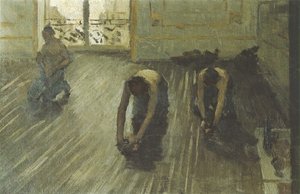
Gustave Caillebotte's 'The Floor Scrapers (study)' captures Parisian laborers with striking realism and light. Explore this iconic Impressionist work depicting urban life, showcasing Caillebotte’s unique perspective.
Biografija umetnika
Gustave Caillebotte (1848-1894): Otkrijte realizam i impresionističke slike pariskog života ovog francuskog majstora, poznatog po delima 'Paris Street; Rainy Day' i jedinstvenim perspektivama. Pionir modernog slikarstva.
About the painting
The Floor Scrapers (Study) 02: A Glimpse into Parisian Labor
Gustave Caillebotte’s “The Floor Scrapers (Study) 02,” painted in 1875, isn't merely a depiction of three men diligently working; it’s a meticulously observed and subtly powerful portrait of urban life in late 19th-century Paris. This early work, often considered a pivotal piece in Caillebotte’s artistic development, offers a rare and intimate view into the lives of the city's working class – a subject largely absent from the grand narratives of the era. The painting immediately draws the eye with its stark contrast: the muted tones of the darkened room, punctuated by the bright white of the freshly sanded floorboards, create an almost photographic realism that was revolutionary for its time.
Caillebotte’s artistic journey began with a formal training in law and engineering, but it was his encounter with photography – particularly the work of Nadar – that profoundly shaped his approach to painting. He recognized the power of capturing fleeting moments and precise details, mirroring the photographic process. This influence is evident in the meticulous rendering of the men’s postures, their tools, and the textures of the wood. The composition itself feels deliberately staged, reminiscent of a photograph, with its careful attention to perspective and lighting. The figures are not idealized; they are presented as ordinary laborers, their faces obscured by shadow, emphasizing their anonymity within the bustling city.
Impressionistic Techniques and a Revolutionary Perspective
“The Floor Scrapers” exemplifies Caillebotte’s early embrace of Impressionism, though with a distinct realism that sets him apart from many of his contemporaries. He employed broken brushstrokes to capture the play of light on the wood and the men's clothing, creating a sense of movement and atmosphere. The use of complementary colors – the cool blues and greens of the shadows against the warm browns and yellows of the floor – adds depth and vibrancy to the scene. Notably, Caillebotte’s decision to depict these laborers in a darkened room, bathed in the diffused light of an unseen window, was a bold departure from traditional studio settings. This choice immediately imbued the painting with a sense of immediacy and authenticity.
Furthermore, Caillebotte's innovative perspective—a low-angle shot that emphasizes the scale of the men and their work—was groundbreaking. It forces the viewer to confront the scene directly, fostering a feeling of intimacy and engagement. The composition isn’t about glorifying labor; it’s about presenting it as a fundamental aspect of urban existence. The painting's technical mastery lies in its ability to convey both the physical reality of the work and the emotional weight of the men’s efforts.
Symbolism and Social Commentary
While seemingly straightforward, “The Floor Scrapers” carries subtle layers of symbolism. The act of scraping floors represents a repetitive, demanding task – a symbol of the daily grind endured by countless working-class individuals in Paris at the time. The absence of any discernible hierarchy or leadership among the men suggests a shared experience of labor and resilience. It’s important to note that Caillebotte was one of the first artists to depict urban proletariat, a subject rarely addressed in art during this period. This choice speaks volumes about his desire to challenge conventional artistic norms and offer a more nuanced representation of Parisian society.
The painting's historical context is crucial to understanding its significance. Paris in the 1870s was undergoing rapid industrialization, leading to significant social and economic changes. The working class faced harsh conditions, long hours, and low wages. Caillebotte’s work serves as a poignant reminder of these realities, offering a glimpse into the lives of those often overlooked by history.
A Timeless Reflection on Labor and Urban Life
“The Floor Scrapers (Study) 02” remains a powerful and evocative artwork. It's not just a depiction of three men working; it’s a meditation on labor, poverty, and the human condition. Caillebotte’s meticulous observation, innovative perspective, and subtle symbolism combine to create a work that continues to resonate with viewers today. Reproductions of this painting offer an opportunity to appreciate Caillebotte's artistic vision and gain a deeper understanding of Parisian life in the 19th century – a testament to the enduring power of art to illuminate social realities.
Pitanja i odgovori
Od čega je izrađeno "The Floor Scrapers (study) 02" i u kom stilu?
„The Floor Scrapers (study) 02“ je urađeno u tehnici Acrylic On Canvas, u stilu Impressionist Painting.
Postoji li informativni list o delu „The Floor Scrapers (study) 02”, autor Gustav Kajlebot namenjen studentima?
Stranica Vodič za učenike za delo „The Floor Scrapers (study) 02”, autor Gustav Kajlebot nudi štampani informativni list u dve stranice: sam rad sa tabelom identifikacije, vremensku traku koja ga smešta u period života umetnika, druga dela istog umetnika, izmerenu paletu boja i citate spremne za kopiranje u četiri stila.
Koja boja najviše dolazi do izražaja u delu "The Floor Scrapers (study) 02"?
Boja koja najviše izdvaja se u delu "The Floor Scrapers (study) 02" je Espresso (#504d40). Dominantna boja je korisna pri uklapanju umetničkog dela u enterijer.
Quick facts and art quiz
About Gustav Kajlebot

Gustav Kajlebot
1848 - 1894, Француска
Biografija umetnika
Parizanin čovek novog doba: Život i umetnost Gustava Kajlbota
Gustav Kajlebot, rođen u imućnoj pariskoj porodici 1848. godine, bio je umetnik u jedinstvenoj poziciji da zabeleži dramatične transformacije koje su preoblikovale njegov grad. Njegov otac, Marsijal Kajlebot, nasledio je uspešan tekstilni posao i služio kao sudija, pružajući Gustavu kako finansijsku sigurnost, tako i perspektivu iz koje je mogao posmatrati uzročno rađajući moderni svet. Iako je u početku uputio svoje studije pravu – stežući diplome iz prava 1868. i 1870. godine – Kajlebotov pravi poziv ležao je u svetu umetnosti. Počeo je ozbiljno školovanje pod vođstvom Leon Bonata, uranjajući u slikarstvo dok je istovremeno razvijao oštar interes za fotografiju, tada još nov medij koji će duboko uticati na njegovu umetničku viziju. Ovo rano izlaganje fotografskim principima — njihovom kadriranju, perspektivi i hvatanju prolaznih trenutaka — postalo bi zaštitni znak njegovog prepoznatljivog stila. Kajlebot nije samo dokumentovao promene; on je aktivno istraživao estetske mogućnosti koje su one nudile.Realizam prožet impresionističkom svetlošću
Kajlebotov umetnički put odstupao je od stroge akademske tradicije, ali nikada nije u potpunosti prihvatio čisto optička istraživanja mnogih svojih impresionističkih kolega. Pronašao je srodnost sa umetnicima poput Edgara Degasa i Đuzepea de Nitisija, deleći fascinaciju modernim životom, ali mu pristupajući kroz sočivo pedantnog realizma. Njegovo rano remek-delo, Les Raboteurs de Parquet (Strugači parketa), izloženo na Salonu 1875. godine, odmah je utvrdilo njegovu reputaciju kao hrabrog i nekonvencionalnog slikara. Rad prikazuje tri radnika koji mukotrpno stružu drveni pod, prikazane sa nepokolebljivom iskrenošću koja je šokirala neke posmatrače, dok je druge očaravala. Nije stvar bio samo motiv — klasa radnika retko je krasila platna visoke umetnosti — već i kompozicija: isečena, gotovo uznemirujuće direktna i lišena sentimentalne idealizacije. Ova posvećenost prikazivanju savremenog života bez ukrašavanja nastavila se u delima poput Gvozdenog mosta, gde je majstorito uhvatio industrijski pejzaž Pariza koji se ubrzano menjao. Ipak, Kajlebot nije bio imun na uticaj impresionizma; njegova paleta je postepeno svetlela, a počeo je da eksperimentiše sa prekidnim potezima četkice i atmosferskim efektima, što je posebno uočljivo u njegovim zadivljujućim pogledima na pariske krovove prekrivene snegom, kao što je Pogled na krovove (Sneg).Pokrovitelj i pionir: Kretanje kroz svet umetnosti
Pored sopstvenih umetničkih poduhvata, Kajlebot je odigrao ključnu ulogu u podršci impresionističkom pokretu. Njegova finansijska nezavisnost omogućila mu je da postane značajan pokrovitelj, kupujući dela Moneta, Renoira, Pizara, Sezana, Degasa i drugih u vreme kada je njihova umetnost bila uglavnom odbijena od strane zvaničnog Salona. On nije bio samo kolekcionar; on je aktivno zastupao ove umetnike, organizujući i finansiracije nekoliko impresionističkih izložbi koje su prkosile konvencionalnim umetničkim normama. Ova posvećenost podsticanju inovacija proširila se i na njegovu sopstvenu kolekciju, koju je zaostavio francuskoj državi nakon svoje smrti 1894. godine — što je zaostavština koja je u početku naišla na otpor, ali je na kraju postala temelj čuvenog muzeja Orse (Musée d’Orsay) i njegovih impresionističkih dragocenosti. Kajlebotova jedinstvena perspektiva manifestovala se i u njegovim kompozicijama; dela poput Boulevard vu d’en haut (Bulvar sa visine), naslikanog 1880. godine, pokazuju izrazito modernu senzibilnost, koristeći uzvišenu tačku gledišta i dinamično kadriranje koje anticipira fotografske perspektive 20. veka. Ovaj inovativni pristup kompoziciji, verovatno pod uticajem japanskih printova i njegovih sopstvenih fotografskih eksperimenata, izdvojio ga je kao istinskog pionira.Nasleđe i ponovno otkriće: Vraćanje modernom majstoru
Decenijama nakon njegove smrti, Kajlebotov rad ostao je relativno nepoznat, u senci slavnijih figura impresionizma. Tek krajem 20. veka počela je sveobuhvatna reevaluacija njegove umetnosti, podstaknuta naučnim istraživanjima i velikim izložbama. Ovo ponovno otkriće otkrilo je umetnika izvanredne tehničke veštine, intelektualne dubine i vizionarskog uvida. Kajlebotova slika nisu samo prikazi modernog života; one su duboka meditacija o složenosti urbanog postojanja, promenljivom društvenom pejzažu i evoluirajućem odnosu između umetnosti i stvarnosti. Njegova sposobnost da neprimetno spoji realizam sa impresionističkim tehnikama, njegove inovativne kompozicije i nepokolebljiva posvećenost prikazivanju sveta oko sebe osigurali su mu mesto ključne figure u umetnosti 19. veka. Danas se Kajlebotova dela slave zbog njihove jedinstvene perspektive, majstorskog izvođenja i trajnog značaja — kao svedočanstvo umetnika koji se usudio da uhvati duh novog doba.Značajna dela
- Les Raboteurs de Parquet (Strugači parketa) (1875): Revolucionarno delo koje prikazuje Kajlebotov realizam i nekonvencionalnu kompoziciju.
- Pogled na krovove (Sneg) (1878): Demonstrira njegovu upotrebu visokih tačaka gledišta i atmosferskih efekata, pod uticajem fotografije i japanskih printova.
- Boulevard vu d’en haut (Bulvar sa visine) (1880): Izrazito moderna kompozicija sa dinamičnom perspektivom.
- Pariska ulica; Kišni dan (1877): Verovatno njegovo najpoznatije delo, koje na jedinstven i upečatljiv način hvata užurbani ritam pariskog života.
- Igra Bezika (1881): Očaravajuće impresionističko delo koje prikazuje parisku slobodu i razonodu.
Quick facts about Gustav Kajlebot
- Artistic Movement Or Style: Realizam, Impresionizam
- Artists Or Movements Influenced By This Artist: ['Impresionizam']
- Artists Who Influenced This Artist:
- Edgar Degas
- Giuseppe de Nittis
- Date Of Birth: 19. avgust 1848.
- Date Of Death: 21. februar 1894.
- Full Name: Gustave Caillebotte
- Nationality: Francuz
- Notable Artworks:
- Les Raboteurs de Parquet
- View of rooftops (snow)
- Boulevard seen from above
- Place Of Birth: Pariz, Francuska
Srodna umetnička dela


Istražite umetnička dela organizovana prema temama, stilovima i karakteristikama.


Gustav Kajlebot
The Floor Scrapers (study) 02
() ·
With its frame: · Hand-painted in oil on linen
Total