A Study in Fragmentation: Modigliani’s Cubist Portrait
This striking portrait by Amedeo Modigliani presents a compelling departure from his more celebrated elongated figures, offering instead a fascinating glimpse into the artist's exploration of Cubism. While known for his signature style, this work – *untitled (328)* – reveals Modigliani’s engagement with the avant-garde movements shaping early 20th-century art. The painting depicts a young woman, rendered not as a realistic likeness but as an assemblage of fractured planes and geometric forms.
Deconstructing Form: Style & Technique
The artwork is unequivocally Cubist in its approach. Modigliani breaks down the subject’s features – her face, neck, and clothing – into angular shapes, presenting multiple perspectives simultaneously on a single canvas. This technique, pioneered by Picasso and Braque, challenges traditional notions of representation, prioritizing intellectual analysis over optical illusion.
The muted color palette, dominated by browns, grays, and off-whites, further emphasizes the painting’s analytical nature. The visible brushstrokes and impasto texture suggest a dynamic process of creation, adding depth and physicality to the fragmented forms. It's likely executed in oil on canvas, allowing for this rich textural quality.
Modigliani Within a Movement
Amedeo Modigliani arrived in Paris in 1906, immersing himself in the city’s vibrant artistic community. While he ultimately developed his own distinct style, he initially experimented with various modern movements, including Cubism. This piece likely dates from a period where he was actively absorbing and responding to these influences.
It's important to note that Modigliani didn’t remain a strict Cubist for long; he soon began to synthesize these lessons into his own unique aesthetic – one characterized by graceful lines, elongated forms, and an evocative sense of melancholy.
Beyond Representation: Symbolism & Emotional Resonance
Despite the painting's abstract nature, it’s not devoid of emotional weight. The woman’s posture and subtle expression hint at introspection and perhaps a quiet sadness. While symbolism isn’t overt, the fragmentation itself can be interpreted as a reflection of the anxieties and uncertainties of the modern era.
The lack of strong shadows contributes to a sense of flatness and detachment, further enhancing the painting's introspective mood.
A Versatile Piece for Modern Interiors
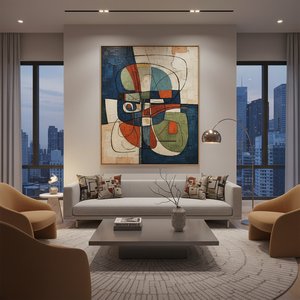
This artwork’s subdued palette and intellectual rigor make it an excellent choice for contemporary interiors. Its abstract nature allows it to complement a variety of design styles – from minimalist spaces to more eclectic collections. A high-quality reproduction would serve as a sophisticated focal point in a living room, study, or bedroom, adding a touch of artistic depth and historical significance.
- Ideal for collectors interested in Modigliani’s lesser-known works.
- A compelling statement piece for modern and contemporary interiors.
- Offers an intriguing example of Cubist influence on a master artist.



 Önizleme yap
 El boyaması versiyona geç
 Paylaş
 Paylaş
 Detayları Gör

 İndir
İndir
 Benzerlerini gör
 X-Işını
 Slayt Gösterisi
 Tümünü Gör






































 Cam seçeneği yalnızca 110 cm altındaki boyutlar için mevcuttur.