A Contemplative Moment: Exploring Modigliani’s “untitled (444)”
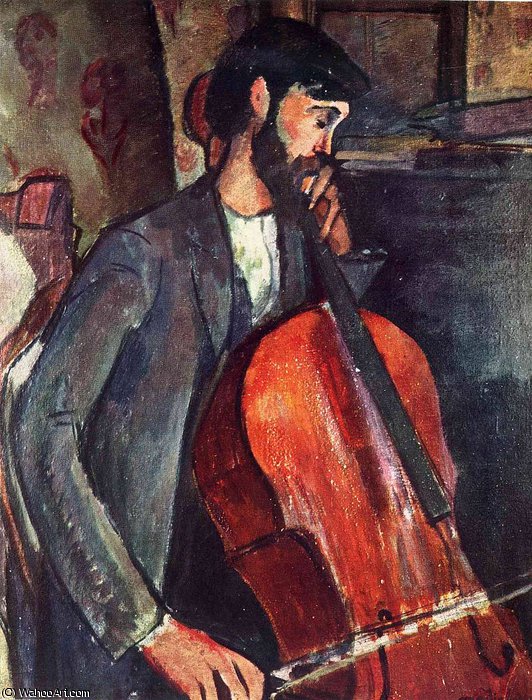
This captivating painting by Amedo Modigliani offers a poignant glimpse into the intimate world of a musician lost in his art. The work, rendered with expressive brushwork and a distinctive color palette, embodies the spirit of early 20th-century Expressionism while retaining Modigliani’s unique stylistic voice.
Subject & Composition
The focal point is a seated man deeply engrossed in playing the cello. He isn't presented as a portrait in the traditional sense, but rather as an archetype of artistic dedication and introspection. The composition is deliberately off-center, drawing the eye across the canvas and creating a dynamic tension. The background, a swirling blend of warm and cool tones, suggests an interior space – perhaps a studio or private room – yet remains ambiguous, focusing attention firmly on the figure and his instrument.
Style & Technique
“untitled (444)” showcases Modigliani’s masterful handling of oil paint. The technique is characterized by
thick impasto, with visible brushstrokes that lend a raw, tactile quality to the surface. Lines are gestural and often broken, contributing to a sense of movement and emotional intensity. Shapes are organic and subtly distorted – a hallmark of Expressionism – prioritizing feeling over precise representation. This approach aligns Modigliani with artists like Chaim Soutine, who similarly employed expressive distortion to convey inner states. The flattened perspective further enhances the painting’s emotive power, creating depth through color variations rather than traditional spatial techniques.
Historical Context & Influences
Born in Italy but flourishing in Paris, Modigliani was deeply influenced by both Renaissance art and the avant-garde movements of his time. He arrived in Paris in 1906, immersing himself in a vibrant artistic community that included Pablo Picasso and Constantin Brâncuși. While he briefly experimented with Cubism, he ultimately developed a highly personal style characterized by elongated forms (more prominent in his portraits) and an emotive use of color. This work, while not featuring the signature elongation, demonstrates his commitment to expressing inner emotion through form and texture – key tenets of Expressionism that were gaining prominence during this period.
Symbolism & Emotional Impact
The cello itself is a powerful symbol, representing artistic passion, creativity, and perhaps even melancholy or introspection. The musician’s contemplative expression suggests a deep connection with his instrument and the music he creates. The painting evokes a sense of quiet solitude and emotional depth.
It's not merely a depiction of someone playing an instrument; it’s a portrayal of the artist’s soul. The warm color palette, punctuated by cooler tones, adds to this complex emotional landscape – suggesting both warmth and underlying unease.
For Collectors & Designers
“untitled (444)” is a compelling example of Modigliani's expressive power. Its rich texture, dynamic composition, and evocative subject matter make it a captivating piece for any art collection. Its warm color palette and emotive quality would lend themselves beautifully to a variety of interior design schemes – from modern living spaces seeking an artistic focal point to more traditional settings desiring a touch of bohemian elegance. A high-quality reproduction of this work will undoubtedly bring a sense of depth, passion, and intellectual curiosity to any environment.
Key Features
- Artist: Amedeo Clemente Modigliani (1884-1920)
- Medium: Oil on Canvas
- Style: Expressionism
- Subject: Portrait of a Cellist
- Emotional Tone: Contemplative, Introspective, Passionate


 Önizleme yap
 El boyaması versiyona geç
 Paylaş
 Paylaş
 Detayları Gör

 İndir
İndir
 Benzerlerini gör
 X-Işını
 Slayt Gösterisi

 Tümünü Gör






































 Cam seçeneği yalnızca 110 cm altındaki boyutlar için mevcuttur.