Eser Açıklaması
A Quiet Moment in the City: Exploring Edward Hopper’s “Drug Store” (1927)
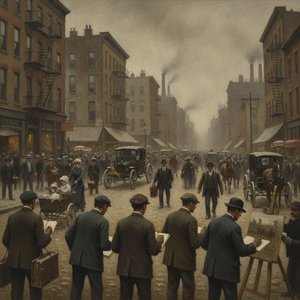
“Drug Store,” painted in 1927 by American master Edward Hopper, is a poignant depiction of urban life – a slice-of-life scene rendered with his signature blend of realism and subtle emotional resonance. This oil on canvas invites viewers into a hushed winter streetscape dominated by the brightly lit storefront of a pharmacy. It’s not merely a record of a place, but an exploration of modern isolation and the quiet rhythms of American towns.
Subject & Composition: A Stage for Modern Life
The painting centers on the facade of a drug store, its large window displaying various goods – likely remedies and everyday necessities. Snow blankets the street, creating a sense of stillness and emphasizing the geometric forms of the building. Hopper’s composition is deliberately flattened; we view the scene from a slightly elevated perspective, almost as if observing it from across the street or perhaps even an upper story window. This vantage point contributes to the feeling of detachment. The strong horizontal lines of the storefront are balanced by the verticality of the buildings and the implied depth of the snowy street. The pharmacy itself becomes a stage, its illuminated interior contrasting with the muted tones of the winter landscape.
Style & Technique: Realism Infused with Emotion
Hopper’s style is firmly rooted in realism, yet transcends simple representation. He doesn't aim for photographic accuracy but rather uses form and light to convey a specific mood. The brushwork is visible – not aggressively so, but enough to reveal the texture of the paint and the artist’s hand. This technique lends a slightly impressionistic quality to the work, softening edges and creating a sense of atmosphere. Hopper masterfully employs oil paints in layers, building up depth and capturing the subtle nuances of light reflecting off the snow and glass. The cool color palette – blues, greys, and whites – dominates, punctuated by warmer reds and yellows within the window display, strategically drawing the eye.
Historical Context & Influences
Painted during the Roaring Twenties, a period of rapid social and economic change in America, “Drug Store” reflects a growing sense of alienation amidst modernization. Hopper was influenced by French Realists like Édouard Manet and Edgar Degas, adopting their focus on everyday life but imbuing it with an uniquely American sensibility. He also drew inspiration from the writings of Ralph Waldo Emerson, which emphasized individualism and introspection. Unlike many artists of his time who embraced abstraction or European avant-garde movements, Hopper remained committed to depicting the world as he saw it – a world often characterized by loneliness and quiet desperation.
Symbolism & Emotional Impact
The symbolism in “Drug Store” is subtle but powerful. The pharmacy itself can be interpreted as representing both healing and vulnerability—a place people turn to for relief, yet also a reminder of their physical fragility. The empty street and the lack of human figures amplify the sense of isolation. The painting evokes feelings of stillness, melancholy, and perhaps even a touch of unease. It’s a scene that resonates with viewers because it taps into universal experiences of loneliness and the search for connection in an increasingly impersonal world.
A Timeless Appeal
“Drug Store” remains one of Hopper's most recognizable works, captivating audiences with its quiet beauty and profound emotional depth. Its enduring appeal lies in its ability to capture a specific moment in time while simultaneously speaking to timeless themes of human experience. Whether you are an art collector, interior designer seeking a piece that evokes contemplation, or simply an admirer of American realism, “Drug Store” offers a compelling and thought-provoking visual experience.



 Önizleme yap
 El boyaması versiyona geç
 Paylaş
 Paylaş
 Detayları Gör

 İndir
İndir
 Benzerlerini gör
 X-Işını
 Slayt Gösterisi


 Tümünü Gör






































 Cam seçeneği yalnızca 110 cm altındaki boyutlar için mevcuttur.