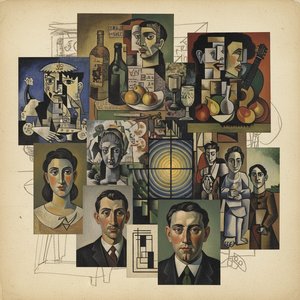
Georges Braque: Pioneering Cubism & The Fruitdish’s Quiet Revolution
Georges Braque (1882-1963) stands as one of the titans of modern art, inextricably linked to Pablo Picasso in the genesis of Cubism—a movement that irrevocably altered the trajectory of Western painting. Born in Argenteuil, France, his formative years instilled within him a profound appreciation for craftsmanship alongside an innate artistic sensibility honed by formal training at the École des Beaux-Arts in Le Havre. This dual foundation proved crucial as he dismantled traditional representational conventions, embracing geometric abstraction and challenging viewers to reconsider their perception of reality. Moving to Paris in 1902, Braque immersed himself in the vibrant artistic milieu of the city, fostering collaborations that would propel him to international acclaim.
- Early Life & Artistic Foundations: Braque’s upbringing within a family of house painters nurtured not only technical mastery but also an early understanding of form and structure—skills he would later translate into groundbreaking visual explorations.
- The École des Beaux-Arts & Marie Laurencin: His studies at Le Havre provided him with the academic grounding necessary to confront established artistic dogma, while his association with Marie Laurencin fostered a shared commitment to innovative aesthetic experimentation.
- Parisian Influences & Francis Picabia: Braque’s Parisian life exposed him to influential contemporaries like Francis Picabia, whose explorations of Surrealism would complement Braque's Cubist endeavors.
The Birth of Cubism – A Dialogue with Picasso
Braque’s artistic journey intersected decisively with Picasso’s in 1907, sparking a collaborative effort that birthed the revolutionary aesthetic known as Cubism. Influenced by Cézanne's radical simplification of form and perspective—particularly his masterful depiction of Mont Sainte-Victoire—Braque embarked on a quest to capture multiple viewpoints simultaneously within a single image. This ambition manifested in works like “Houses at L’Estaque,” where Braque fragmented architectural structures into interlocking planes, mirroring Cézanne’s approach to representing space. The resulting paintings defied conventional illusionism, prioritizing geometric abstraction and challenging viewers to engage with the artwork on an intellectual level.
- Cézanne's Influence: Braque recognized Cézanne’s profound impact on his artistic vision, adopting techniques that mirrored Cézanne’s simplification of form and perspective.
- Collaborative Exploration: The partnership with Picasso fueled a dynamic exchange of ideas, resulting in paintings that were indistinguishable for years—a testament to their shared commitment to pushing the boundaries of artistic expression.
- Analyzing Space & Form: Braque meticulously scrutinized Cézanne’s methods for representing space and form, incorporating these insights into his own Cubist compositions.
“The Fruitdish” – A Study in Texture & Illusion
“The FruitDish,” created in 1912, exemplifies Braque's masterful manipulation of texture and illusionistic representation—a hallmark of Synthetic Cubism. This still life oil painting on canvas is more than just a depiction of fruit; it’s an intellectual exercise in challenging viewers’ perceptions of reality. Inspired by the discovery of mass-produced faux bois wallpaper purchased in Avignon, Braque employed *papier collé* – a technique pioneered by Picasso—to integrate fragments of printed paper into his charcoal drawings. The wallpaper's geometric patterns and wood grain texture served as a deliberate counterpoint to the fragmented forms of Cubism, prompting contemplation about how artists represent space and materiality.
- The Role of Papier Collé: Braque’s use of papier collé—a technique championed by Picasso—represents a pivotal moment in Cubist art history.
- Texture & Illusionistic Representation: The interplay between charcoal lines and the textured surface of faux bois wallpaper underscores Braque's commitment to exploring both visual elements simultaneously.
- Symbolic Significance: The inclusion of geometric forms alongside naturalistic depictions—such as the grapes—suggests a broader exploration of artistic conventions and their ability to convey meaning beyond mere appearance.
Legacy & Impact – Beyond Fragmentation
Georges Braque’s contribution to Cubism transcends mere stylistic innovation; it represents a fundamental rethinking of how artists engage with the visual world. By prioritizing geometric abstraction alongside illusionistic representation—a strategy mirrored in “The FruitDish”—Braque ushered in an era of artistic experimentation that continues to inspire contemporary artists. His work stands as a beacon of modernist thought, demonstrating the transformative potential of challenging established norms and embracing new perspectives on form, space, and perception. Reproductions of "The Fruitdish" offer viewers a chance to experience Braque’s groundbreaking vision firsthand—a testament to his enduring influence on the history of art.



 Tabloyu Sipariş Et
 Paylaş
 Paylaş
 Detayları Gör

 İndir
İndir
 Benzerlerini gör
 X-Işını
 Slayt Gösterisi

 Tümünü Gör






































 Cam seçeneği yalnızca 110 cm altındaki boyutlar için mevcuttur.