A Surrealist Embrace: Decoding Pablo Picasso’s “Mother and Child”
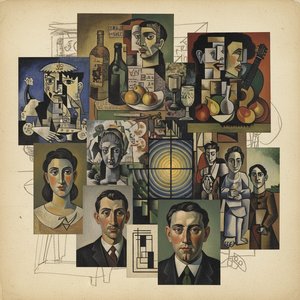
Pablo Picasso's "Mother and Child," painted in 1921, isn’t merely a depiction of familial love; it’s a carefully constructed visual puzzle, a window into the artist’s evolving mind during a period of profound artistic experimentation. Measuring a modest 97 x 71 cm, this seemingly simple scene—a woman holding her baby while simultaneously brushing its teeth—unfolds with a surrealist intensity that continues to captivate viewers nearly a century later. The painting immediately draws the eye to the central figures: a woman, occupying the majority of the right side of the canvas, and her infant child positioned on the left. This deliberate asymmetry creates an intimate yet subtly unsettling atmosphere, hinting at a narrative far richer than the surface suggests. Picasso masterfully employs bold lines and a restrained palette—primarily blues and whites—to establish a sense of quiet dignity amidst the dreamlike quality of the composition. The brushstrokes themselves are confident and decisive, reflecting a shift towards a more controlled and classical style following his Cubist explorations, yet retaining the artist’s signature expressive energy.
Composition and Symbolism: A Dance of Actions
The most striking element of “Mother and Child” is undoubtedly the woman's dual action—holding her baby while simultaneously brushing its teeth. This seemingly mundane activity becomes imbued with symbolic weight, prompting endless interpretations. Is she prioritizing hygiene, a reflection of societal norms? Or does this gesture represent a deeper concern for nurturing, protecting, and shaping the child’s future? Picasso deliberately blurs the lines between these functions, suggesting that motherhood is not simply about providing sustenance but also about actively molding and guiding the next generation. The baby's position on the left side of the canvas further emphasizes his vulnerability and dependence, while the woman’s dominant presence conveys a sense of strength and responsibility. Notice, too, how Picasso uses geometric shapes—particularly rectangles and squares—to define the figures, echoing the influence of Cubism but grounding them in a more stable, classical form. The overall composition feels deliberately balanced, creating a visual harmony that belies the underlying tension and ambiguity.
Echoes of Influences: Modigliani and Beyond
Picasso’s artistic journey was profoundly shaped by his contemporaries, most notably Amedeo Modigliani, whose elongated figures and expressive faces exerted a significant influence on Picasso's work during this period. The subtle elongation of the woman’s torso, reminiscent of Modigliani’s style, contributes to the painting’s overall sense of elegance and formality. However, Picasso transcends mere imitation; he integrates these influences into his own unique visual language. Furthermore, traces of Velázquez and Goya—masters he studied independently—can be discerned in the careful rendering of light and shadow, and the subtle psychological depth conveyed through the figures' expressions. The painting’s connection to mathematics is also noteworthy. Picasso was fascinated by geometric proportions and frequently employed the golden ratio – a mathematical principle found throughout nature – to achieve visual harmony within his compositions. In “Mother and Child,” this can be observed in the relationship between the woman’s body and the baby, creating a sense of balanced proportion and aesthetic appeal.
A Legacy of Modern Art: Berardo Collection and Beyond
“Mother and Child” stands as a pivotal work within Picasso's oeuvre and a testament to his enduring influence on modern art. Its surrealist qualities anticipated the rise of Surrealism, while its classical elements demonstrated Picasso’s ability to synthesize diverse artistic traditions. The painting’s themes—motherhood, vulnerability, and the complexities of human relationships—resonate deeply with viewers across generations. It's a significant piece within the collection of the Berardo Collection Museum in Lisbon, Portugal, which houses an impressive array of modern and contemporary art, showcasing Picasso’s impact on the artistic landscape. Picasso’s work continues to inspire artists today, and his legacy is celebrated through exhibitions and reproductions like those offered by TopImpressionists.com. For those seeking a tangible connection to this iconic masterpiece, a high-quality reproduction offers an opportunity to bring its evocative power into your own home.
Explore more of Picasso’s works on /art/list/?Filter=Pablo-Picasso
Discover the Berardo Collection Museum: /art/list/?Filter=A@D3C24B-The-Berardo-Collection-Museum-(Portugal)-A-Comprehensive-Guide
Learn about the connection between mathematics and art: https://en.wikipedia.org/wiki/Mathematics_and_art



 Önizleme yap
 El yapımı tablo satın al
 Paylaş
 Paylaş
 Detayları Gör

 İndir
İndir
 Benzerlerini gör
 X-Işını
 Slayt Gösterisi


 Tümünü Gör






































 Cam seçeneği yalnızca 110 cm altındaki boyutlar için mevcuttur.