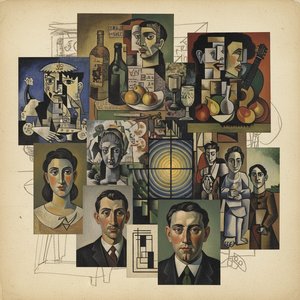
A Symphony of Yellow: Reimagining Picasso’s Standing Woman
In the vast, transformative landscape of Pablo Picasso’s oeuvre, few works capture the post-war spirit with as much luminous intensity as Standing Woman. Painted in 1946, this masterpiece serves as a radiant testament to an artist who, even after decades of revolutionizing the visual language, continued to find profound new ways to dissect and celebrate the human form. The canvas is bathed in a striking palette of yellow hues—warm, golden, and sun-drenched—that imbues the composition with an unexpected aura of serenity. This choice of color does more than merely decorate the surface; it acts as a unifying force, weaving together the fragmented planes of the figure into a cohesive, glowing entity that seems to radiate light from within.
The subject itself is a captivating study in balance and tension. A female figure, rendered through the lens of Picasso’s evolved Cubist vision, sits gracefully upon a chair, her presence anchoring the left side of the frame. Yet, there is a restless energy at play; her head tilts subtly toward the right, creating a dynamic imbalance that compels the viewer's eye to dance across the textured surface. The composition utilizes the bold, geometric language of Analytical Cubism, where the body is not merely depicted but meticulously deconstructed into interlocking shapes—cubes, spheres, and sharp angles. This fragmentation does not obscure the woman; rather, it invites us to perceive her from multiple perspectives simultaneously, capturing the essence of her physical presence and her psychological depth in a single, breathtaking moment.
The Intersection of Cubism and Naïve Artistry
To gaze upon Standing Woman is to witness a masterful dialogue between two seemingly opposing worlds: the intellectual rigor of Cubism and the raw, emotive simplicity of Naïve Art. While the structural foundation of the piece relies on the complex, multi-faceted planes characteristic of Picasso’s earlier radical experiments, there is an undeniable warmth and directness in the execution that speaks to his later interest in Primitivism. The features of the face are simplified, almost elemental, providing a focal point of intense, unblinking gaze that connects the subject directly to the observer. This stylistic duality creates a profound emotional impact, offering a sense of structural stability paired with a vulnerable, human intimacy.
For the discerning collector or interior designer, this artwork offers much more than mere aesthetic appeal; it provides a sophisticated focal point capable of anchoring a room with its commanding scale and vibrant energy. The 146 x 89 cm dimensions allow the painting to dominate a space, while its warm earth tones and brilliant yellows can breathe life into contemporary, minimalist, or even classical settings. A high-quality reproduction of this work allows one to bring the transformative power of Picasso’s post-war optimism into a private sanctuary, serving as a constant reminder of the beauty found in fragmentation and the enduring strength of the human spirit.



 Önizleme yap
 El yapımı tablo satın al
 Paylaş
 Paylaş
 Detayları Gör

 İndir
İndir
 Benzerlerini gör
 X-Işını
 Slayt Gösterisi


 Tümünü Gör






































 Cam seçeneği yalnızca 110 cm altındaki boyutlar için mevcuttur.