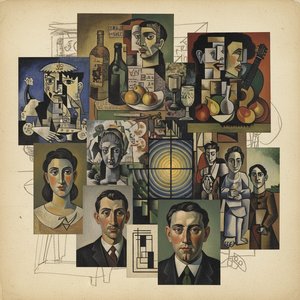
Deconstructing Reality: An Exploration of Pablo Picasso’s *Still-Life with Cheese*
This captivating artwork, *Still-Life with Cheese*, is a prime example of Analytical Cubism – a revolutionary style co-pioneered by Pablo Picasso and Georges Braque in the early 20th century. While often attributed to Braque, its stylistic hallmarks are deeply rooted in Picasso’s innovative approach to form and perception. This piece isn't merely a depiction *of* objects; it’s an investigation *into* how we see them.
Subject Matter & Composition
The still life presents a fragmented arrangement of everyday items: a trumpet, a teapot, and a bowl of fruit – seemingly simple subjects elevated through radical artistic treatment. However, don't expect a traditional, recognizable scene! Picasso dismantles these objects into geometric components—planes, angles, and lines—and reassembles them on the canvas in an abstract configuration. The composition is deliberately unbalanced; the assertive angularity of the trumpet dominates the left side, while the more rounded forms of the teapot and fruit occupy the right, creating a dynamic visual tension. This deliberate imbalance prevents the eye from resting, encouraging continuous exploration of the artwork’s surface.
A Cubist Revolution: Style & Technique
*Still-Life with Cheese* embodies the core tenets of Analytical Cubism. Key characteristics include:
- Fragmentation: Objects are broken down into their essential geometric forms.
- Multiple Perspectives: The artwork presents multiple viewpoints simultaneously, challenging traditional single-point perspective.
- Monochromatic Palette: A restrained palette of grays, blacks, and subtle yellows dominates the composition. This limited color scheme focuses attention on form rather than hue.
- Flattened Space: Depth is minimized, creating a flattened picture plane where objects appear to exist simultaneously in different spatial relationships.
Picasso’s technique involves layering paint in thin, translucent glazes. This builds up the image gradually, allowing underlying forms to peek through and contribute to the overall sense of complexity. The minimal texture further emphasizes the artwork's intellectual rather than purely sensual qualities.
Historical Context & Artistic Innovation
Emerging around 1907-1914, Cubism was a direct response to the limitations of traditional representational art. Artists like Picasso and Braque sought to move beyond simply *imitating* reality and instead explore the underlying structure of objects and space. Influenced by Paul Cézanne’s emphasis on geometric forms and non-Western art (particularly African masks), Cubism fundamentally altered the course of modern art, paving the way for abstraction and countless subsequent artistic movements. This period marked a pivotal shift in how artists approached representation, prioritizing conceptual understanding over optical illusion.
Symbolism & Emotional Impact
While not overtly symbolic, *Still-Life with Cheese* invites contemplation on the nature of perception itself. The fragmented forms can be interpreted as representing the complexities of modern life and the breakdown of traditional values. The intellectual rigor of Cubism reflects a desire to analyze and understand the world in a new way. The artwork doesn’t aim for emotional resonance in a conventional sense; instead, it stimulates the intellect and challenges the viewer's assumptions about how art should function. It evokes a feeling of *dissection* – as if we are examining the very building blocks of reality.
A Timeless Masterpiece for Modern Interiors
*Still-Life with Cheese*, or a high-quality reproduction, is an exceptional addition to any modern or contemporary interior. Its neutral color palette and abstract composition make it incredibly versatile, complementing a wide range of décor styles. The artwork’s intellectual depth adds sophistication and intrigue to a space, sparking conversation and inspiring contemplation. It's a statement piece that speaks to a discerning eye and appreciation for art history’s most groundbreaking innovations.
Its enduring appeal lies in its ability to challenge our perceptions and remind us that there are multiple ways of seeing the world.



 Önizleme yap
 El yapımı tablo satın al
 Paylaş
 Paylaş
 Detayları Gör

 İndir
İndir
 Benzerlerini gör
 X-Işını
 Slayt Gösterisi
 Tümünü Gör






































 Cam seçeneği yalnızca 110 cm altındaki boyutlar için mevcuttur.