A Presence in the Spanish Court
Justus Tiel moved through the halls of the Spanish court in Madrid, a Flemish painter working under the shadow of Philip II. His life remains largely a collection of fragments, a series of traces left in official documents rather than a clear, written history. He was a relative of Jan de Til, and his presence in the royal household was marked by his role as a painter for the king. While much of his output has been lost to time, the work that remains offers a glimpse into the visual language of the Habsburg court.
His hand is visible in the way he handled the likenesses of the royal family. He worked alongside other painters of the era, absorbing the stylistic habits of the court. His brushwork reflects the influence of Alonso Sánchez Coello and Juan Pantoja de la Cruz, capturing the specific gravity required for royal portraiture. He was not a man of grand declarations, but of steady, commissioned labor.
The Weight of Allegory
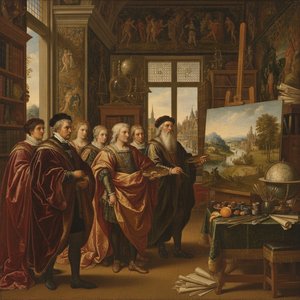
In the year 1590, Tiel produced a work that remains his most significant surviving contribution. This piece, an allegory of the education of Philip III, is held in the Museo del Prado in Madrid. It is a dense composition, focusing on a young prince who is twelve years old at the time of the painting. The boy wears a suit of armor that he has already outgrown, a detail that grounds the work in a sense of passing time.
The painting uses specific symbols to speak of the responsibilities of a future ruler:
- The figure of Chronos, representing Time.
- The figure of Cupid, representing Love.
- The female figure of Justice, representing the moral standard of a king.
These figures surround the prince, creating a scene where the weight of governance is felt through the presence of these personifications. The composition is tight and centered, drawing the eye to the young heir amidst the heavy symbolism of his future duties.
A Legacy in Oil and Panel
Tiel’s career was defined by the specific demands of his patrons. He was a painter of the court, a man whose skill was measured by his ability to translate the status of the Spanish monarchy into oil on panel. His work is characterized by a certain stillness, a way of capturing a moment in a life that is destined for power. Even when he painted the prince at fourteen, as seen in other documented works, the focus remained on the physical reality of the sitter and the symbols of his station.
He died in Madrid in 1595. Though much of his career is obscured by the loss of his other portraits, the surviving pieces provide a quiet, steady record of a man who helped shape the visual identity of a dynasty during a pivotal era in Spanish history.
Soru ve Cevaplar
Justus Tiel adlı sanatçının eserlerini kronolojik sırayla nerede görebilirim?
Sanatçının Eser Kronolojisi sayfası, Justus Tiel eserlerini tarihe göre, yıl yıl sıralanmış bir şekilde sunar.
Justus Tiel adlı sanatçının eserlerinin renk profilini nerede görebilirim?
Justus Tiel'in bu web sitesi üzerinde yer alan eserlerindeki renk kullanımı, sanatçının Palet Genomu sayfasından incelenebilir.
Justus Tiel’in kariyeri hangi dönemlere ayrılıyor?
Justus Tiel adlı sanatçının eserlerinin kronolojik bir dökümü, yapıtların yaratım sırasına göre bölüm bölüm ilerlediği Sanat Yolculuğu sayfasında sunulmaktadır.
Justus Tiel adlı sanatçının eserlerini bir 3D galeride nerede görebilirim?
Sanal bir ziyaret mümkün: Justus Tiel sanatçısının 3B Galeri sayfası, eserleri üç boyutlu bir galeride sunuyor.