

购买高分辨率增强版数字图像,其品质远超在线预览。
每一份文件都由我们的内部专家使用先进工具与专业的后期润色技术精心打造。我们确保每一张图像都具备卓越的清晰度、精准的色彩还原度以及细腻的细节表现。
最终文件将在 72 小时内通过电子邮件交付,并针对专业、编辑及印刷用途进行了优化。其品质与顶级设计工作室、出版社和画廊所信赖的标准完全一致。
下载高分辨率文件,用于个人展示、打印及创意项目。 ( Switch to Print Switch to hand made Painting)
选择 TopImpressionists.com,您获得的不仅仅是一张图像——您收到的是经过专业级增强、精雕细琢的数字艺术作品,并享有满意保证。以下是您的订单中自动包含的所有内容:

您的高分辨率数字图像文件将在下单后 72 小时内通过电子邮件发送给您 —— 即可立即使用。

您的艺术品经过专业优化,结合先进的 AI 技术与人工修饰,确保呈现极致的细节、清晰度与色彩准确度。

不小心删除了文件或找不到了?没关系——我们将随时为您免费重发。

即刻拥有您的艺术作品,无需支付任何关税、税费或运费——数字下载始终免税。

我们通过专业工具与色彩管理技术,确保您的数字图像尽可能真实地还原原作色彩。

如果您对所购买的数字图像不满意,我们将在60天内为您进行修改或退还100%的款项——无需任何解释。

如果不满意?在收到数字文件后的60天内,我们为您提供全额退款——无需任何理由。

购买 3 张图片可享 10% 折扣 - 购买 5 张可享 15% 折扣 - 购买 10+ 张可享 20% 折扣。非常适合创意项目、画廊和机构使用。
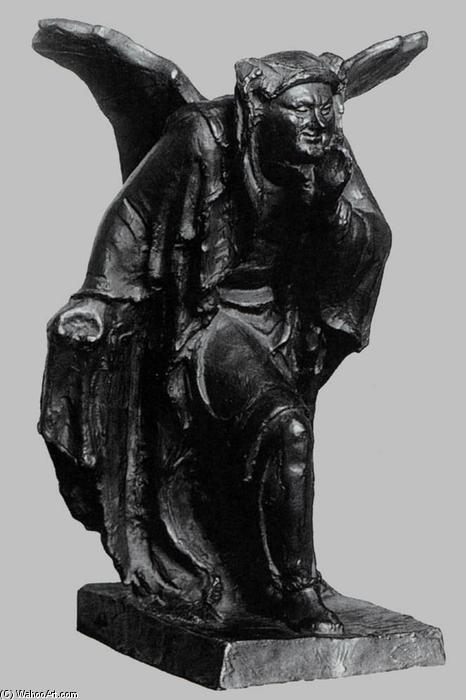
Hermann Ernst Freund’s “Loki” stands as a compelling testament to the burgeoning Romantic movement’s fascination with ancient mythology, specifically the complex and often contradictory narratives of Norse lore. Crafted in Rome during a pivotal decade of his artistic development – 1818-1820 – this bronze sculpture transcends mere representation; it embodies a potent distillation of Loki's character: cunning trickster, shapeshifter, and harbinger of chaos, yet simultaneously imbued with an unsettling intelligence and a hint of tragic vulnerability. Freund’s decision to focus on this notoriously ambiguous figure speaks volumes about the era’s shifting artistic sensibilities – a move away from the rigid formality of Neoclassicism towards a more emotionally charged exploration of folklore and the darker aspects of human nature.
The sculpture’s power lies not only in its subject but also in Freund's masterful manipulation of bronze – a medium he expertly wielded throughout his career. The figure is rendered with remarkable anatomical detail, capturing the muscularity and coiled energy of Loki mid-pose. Note the deliberate roughness of the surface, achieved through careful polishing and patination; this textural contrast emphasizes the figure’s physicality while simultaneously hinting at an underlying sense of unease. The drapery, flowing and dynamic, is sculpted with a remarkable degree of realism, suggesting both movement and a subtle suggestion of concealment – mirroring Loki's ability to blend seamlessly into various roles.
Technique: The bronze casting process itself contributes significantly to the sculpture’s impact. The inherent qualities of the metal—its weight, its capacity for detail, and its potential for surface treatment—are fully exploited by Freund, creating a work that is both imposing and intimate.Loki's pose – seated, one leg extended, head turned in a gesture of deliberate observation – immediately conveys his characteristic cunning. The subtle suggestion of a smirk plays upon the viewer’s expectations, inviting speculation about his intentions. The presence of wings, a clear reference to Norse mythology, reinforces his status as a supernatural being, capable of transformation and wielding considerable power. However, it is not merely a depiction of brute force; there's an element of calculated strategy in Loki’s stance, reflecting his role as a master manipulator.
“Loki” is more than just a sculpture; it’s an evocation of the complexities inherent in Norse mythology – a world populated by gods and giants, heroes and monsters, where fate is often capricious and morality ambiguous. Freund's work captures this spirit with remarkable sensitivity, inviting viewers to contemplate the nature of trickery, intelligence, and the enduring power of myth. Reproductions of this piece offer a tangible connection to a pivotal moment in Romantic art history, allowing us to experience firsthand the artistic vision of a sculptor who dared to delve into the shadowy depths of Norse legend. It remains a potent symbol of both the allure and the danger inherent in embracing the unknown.
Hermann Ernst Freund (1786-1840) was a German-born Danish sculptor who achieved recognition for his pioneering work in Nordic mythology and, most notably, the ambitious *Ragnarok Frieze*. Born near Bremen, Germany, he initially pursued training as a smith before dedicating himself to the world of art. He enrolled at the Art Academy in Copenhagen, where his talent quickly shone through, earning him all four silver and gold medals.
Following his graduation, Freund embarked on a decade-long sojourn in Rome (1810-1820). This period proved pivotal to his artistic development. He became the closest assistant to the renowned sculptor Bertel Thorvaldsen, gaining invaluable experience and refining his skills. His work during this time, such as the marble bust of Bernhard Severin Ingemann (1820), demonstrates a clear influence of Thorvaldsen’s Neoclassical style.
Upon returning to Denmark, Freund distinguished himself as an early proponent of Romantic Nationalism. He was the first Danish sculptor to actively engage with themes from Nordic mythology, creating a series of twelve statuettes between 1822 and 1829. These included compelling representations of figures like Loki (1822), Odin (bronze, 1827), and Thor (1829). His approach skillfully blended the grandeur of ancient Greek and Roman mythological traditions with distinctly Norse subject matter.
In 1829, Freund was appointed professor at the Academy, solidifying his position within the Danish art world. Inspired by his travels in Southern Italy, he had his official residence, Materialgaard, decorated in a Pompeiian style. He mentored several young artists including Georg Hilker, Heinrich Eddelien, Constantin Hansen and Christen Købke who assisted with the decoration of Materialgaard based on Freund’s designs.
Hermann Ernst Freund played a crucial role in shaping Danish sculpture during the Golden Age. His pioneering exploration of Nordic mythology not only revitalized national artistic identity but also established a unique and enduring legacy. The largest collection of his works is housed at the Glyptotek in Copenhagen, ensuring that future generations can appreciate his contributions to art history. He remains an important figure for understanding the intersection of Neoclassicism, Romanticism, and National Identity in 19th-century Danish art.

1786 - 1840 , Germany


第一时间获取最新的艺术新闻、独家优惠及装饰灵感。
向我们介绍您的项目需求,我们的艺术专家将为您提供 3 个个性化的艺术品推荐。
由我们的专家为您精选 3 款心仪之作 —— 完全免费!
 分享
分享 分享
分享
 详情
详情

 下载
下载
 相似作品
相似作品 幻灯片播放
幻灯片播放


 展开详情
展开详情