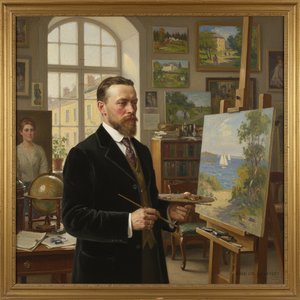
Early Life, Family and Training
Emil Hallatz was born on 25 July 1837 in Frankfurt (Oder), Kingdom of Prussia. He was the son of Ignatz Hallatz, a master tailor, and Louise Hallatz, née Schneider. His upbringing in this Prussian town provided a stable foundation before he turned toward the formal study of fine arts. The precision of his father's trade perhaps echoed in the disciplined approach Hallatz would later apply to his own craft.
His formal artistic education began at the Academy in Berlin. It was here that he encountered the guidance of Carl Steffeck, a mentor who would significantly influence his technical direction. Under Steffeck's instruction, Hallatz focused his studies on the nuances of the natural world. He trained specifically as an animal and landscape painter, developing the skills necessary to capture both the anatomy of creatures and the expansive qualities of the terrain.
Travels and Artistic Development
The years following his initial training were defined by a movement toward the great centers of European art. In 1862, Hallatz traveled to Paris, a city that would profoundly shape his technical approach to his chosen subjects. During his time there, he spent much of his energy studying the works of animal painters Constant Troyon and Rosa Bonheur. This period of observation allowed him to absorb a specific way of handling form and character, moving beyond mere imitation toward a more spirited execution.
His curiosity extended beyond the French capital. In 1863, he spent time visiting several Italian cities, immersing himself in the light and landscapes of the region. These travels provided a necessary breadth to his perspective before he returned to Berlin to establish a permanent residence. It was in the German capital that his professional identity truly solidified. He became a prolific painter of animals, developing a style characterized by energetic, rapid drawing and a broad, intelligent manner of painting. His work often possessed a certain wit, imbuing his subjects with a sense of humor and a lively, spirited character.
Personal Life and Family
In the autumn of 1872, Hallatz’s private life took a significant turn when he married Ernestina Louise Augusta Kux, a widow, in the St. Matthäus Church in Berlin. This union established a household that would grow alongside his professional reputation in the Prussian capital. The marriage was marked by the arrival of two children, anchoring his domestic life amidst his increasing activity as a painter.
The couple welcomed their first child, a son named Erich Karl Anton Robert Hallatz, in August 1873. Two years later, in October 1875, their daughter Margarethe Anna Helene Hallatz was born. These family ties provided a sense of permanence as he established his presence in Berlin, eventually leading to the construction of a dedicated atelier house on Schmargendorfer Straße in 1884.
الأسئلة والأجوبة
أين يمكنني مشاهدة أعمال Emil Hallatz الفنية مرتبة حسب الأجواء؟
تتيح لك صفحة ركن الأجواء الخاصة بـ Emil Hallatz تصفح أعمال الفنان مرتبةً حسب الحالة المزاجية.
هل يمكنني استكشاف أعمال Emil Hallatz عبر الكلمات المفتاحية؟
تجمع صفحة حسب الكلمات المفتاحية الخاصة بـ Emil Hallatz أعمال الفنان وفقاً للكلمات المفتاحية.
كيف تطور فن Emil Hallatz بمرور الوقت؟
تتجلى المسيرة المهنية لـ Emil Hallatz مرحلة تلو الأخرى في صفحة مسيرة فنية: وهي عبارة عن خط زمني أفقي للأعمال الفنية، مُصنفة ضمن فصول تمثل كل حقبة من مسيرته.
ما هي أكثر الأعمال الفنية مشاهدةً لـ Emil Hallatz؟
يمكنكم الاطلاع على إحصائيات أعمال Emil Hallatz عبر صفحة إحصائيات الزيارات الخاصة بالفنان.