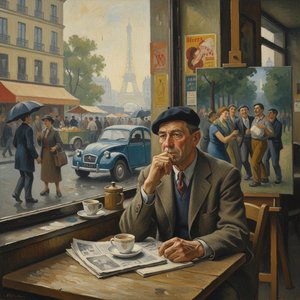
The Melodies of Color and Light
In the sun-drenched streets of Marseille, a man once sought to capture the world through the movement of his fingers, though his path was shaped by a sudden physical struggle. Born in 1856, Étienne Martin began his life as a pianist, seeking to translate sound into emotion. However, the onset of hand cramps forced a redirection of his creative spirit. He turned his focus from the keys of a piano to the brush and the pen, finding a new way to express the rhythms of life. This transition from music to composition, and eventually to the canvas, infused his later visual works with a certain lyrical quality that echoed his early musical training.
His education was a matter of lineage and mentorship. He first learned the delicate art of watercolor from his father, Paul Martin, a man who had already established himself in the artistic circles of the region. This foundation allowed him to transition into the more robust medium of oil painting under the guidance of Antoine Vollon. The influence of Vollon remained a permanent fixture in Martin's style, guiding his hand as he moved through the salons of Paris. By 1876, he was a regular presence at the Paris Salon, eventually earning an honorable mention in 1885 and a silver medal at the Exposition Universelle in 1889.
A Life Dedicated to the Muse of Provence
As the years passed, Martin’s connection to his home city deepened through roles of stewardship and leadership. Following the death of his father in 1905, he stepped into the position of Curator of the Musée Gassendi in Digne-les-Bains, a role he maintained until his final days in 1945. His commitment to the artistic community was further evidenced by his leadership within the Association des Artistes Marseillais and his election to the Académie de Marseille in 1903. He was a man deeply embedded in the institutional life of French art, moving between the quiet halls of museums and the active debates of artistic associations.
His intellect extended beyond the visual, as he was also a writer who pondered the intersection of human feeling and the rapid advancements of his era. In his writings, such as Réflexion d'un artiste sur la science, he explored the tension between the progress of science and the soul of the artist. This contemplative nature often bled into his paintings, which frequently carried a nostalgic tone, looking back at a world that was rapidly changing. His works are preserved today in several significant collections, including:
- Musée des beaux-arts de Dijon
- Musée des beaux-arts de Marseille
- Musée Cantini
- Musée des beaux-arts de Rouen
- Musée d'art de Toulon
الأسئلة والأجوبة
من أي بلد Étienne Martin؟
وُلد Étienne Martin في France.
أين يمكنني مشاهدة أعمال Étienne Martin الفنية في معرض ثلاثي الأبعاد؟
يمكنكم مشاهدة أعمال Étienne Martin الفنية في معرض ثلاثي الأبعاد عبر صفحة متحف ثلاثي الأبعاد الخاصة بالفنان.
أين يمكن العثور على أعمال Étienne Martin الفنية مصنفة حسب التقنية؟
للعثور على جميع أعمال Étienne Martin حسب الوسيط الفني، يرجى زيارة صفحة حسب الوسيط الفني الخاصة بالفنان.
كم عدد الأعمال الفنية المتاحة لـ Étienne Martin؟
يمكنك تصفح 1 عمل فني من أعمال Étienne Martin في صفحة كافة الأعمال الفنية.