A Life Between Borders
Paris, 1876. Raoul Martinez enters a world of privilege, born to a wealthy family of Cuban origin. His early years are shaped by the quiet luxury of a family estate and a lineage that connects the French capital to a hacienda near Havana. This dual identity—French by birth and Cuban by blood—defines a life spent navigating the cultural currents of Europe. After his education in Paris, he spends time working at the family estate before the pull of the European art scene draws him toward Brussels.
By 1907, the trajectory of his life shifts from the private sphere of a wealthy estate to the structured rigor of the Accademia Libera "L'Effort" in Brussels. It is here that the self-taught beginnings of his career meet formal discipline. He enters a circle of avant-garde painters, a group that would later be recognized as the Fauves du Belgique. The shadows of the First World War force a movement of his own, driving him into the Netherlands and Belgium as he seeks stability amidst the chaos of a continent at war.
The Language of Form and Color
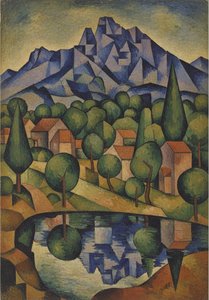
The work of Raoul Martinez is a dialogue with the giants of the previous century. He does not merely observe; he absorbs the structural logic of Cézanne and the emotional intensity of Van Gogh. His canvases are a collision of influences, where the bold color of Matisse meets the fractured perspectives of Cubism and the kinetic energy of Futurism. Yet, he resists the total surrender to abstraction. He maintains a tether to the recognizable, preferring to ground his experiments in the tangible reality of the world.
His subject matter is a study of the everyday, rendered with a specific, tactile focus:
- Still Lifes: From a crystal decanter to a pewter jug with lemons and books, his arrangements of fruit, flowers, and glassware reveal a preoccupation with light and volume.
- Landscapes and Cityscapes: His brush captures the essence of urban environments, such as the Waalseilandgracht, and the quietude of wooded lands.
- Self-Portraits: Introspective looks that anchor his identity within his evolving style.
A Legacy in Museums and Collections
The middle years of the twentieth century see Martinez settling in Paris, but his artistic footprint remains deeply embedded in the Low Countries. His presence in the Dutch art scene is solidified by the support of collectors like H.P. Bremmer, who recognizes the merit of his still lifes during exhibitions in Amsterdam. This recognition bridges the gap between his private practice and the public eye, leading to solo exhibitions in major institutions like the Haags Gemeentemuseum in The Hague and Museum De Wieger in Deurne.
His paintings now reside in significant collections, including the Musée d’Art Moderne de la Ville de Paris and the Rijksmuseum Kröller-Müller. He remains a figure of transition, an artist who navigated the shift from the late nineteenth-century traditions to the radical geometries of the modern era, leaving behind a body of work that balances the weight of history with the freedom of the avant-garde.
الأسئلة والأجوبة
هل يمكنني تصفح أعمال Raoul Martinez حسب الحركة الفنية؟
يمكن تصفح أعمال Raoul Martinez حسب الحركة الفنية عبر صفحة جميع المدارس الفنية.
أين ومتى وُلد Raoul Martinez؟
وُلد Raoul Martinez في Cuba عام 1876.
أين يمكنني العثور على إحصائيات حول أعمال Raoul Martinez؟
يمكنكم الاطلاع على إحصائيات أعمال Raoul Martinez عبر صفحة إحصائيات الزيارات الخاصة بالفنان.
أين يمكن العثور على أعمال Raoul Martinez الفنية مصنفة حسب لوحة الألوان؟
تجمع صفحة حسب لوحة الألوان أعمال Raoul Martinez الفنية حسب لوحات ألوانها.