Send
Send Share
Share
 Details
 Guide
Guide

 Download
 Similars
 Diaporama
 Q&A
Q&A Stats
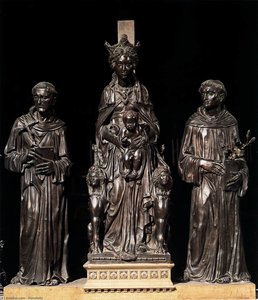
StatsMusician Angels

- 58.0 x 21.0 cm


Donatello’s ‘Musician Angels,’ created in 1447, showcases six angelic figures playing instruments—lute, flute, drum—within a stylized basilica setting. Crafted in bronze, this sculpture exemplifies Early Renaissance artistic innovation.
 Read More
Donatello (1386-1466): Florentine sculptor of the Early Renaissance. Pioneer of freestanding nude sculpture like 'David,' known for expressive realism, classical influence & innovative techniques. Explore his masterpieces and legacy.
Giclée / Art Print
Museum-quality giclée or canvas print with fast production and flexible finish options. ( Buy Hand Made Painting Switch to Digital Image)




































Standard
custom
CM
INCH
Pick from our preset sizes that match the artwork's original proportions.
Loading sizes...

width
height
Type the width and the height you need, to fit your frame or your wall. A print can only be cut, never made bigger than the picture, so a size with a different shape loses a part of the image. We send you a digital mockup to approve before we print anything. The picture shown on this page does not show the real cut — only the mockup does.
Worldwide Delivery () in 2 weeks instead of standard 4/5 weeks. (1 November)

Free Worldwide Express Shipping

High-Quality Linen Canvas

Full Shipping Insurance

Customs Tax Refund Guarantee

True Color Matching Guarantee

100-Day Return Policy (Defects Only)

100% Money-Back Guarantee

Bulk Discount Offer
 Glass option is only available in size under 110 CM

Musician Angels
Giclée / Art Print
Reproduction Size
-


Total Price
$ 70
A Celestial Symphony in Bronze
In the hallowed, quiet stillness of the Basilica di Sant'Antonio in Padua, there exists a moment where time seems to suspend itself, captured forever in the shimmering bronze of Donatello’s Musician Angels. Completed in 1447, this exquisite relief is far more than a mere sculptural feat; it is a profound visual manifestation of the Renaissance spirit, where the boundaries between the earthly and the divine begin to dissolve. As one gazes upon these angelic figures, there is an immediate sense of being drawn into a sacred concert, a heavenly performance that resonates through the centuries. The sculpture presents a group of at least six celestial beings, each meticulously rendered as they engage in the art of instrumental music. From the delicate strings of a lute to the rhythmic pulse of a drum and the airy notes of a flute, Donatello captures a visual distillation of harmony, inviting the viewer to listen with their eyes.
The technical mastery displayed in this work is nothing short of breathtaking. Utilizing the basse rilievo—or shallow relief—technique, Donatello achieved an astonishing level of detail that allows for exceptional texture while maintaining a sense of sculptural volume. Through the skilled application of hammering and chasing, the artist transformed cold bronze into a surface that mimics the natural contours of life, creating an illusion of depth and movement within a narrow plane. The figures are dressed in flowing robes that appear to ripple with the motion of their performance, set against a background of architectural elements that suggest a celestial balcony. This interplay of light and shadow across the golden hues of the bronze lends the piece a lifelike appearance, making the angelic musicians seem as though they might step forward from their metallic stage at any moment.
The Harmony of Humanism and Faith
Beyond its physical beauty, the Musician Angels serves as a profound symbol of the intellectual climate of the Early Renaissance. During this era, Padua was a vibrant hub of humanist thought, where scholars and artists sought to reconcile classical wisdom with Christian piety. The choice of musical instruments is deeply intentional; in the theological landscape of the 15th century, music was viewed as a pathway to divine contemplation, mirroring the biblical narrative of angels singing hymns to glorify God. By depicting these heavenly messengers through the lens of realistic human proportions and recognizable instruments, Donatello celebrates human reason and artistic expression as essential tools for understanding the cosmos.
For the discerning collector or interior designer, a high-quality reproduction of this masterpiece offers more than mere decoration; it provides an anchor of serenity and intellectual depth. The piece embodies a balanced, harmonious order that can transform a space, bringing with it the prestige of Florentine history and the tranquil energy of a divine melody. Whether placed in a curated gallery or as a focal point in a sophisticated living environment, Donatello’s work continues to inspire awe, reminding us of a time when art was the ultimate bridge between the terrestrial world and the infinite heavens.
Questions & Answers
What atmosphere would a reproduction of "Musician Angels" by Donatello bring to a room?
"Musician Angels" by Donatello has an elegant atmosphere and is recommended for a living room. The mood is what the work brings to the space around it.
What color leads the composition of "Musician Angels" by Donatello?
The dominant color of "Musician Angels" by Donatello is espresso (#4e4b41).
Is there a guide for "Musician Angels" by Donatello?
The guide to "Musician Angels" is the artwork's Guide page - a printable factsheet showing the artwork with its caption, credit line and identity table (artist, dates, medium, original size, collection).
Artist Biography
early life and career
donato di niccolò di betto bardi, known as donatello, was born in florence, italy around 1386. he studied classical sculpture, which heavily influenced his development of an early renaissance style. this new approach to art and culture would eventually become the hallmark of the florentine renaissance.key works and innovations
donatello's most famous work, david, was the first freestanding nude male sculpture since antiquity. commissioned by the medici family, it showcased his innovative style and technical expertise. other notable works include:- st. louis of toulouse (now in the museum of the basilica di santa croce), which featured a classical frame designed by donatello.
- the sacrifice of isaac, created for the campanile of santa maria del fiore in florence, characterized by strong portrait details.
- crucifix (1425) for santa croce, which portrayed christ in a moment of agony.
artistic style and legacy
donatello's style can be divided into broad phases, beginning with the development of expressiveness and classical monumentality. his work was not immediately accepted by the community but eventually became the most popular, influencing other italian courts and european artists. key art movements:personal life and working style
donatello was known for being amiable and well-liked, but poor at the business side of his career. he tended to accept more commissions than he could handle, often completing works late or handing them over to other sculptors. notable artworks and artists:- leonardo da vinci: annunciation (detail)
- amico aspertini: statua di pan/leone che azzanna un cavallo
- michelangelo buonarroti: tondo pitt
museums and art collections:
- museo della collegiata (empoli, italy): a hidden gem of the renaissance, featuring works by francesco botticini and raffaello botticini.
- the early italian renaissance art movement

Donatello
1386 - 1466 , Italy
Quick Facts
- Full Name: Donatello di Niccolò
- Nationality: Italian
- Date Of Birth: 1386
- Date Of Death: 1466
- Place Of Birth: Florence, Italy
- Notable Artworks:
- David
- St. Louis of Toulouse
- Sacrifice of Isaac
- Crucifix
- Artistic Movement Or Style: Early Renaissance
- Artists Who Influenced This Artist: ['Classical sculpture']
- Artists Or Movements Influenced By This Artist:
- Italian Renaissance
- Early Renaissance
- Florentine Renaissance
Related Articles

The Eternal Glow of Bronze: A Guide to Sculpting with Light, Strength, and Timeless Artistry
Explore the profound beauty of bronze sculpture. From the ancient lost-wax technique to the interplay of light and patina, discover how this enduring alloy captures human emotion and history through masterful artistry and strength.
Explore artworks organized by themes, styles, and characteristics.